
TRICERATOPS TOPIC HUB · DEFENSE & BEHAVIOUR
How Did Triceratops Defend Itself? Horn Combat and T. rex Evidence
What fossils say about Triceratops horns, intraspecific combat, display, Tyrannosaurus encounters, social behaviour and defensive limits.
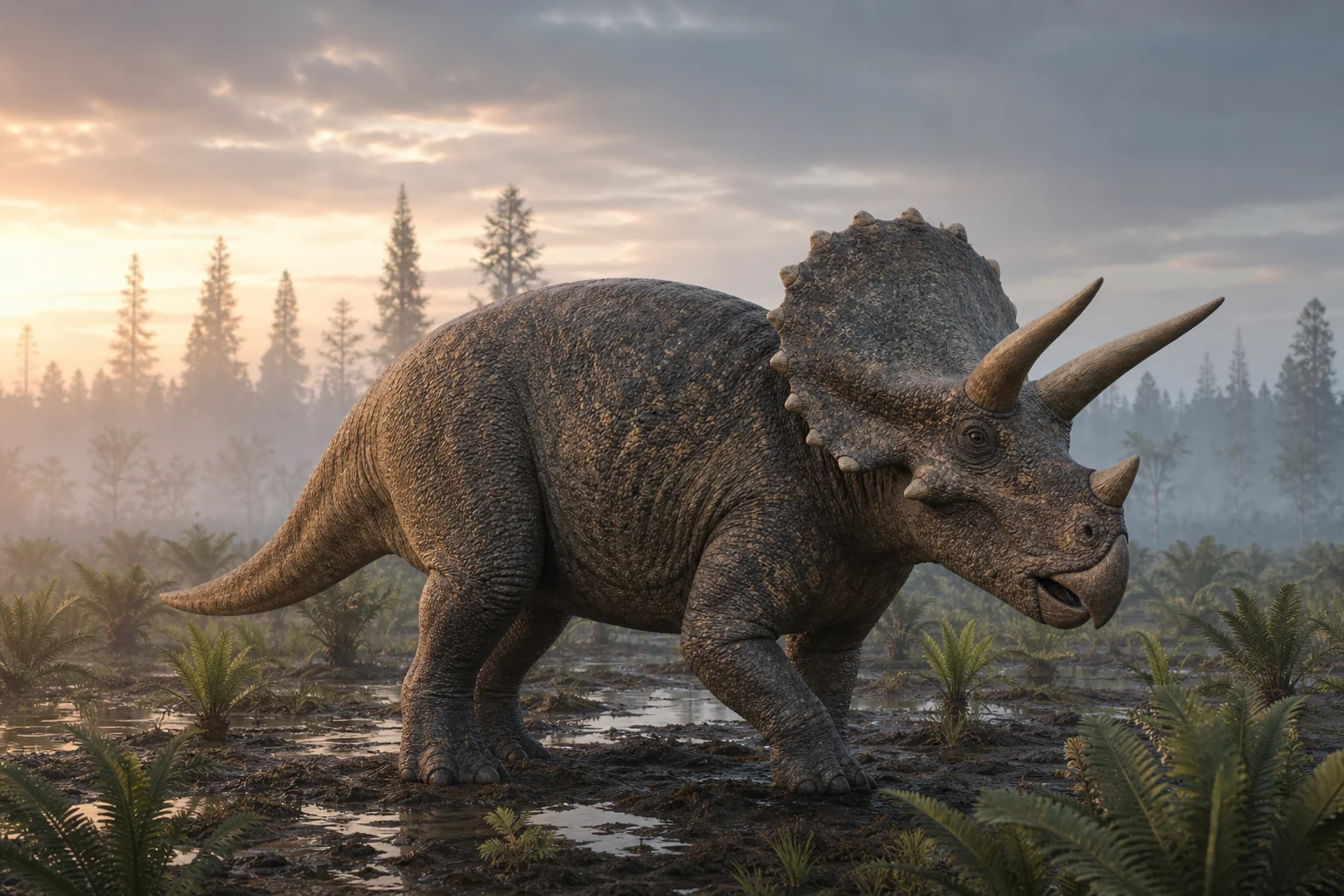 View full-resolution reconstruction ↗
This is an original generative reconstruction, not a photograph or scientific plate. Measurements and interpretations below are tied to named sources.
01 / DEFENSIVE ANATOMY
What could Triceratops use against a predator?
The brow horns projected from a skull backed by a muscular neck and multi-tonne body. Turning the head placed two long points between the torso and an attacker. The sharp beak could also cut, although its primary role was feeding.
This anatomy establishes capability, not a particular tactic. Triceratops may have jabbed, pushed, swept or simply presented its horns. Fossils do not preserve a charge speed, and comparisons with rhinoceroses or cattle are analogies rather than direct observations.
02 / INTRASPECIFIC COMBAT
What proves Triceratops fought each other?
A PLOS ONE study compared skull abnormalities in Triceratops and Centrosaurus. Triceratops showed elevated lesions in frill bones positioned where an opponent's brow horns would contact during face-to-face engagement. The different pattern in Centrosaurus argues against one general disease or predator explanation.
The evidence supports horn contact but not a single ritual. Animals could have locked horns, pushed, angled the head or struck. Many encounters may have been controlled displays, while some produced wounds that healed.
03 / DISPLAY & RECOGNITION
Were the horns and frill also for display?
Almost certainly. The structures dominate the animal's outline and changed predictably with maturity. Colour does not fossilise, but living animals commonly use large, vascular visual surfaces to signal age, condition or identity.
“Display or defense” is a false choice. Deer antlers advertise and fight; bovine horns deter predators and compete. Triceratops ornamentation could similarly combine several functions, with their relative importance changing by age and circumstance.
04 / TYRANNOSAURUS
What evidence connects Triceratops and T. rex?
Tyrannosaur tooth traces occur on Triceratops frills and horns. One partial skull has a broken brow horn and marks with healing, showing the animal lived after at least part of the encounter. Other traces lack healing and could have been made while a carcass was processed.
A predator may have attacked from the side or rear rather than meeting the horns head-on. Once an animal died, biting or pulling the frill could provide access to large neck muscles. Each trace must therefore be interpreted individually.
| Evidence | What it supports | Limit |
|---|---|---|
| Healed frill lesions | Contact during life | Exact behaviour not preserved |
| Comparative lesion pattern | Horn-to-horn combat | Does not measure frequency |
| Healed tyrannosaur bite | Survived aggressive encounter | One event, attacker assignment debated |
| Unhealed bite traces | Tyrannosaur feeding | Cannot show whether prey was hunted |
05 / SOCIAL DEFENSE
Did herds circle their young?
No direct fossil records a defensive circle. Most Triceratops specimens are isolated, unlike the enormous bonebeds of some other ceratopsids. Rare multi-individual sites show that aggregation occurred, including among juveniles, but the duration and social organisation are unknown.
Temporary gatherings could occur for breeding, migration, water or food without permanent family herds. A cautious reconstruction can show several animals together; it should not present a coordinated defensive formation as established fact.
06 / EVIDENCE VERDICT
What is the best current picture of Triceratops defense?
Horns and body mass
A frontal approach to a healthy adult carried obvious physical risk.
Combat with peers
Lesion placement matches brow-horn contact between Triceratops.
Survival of a tyrannosaur bite
Healing records one encounter but not a universal outcome.
Permanent defensive herds
Occasional aggregation does not prove circles or lifelong groups.
Bottom line: Triceratops was formidable, but fossils support flexible behaviour rather than a single charge, shield or herd tactic.
FAQ
Questions readers ask
Did Triceratops use its horns as weapons?
Probably. Healed frill lesions occur where horn contact is predicted, and their distribution differs from related ceratopsids. Display and weapon use could occur together.
Could Triceratops kill a T. rex?
Its horns and body mass could seriously injure a predator, but no fossil records a confirmed kill. One partially healed tyrannosaur bite shows that at least one Triceratops survived an encounter.
Was the frill armour?
It covered part of the neck but was not a simple shield. Some areas were thin, bite marks could puncture it, and its changing shape strongly supports visual and social functions.
Did Triceratops form defensive circles?
There is no direct evidence for defensive circles. Rare bonebeds show occasional aggregation, but most specimens are isolated and do not establish permanent herd tactics.
SOURCES & FURTHER READING
Evidence used for this guide
Measurements and behavioural claims are tied to museum summaries or peer-reviewed research. External sources may update as new specimens and analyses are published.
- 01Triceratops ↗Natural History Museum, London
Museum overview of size, teeth, horns, frill, skin, discovery, social evidence and encounters with Tyrannosaurus.
- 02Why did Triceratops have a frill? ↗Natural History Museum, London
Expert explanation of why display, recognition and combat are stronger interpretations than a simple neck shield.
- 03Evidence of combat in Triceratops ↗PLOS ONE · PMC2617760
Comparative lesion patterns supporting physical horn-to-horn combat as one function of Triceratops cranial ornamentation.
- 04Major cranial changes during Triceratops ontogeny ↗Proceedings of the Royal Society B · PMC1635501
A skull growth series documenting changes in horn direction, frill margins, bone texture and fusion from juveniles to adults.
- 05Evolutionary trends in Triceratops from the Hell Creek Formation ↗PNAS · PMC4104892
More than fifty stratigraphically placed skulls showing the transition from T. horridus to T. prorsus morphology through Hell Creek time.
- 06Wear biomechanics in the slicing dentition of Triceratops ↗Science Advances · PMC4640618
Three-dimensional and tissue-level analysis of the self-sharpening dental battery used to slice abrasive plants.
- 07The first Triceratops bonebed and its implications for gregarious behavior ↗Journal of Vertebrate Paleontology · DOI 10.1080/02724634.2009.10010382
A rare multi-individual assemblage that supports at least occasional aggregation without proving permanent herds.
- 08Torosaurus is not Triceratops ↗PLOS ONE · PMC3290593
A test of developmental predictions that supports retaining Torosaurus as distinct while illustrating the ongoing taxonomic debate.
- 09The Last American Dinosaurs ↗Smithsonian National Museum of Natural History
Museum context for the latest Cretaceous ecosystem and the end-Cretaceous impact extinction.