
Explore this animal in Size of Extinct Animals ↗
23 / Cenozoic
Dire Wolf
Aenocyon dirus
A heavy-jawed canid hunted the large herbivores of Ice Age America.
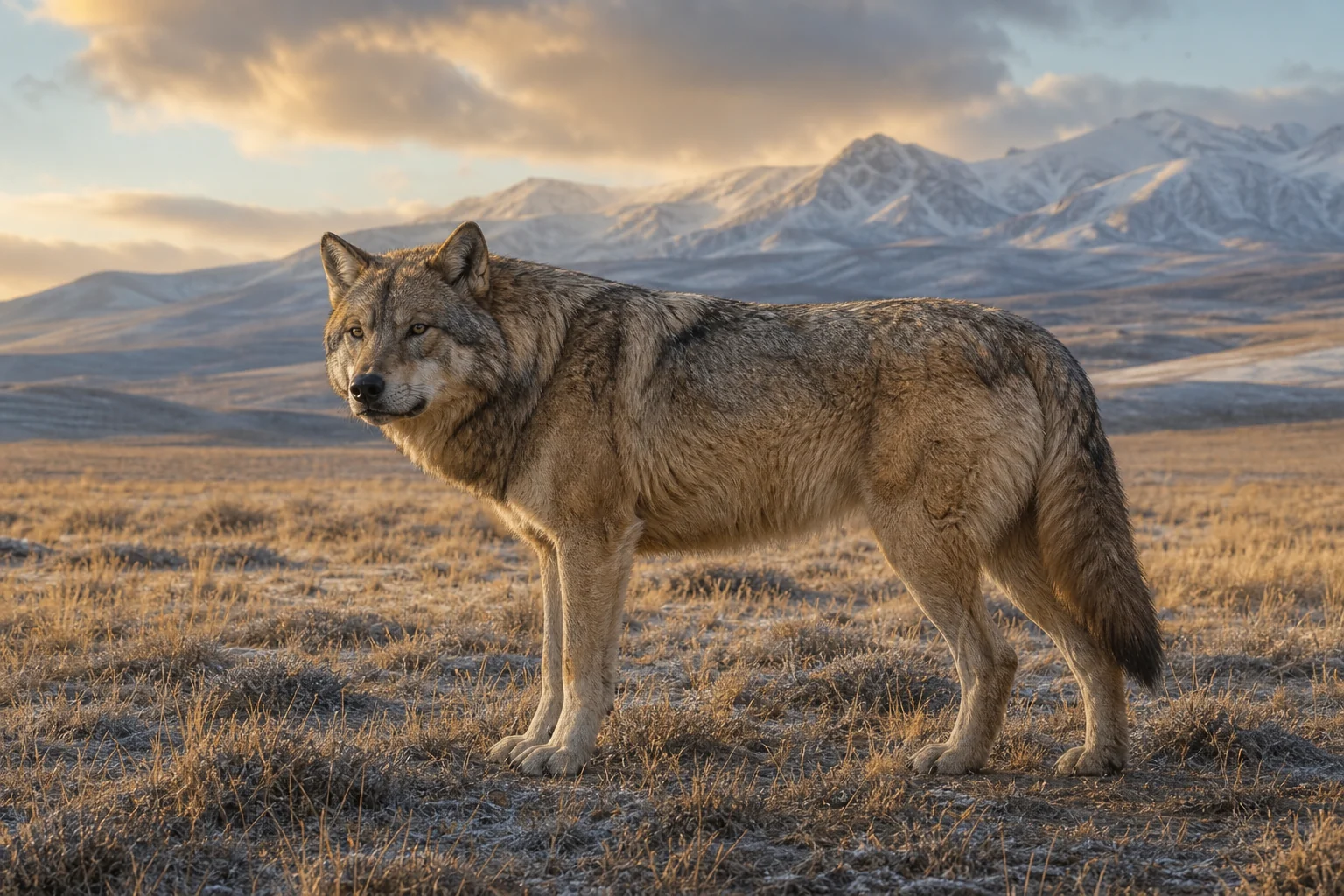 View original image · 1536 × 1024
- Time range
- About 125,000–10,000 years ago
- Final stage
- End of the Pleistocene
- Geographic range
- North America · Northern South America
01 / ANSWER FIRST
What was the dire wolf?
The dire wolf was a large, robust American canid whose wolf-like body evolved on a deeply separate lineage from living gray wolves.
Ancient genomes overturned the idea that it was simply a heavier gray wolf. A 2021 analysis found long isolation and no detected recent gene flow with gray wolves or coyotes; newer genomic work continues to refine the lineage’s deeper ancestry without turning it into Canis lupus.
02 / QUICK FACTS
Dire wolf at a glance
- Scientific name
- Aenocyon dirus
- Age
- About 125,000–10,000 years ago
- Typical mass
- Around 60–68 kg
- Range
- North America to northern South America
- Lineage
- Distinct extinct American canid
- Diet
- Horses, bison, camels and other large prey
- Key site
- La Brea Tar Pits
- Extinction
- End of the Pleistocene
03 / CORE QUESTION
Was a dire wolf just a bigger gray wolf?
Dire wolves were generally heavier and more robust than many gray wolves, with skull and teeth suited to large prey and bone loading. Their silhouette converged on a wolf-like form because both hunted large mammals.
Ancient DNA places dire wolves outside the living wolf-coyote-dhole radiation. Genetic evidence—not appearance alone—supports the separate genus Aenocyon, while exact deep branching and ancient admixture remain active research questions.
Read the complete size, DNA and gray-wolf comparisonHow to read the numbers
This page separates direct evidence, comparative inference and unresolved debate.
04 / LIFE & DISCOVERY TIMELINE
From American predator to genomic surprise
Widespread American canid
Dire wolves ranged across varied open and woodland ecosystems.
Large-prey specialist
Teeth and isotopes record dependence on megafaunal food webs.
Extinction
It vanished as prey communities and climate rapidly reorganised.
Ancient DNA revision
Five genomes revealed a deeply divergent New World lineage.
05 / ANATOMY
Wolf-like through convergence
Robust skull
A broad head and large carnassials processed meat and resisted high feeding loads.
Large teeth
Teeth suited slicing flesh but often show wear and breakage from hard-food contact.
Heavy body
Robust limb bones support a powerful predator rather than an exaggerated fantasy giant.
Canid locomotion
Long-distance travel was plausible, but proportions were less gracile than many gray wolves.
06 / DIET & BEHAVIOUR
What did dire wolves eat?
Stable isotopes and tooth wear implicate horses, bison, camels, ground sloths and carrion, with regional and climatic shifts.
Read the complete guide07 / DIET & BEHAVIOUR
Did they hunt in packs?
Pack hunting is plausible from canid anatomy, repeated large-prey access and many individuals at La Brea, but asphalt traps gathered unrelated carnivores and cannot directly record coordinated behaviour.
08 / RANGE & HABITAT
Where did dire wolves live?
Dire wolves occupied much of the Americas south of the major ice sheets, across grassland, woodland and seasonal environments.
Western North America
La Brea provides the densest record but not an unbiased snapshot.
Eastern caves
Cool cave deposits preserved rare DNA-bearing remains.
Southern plains
Large grazers sustained predator communities across Texas and Mexico.
Northern South America
Fossils extend the lineage beyond the traditional North American image.
09 / FOSSIL EVIDENCE
How do we know the dire wolf?
La Brea abundance
Thousands of specimens reveal anatomy and population variation while amplifying predator-trap bias.
Ancient genomes
Five initial genomes established deep divergence; newer sequences test finer ancestry.
Tooth chemistry
Isotopes reconstruct trophic position and prey communities.
Dental damage
Wear and fractures record hard feeding but do not distinguish hunting from scavenging alone.
10 / DISAPPEARANCE & DEBATE
Why did dire wolves go extinct?
Dire wolves disappeared as end-Pleistocene climate change and megafaunal collapse transformed their prey base.
Dependence on large prey, competition with more flexible canids and human-driven ecological change may all have mattered. Dire-wolf extinction was not caused by one demonstrated duel with gray wolves, and genetics shows little opportunity for adaptive introgression with them.
12 / FREQUENTLY ASKED QUESTIONS
Dire wolf FAQ
Was the dire wolf a gray wolf?
No. Ancient DNA supports a separate, deeply divergent American canid lineage.
How big was it?
Typical estimates are around 60–68 kg: robust and large, but not a fantasy giant.
Did it hunt in packs?
Plausible but not directly demonstrated; La Brea abundance alone cannot prove cooperation.
What did it eat?
Horses, bison, camels and other large mammals, plus carrion when available.
Could it interbreed with gray wolves?
The 2021 genomes found no evidence of recent gene flow despite overlapping ranges.
Why did it vanish?
Large-prey loss, climate and ecological competition probably interacted.
04 / SOURCES & FURTHER READING
Check the source record
Use the scientific name to compare taxonomy, occurrence records and the fossil record. Database coverage and classifications may differ.
05 / REVISION HISTORY
How has this record changed?
- Rewrote an extinction cause that presented environmental or faunal turnover as established; it is now given as context the record does not prove.
- Upgraded to a bilingual S-tier topic hub with two independent evidence guides.
- Verified authoritative entity sources and added three responsive reconstruction sizes.
- Initial bilingual species record published.
06 / CORRECTIONS & ADDITIONS