
THYLACINE TOPIC HUB · ANATOMY & IDENTITY
Thylacine Size, Stripes, Jaws and Marsupial Anatomy
How large was the thylacine, why did it look dog-like and what do skins, skeletons, preserved bodies and film actually reveal?
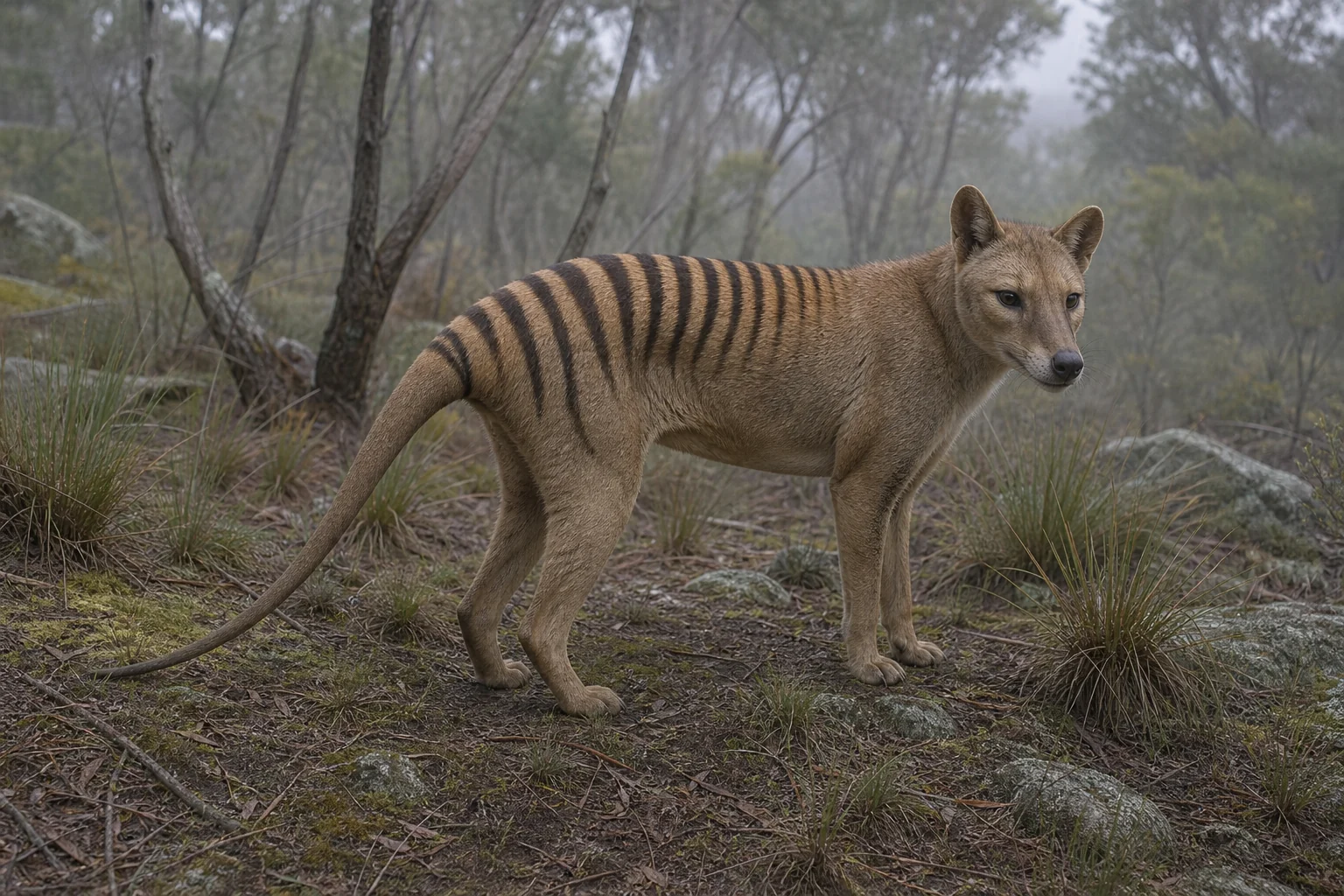 View full-resolution reconstruction ↗
This is an original generative reconstruction, not a photograph or scientific plate. Measurements and interpretations below are tied to named sources.
01 / SIZE
How big was a thylacine?
Museum measurements place most adults around 1.0–1.3 metres in head-and-body length, plus a substantial tail, and roughly 15–30 kilograms. Males averaged larger than females, so a specimen range is more honest than one maximum.
02 / STRIPES
What did the stripes look like?
Usually fifteen to twenty dark bands crossed the rump and narrowed onto the tail base. Preserved skins vary from sandy yellow-brown to grey. Camouflage and recognition are plausible functions, but neither can now be tested directly.
03 / TAIL & GAIT
Why was the tail distinctive?
The tail thickened smoothly into the rump and moved less freely than a dog's. Captive film records a stiff-backed walk and short hops, but confined zoo footage cannot establish the full speed or endurance of a wild animal.
04 / SKULL & JAWS
Did its huge gape mean a crushing bite?
Adults carried forty-six teeth and opened the jaws widely, but gape is not bite force. Skull mechanics and tooth form fit small to medium vertebrate prey better than routine attacks on very large animals.
05 / MARSUPIAL TRAITS
What proves it was a marsupial?
Females had a rear-opening pouch for up to four dependent young; males carried a partial protective pouch. Teeth, ankle bones and reproduction place it with Australian marsupial carnivores despite the canine silhouette.
06 / RECONSTRUCTION
What should a responsible reconstruction show?
Show a low long body, short dense fur, rounded upright ears, stiff tapering tail and variable stripes. Keep directly preserved proportions separate from uncertain colour nuance, sounds, social life and maximum running performance.
FREQUENTLY ASKED QUESTIONS
Questions readers ask
Was the thylacine a wolf?
No. It was a carnivorous marsupial; its dog-like shape evolved independently.
When did the last thylacine die?
The last confirmed captive died on 7 September 1936 at Beaumaris Zoo in Hobart.
Are thylacines still alive?
No verified evidence has appeared after 1936, despite many reported sightings.
Why did thylacines have stripes?
Their function is unknown; camouflage or recognition are plausible but untested.
Did thylacines attack sheep?
Some attacks likely occurred, but historical blame and bounty policy greatly exceeded firm evidence.
Could a thylacine be cloned?
Museum DNA is fragmented; no living cell or validated cloning route currently recreates the extinct species.
SOURCES & FURTHER READING
Evidence used in this guide
Measurements and interpretations are tied to museum resources or peer-reviewed studies; disputed conclusions include evidence on both sides.
- 01The Thylacine ↗Australian Museum
Museum profile of identity, anatomy, pouch, distribution and extinction history.
- 02Thylacine ↗National Museum of Australia
Collection evidence and the documented 1936 death of the last captive.
- 03No need for disease ↗Journal of Animal Ecology · DOI 10.1111/1365-2656.12029
Population modelling tests documented European impacts without requiring an epidemic.
- 04Resolving when and where the thylacine went extinct ↗Science of the Total Environment · PMID 36934937
Quality-rated sighting analysis, presented as probability rather than confirmation.