
THYLACINE TOPIC HUB · EXTINCTION EVIDENCE
Why Did the Thylacine Go Extinct?
Bounties, habitat conversion, prey, dogs, disease, genetics and what the last confirmed records do—and do not—prove.
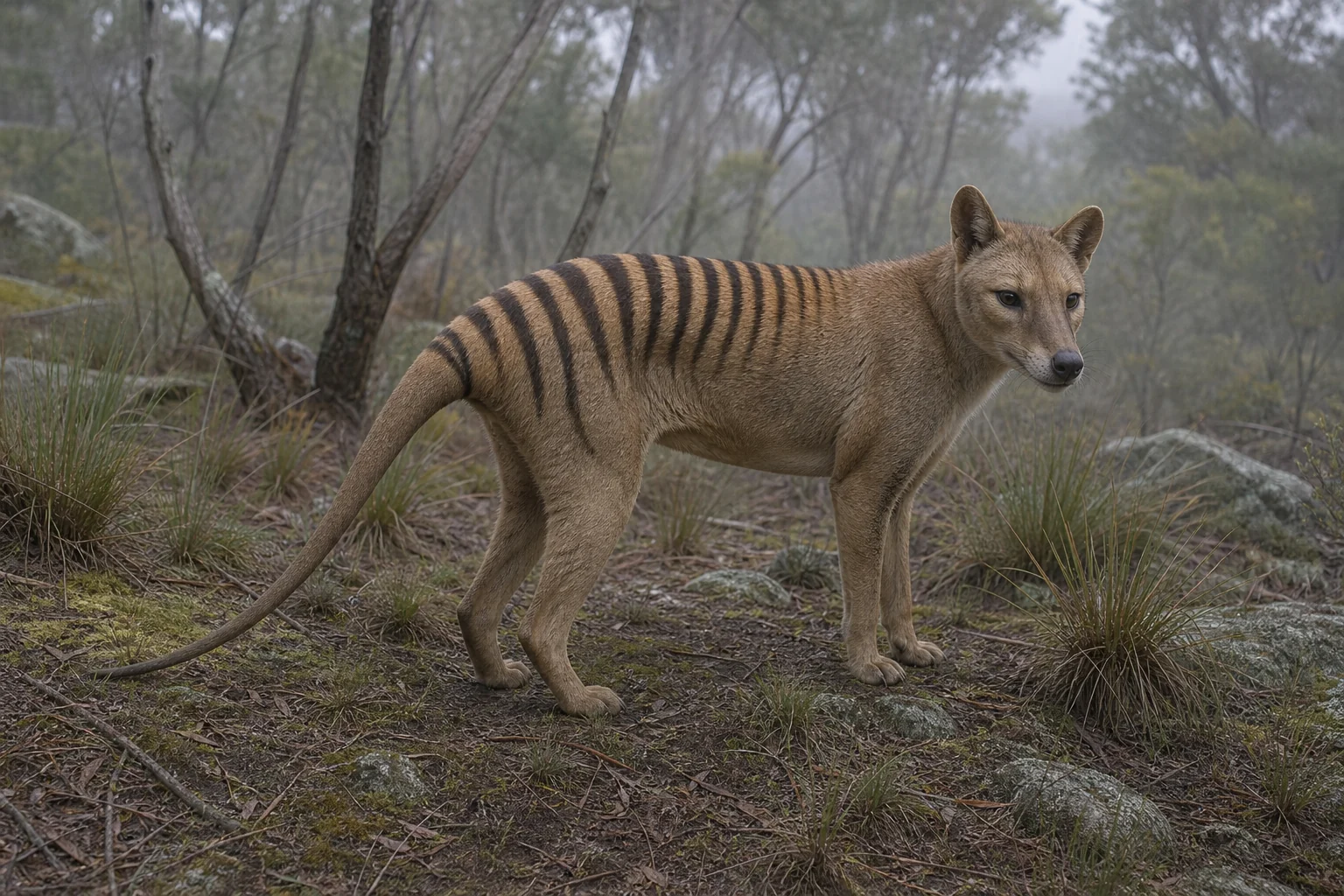 View full-resolution reconstruction ↗
This is an original generative reconstruction, not a photograph or scientific plate. Measurements and interpretations below are tied to named sources.
01 / MAINLAND LOSS
Why did mainland populations vanish first?
Dated remains place mainland disappearance thousands of years before European settlement. Dingo arrival, climatic variability and human competition overlap, but current evidence cannot assign a single universal cause. Tasmania's isolation retained the final population.
02 / BOUNTIES
How did persecution work?
Tasmania paid official bounties from 1888 to 1909 while private rewards continued. Thousands of claims, traps and skins document sustained removal, driven by a livestock-pest reputation much stronger than the evidence for routine sheep predation.
03 / LANDSCAPE
Did farming add pressure?
Pastoral expansion converted lowland mosaics, fragmented cover and changed prey communities. A naturally sparse predator can collapse when food-web change and direct mortality act together even without one visible habitat threshold.
04 / DOGS & DISEASE
Was an epidemic required?
Dogs could compete, disturb or transmit pathogens, and historical reports mention illness. Yet population modelling shows documented hunting, habitat change and prey harvesting can reproduce decline without requiring an unverified epidemic.
05 / LAST RECORDS
What happened in 1930 and 1936?
The last well-documented wild killing occurred in 1930. The last confirmed captive died at Beaumaris Zoo on 7 September 1936, shortly after protection. Later reports lack a diagnostic specimen, photograph or DNA sample.
06 / SIGHTING MODELS
Could survival have continued later?
Quality-rated sightings allow statistical survival into later decades, because rare animals can evade detection. A probability distribution is not a rediscovery. Extinction remains the evidence-based status and each new claim needs independent verification.
FREQUENTLY ASKED QUESTIONS
Questions readers ask
Was the thylacine a wolf?
No. It was a carnivorous marsupial; its dog-like shape evolved independently.
When did the last thylacine die?
The last confirmed captive died on 7 September 1936 at Beaumaris Zoo in Hobart.
Are thylacines still alive?
No verified evidence has appeared after 1936, despite many reported sightings.
Why did thylacines have stripes?
Their function is unknown; camouflage or recognition are plausible but untested.
Did thylacines attack sheep?
Some attacks likely occurred, but historical blame and bounty policy greatly exceeded firm evidence.
Could a thylacine be cloned?
Museum DNA is fragmented; no living cell or validated cloning route currently recreates the extinct species.
SOURCES & FURTHER READING
Evidence used in this guide
Measurements and interpretations are tied to museum resources or peer-reviewed studies; disputed conclusions include evidence on both sides.
- 01The Thylacine ↗Australian Museum
Museum profile of identity, anatomy, pouch, distribution and extinction history.
- 02Thylacine ↗National Museum of Australia
Collection evidence and the documented 1936 death of the last captive.
- 03No need for disease ↗Journal of Animal Ecology · DOI 10.1111/1365-2656.12029
Population modelling tests documented European impacts without requiring an epidemic.
- 04Resolving when and where the thylacine went extinct ↗Science of the Total Environment · PMID 36934937
Quality-rated sighting analysis, presented as probability rather than confirmation.