
Explore this animal in Size of Extinct Animals ↗
28 / Recently extinct
South Island Giant Moa
Dinornis robustus
One of the tallest birds ever known browsed forests without wings of any kind.
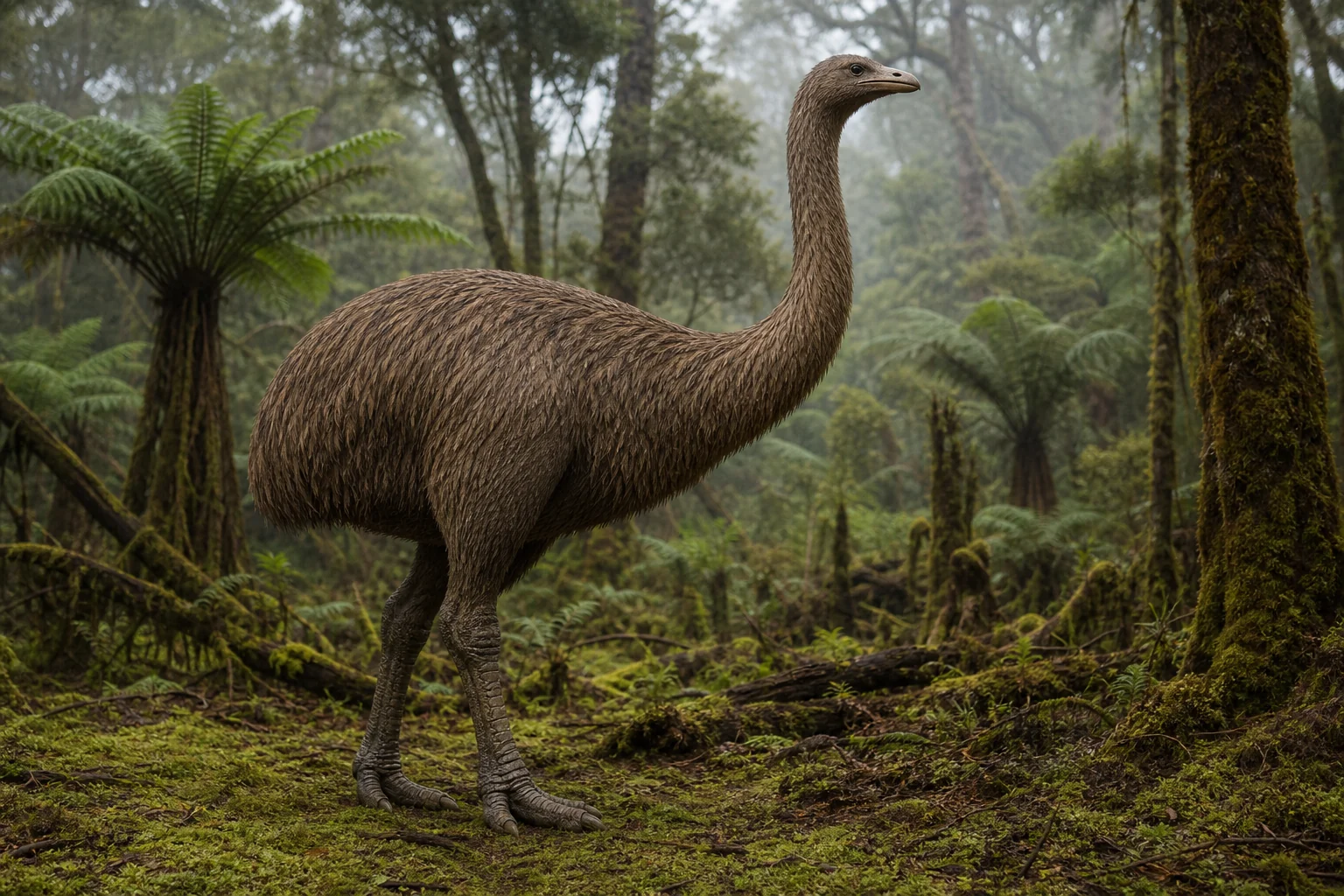 View original image · 1536 × 1024
- Time range
- Prehistory–15th century
- Final stage
- After human settlement
- Geographic range
- South Island, New Zealand
01 / ANSWER FIRST
What was the South Island giant moa?
The South Island giant moa was a completely wingless, plant-eating bird and one of the tallest birds known, with adult females far larger than males.
It belonged to a New Zealand radiation of nine moa species rather than to ostriches. Its height is often quoted with the neck fully stretched, so hip height, body mass and sex are better comparison measures than a single headline number.
02 / QUICK FACTS
South Island Giant Moa at a glance
- Scientific name
- Dinornis robustus
- Age
- Late Pleistocene to about the 15th century
- Maximum standing height
- Up to about 3 m with neck extended
- Largest body mass
- About 240 kg for the largest females
- Diet
- Leaves, twigs, fruit and other plants
- Range
- South Island, New Zealand
- Flight
- Flightless; no external wings
- Extinction
- Within centuries of Polynesian settlement
03 / ANATOMY
A giant bird built without wings
Extreme sexual size difference
DNA and measurements show that specimens once assigned to different species can represent giant females and much smaller males of the same species.
Long neck, broad pelvis
A long flexible neck reached browse at several levels, while the broad pelvis and powerful legs carried a massive trunk.
No functional wing
Moa lost the wing so completely that even the small external wing remnants seen in many other flightless birds were absent.
Feet for walking, not racing
Robust legs crossed forest, scrub and upland ground; giant moa were not simply oversized ostriches adapted to open-country sprinting.
04 / DIET & BEHAVIOUR
What did giant moa eat?
Beaks, gizzard stones, coprolites and plant remains indicate browsing on leaves, twigs, herbs and fruit. Different moa divided vegetation by body size, beak shape and habitat.
05 / DIET & BEHAVIOUR
How did it live?
Growth rings and medullary bone suggest slow maturation and limited reproduction. In an ecosystem without native terrestrial mammals, moa occupied large-herbivore roles vulnerable to a new efficient hunter.
06 / RANGE & HABITAT
Where did the South Island giant moa live?
Bones and preserved soft tissues place it across much of New Zealand's South Island, but local abundance changed with vegetation and climate.
Lowland forest
Forest margins supplied browse and cover, especially before extensive human burning.
Shrubland and grassland
Open mosaics offered herbs and shrubs; diets can be tested from coprolite plant fragments.
Upland valleys
Dry caves and rock shelters preserved feathers, skin, feet and dung that ordinary wet sites destroy.
07 / FOSSIL EVIDENCE
How do scientists reconstruct giant moa?
Skeletons and ancient DNA
Bones establish proportions while ancient DNA corrected species assignments and exposed the extraordinary difference between females and males.
Feathers and soft tissues
Rare naturally mummified remains preserve feather texture, skin and foot pads, reducing reliance on living analogues.
Dung, eggshell and footprints
Coprolites identify plants and parasites; eggshell chemistry and tracks add nesting, movement and environmental evidence.
Archaeological kill sites
Cut-marked bones, ovens and dense processing sites directly connect early people with rapid moa exploitation.
08 / DISAPPEARANCE & DEBATE
Why did the South Island giant moa go extinct?
Human hunting was the principal driver, amplified by egg collection, habitat burning and a slow reproductive life history.
Moa survived earlier climatic swings but disappeared soon after people settled New Zealand. The speed, archaeological association and simultaneous loss across moa species make a primarily human cause the strongest explanation.
09 / FREQUENTLY ASKED QUESTIONS
South Island Giant Moa FAQ
Was the giant moa taller than an ostrich?
Yes when the neck was fully extended, but the quoted three-metre figure is not a normal alert posture and does not describe every individual.
Did moa have wings?
Moa had lost external wings completely; this distinguishes them from many other flightless birds with reduced wing bones.
What hunted giant moa before humans?
Haast's eagle was the principal native predator capable of killing large moa, especially younger or vulnerable animals.
When did the last moa die?
Reliable evidence places moa extinction within a few centuries of Polynesian settlement, broadly by the fifteenth century.
04 / SOURCES & FURTHER READING
Check the source record
Use the scientific name to compare taxonomy, occurrence records and the fossil record. Database coverage and classifications may differ.
05 / REVISION HISTORY
How has this record changed?
- Expanded into a curated bilingual A-tier profile with anatomy, ecology, range, evidence, debate and FAQs.
- Verified authoritative entity sources and added three responsive reconstruction sizes.
- Initial bilingual species record published.
06 / CORRECTIONS & ADDITIONS