
Explore this animal in Size of Extinct Animals ↗
35 / Paleozoic
Helicoprion
Helicoprion davisii
Its spiral tooth whorl worked like a permanent slicing blade inside the lower jaw.
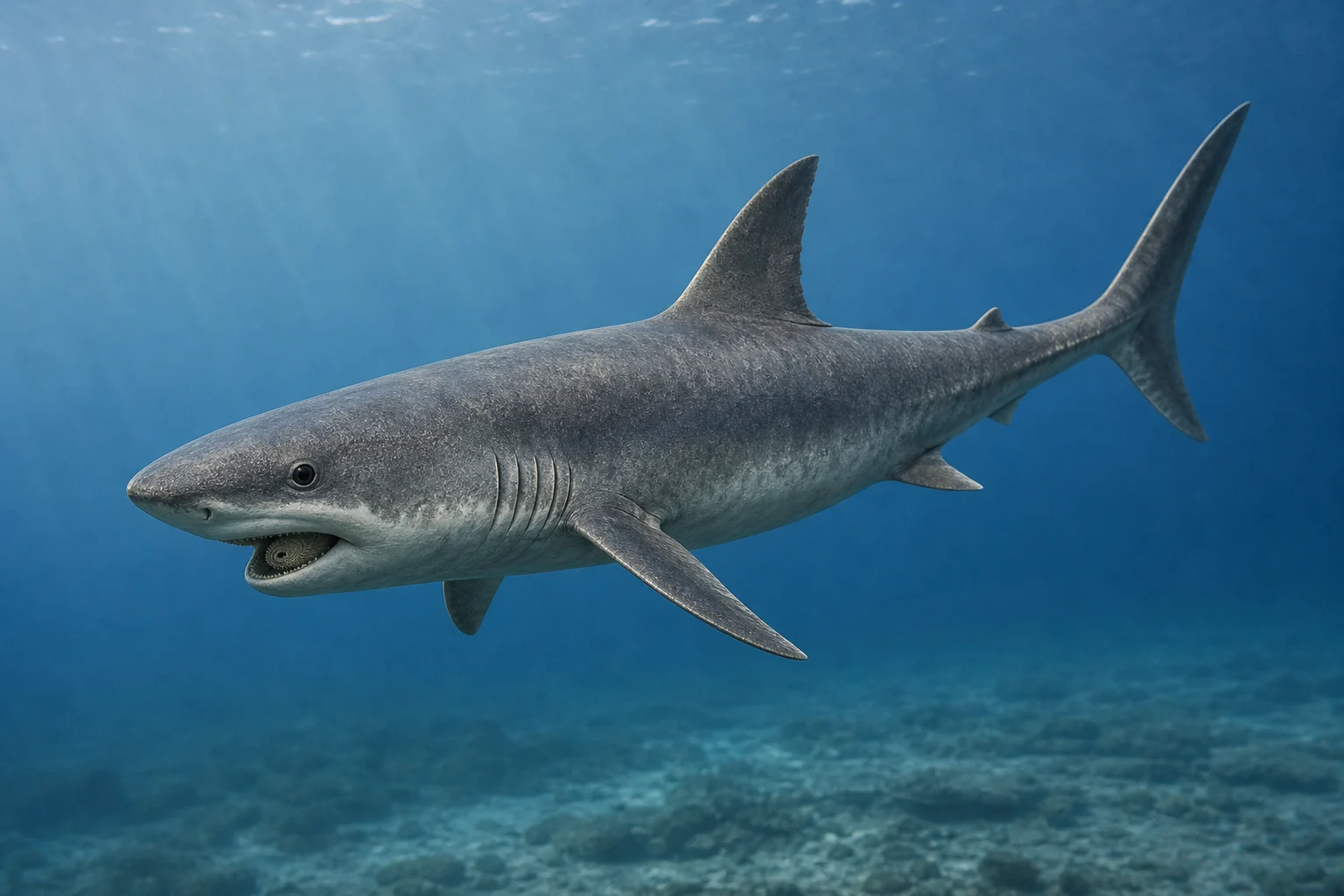 View original image · 1536 × 1024
- Time range
- About 290–250 million years ago
- Final stage
- End of the Permian
- Geographic range
- Coasts of Pangaea · North America, Russia and Australia
01 / ANSWER FIRST
What was Helicoprion?
Helicoprion was a Permian shark-like cartilaginous fish whose continuously growing teeth formed a spiral whorl inside the lower jaw.
It was not a modern shark and the whorl was not on its nose, fin or tail. Fossils preserving jaw cartilage and CT scans fixed the whorl within the lower jaw, ending more than a century of competing reconstructions.
02 / QUICK FACTS
Helicoprion at a glance
- Scientific name
- Helicoprion davisii
- Age
- Permian, about 290–250 Ma
- Group
- Eugeneodont cartilaginous fish
- Jaw feature
- Spiral tooth whorl in lower jaw
- Diet
- Cephalopods, fish and other marine prey
- Range
- Permian seas across several continents
- Body size
- Large, but model-dependent
- Extinction
- End-Permian crisis
03 / ANATOMY
How did the tooth whorl fit and work?
Lower-jaw whorl
The spiral sat at the jaw midline. New teeth formed at the rear and pushed older teeth forward and inward without normal shedding.
Three-part cutting action
Biomechanical models suggest front teeth hooked prey, middle teeth pierced and cut it, and rear teeth moved food deeper into the mouth.
Cartilaginous skull
Most cartilage decayed, leaving tooth whorls far more common than bodies. Rare mineralised cartilage therefore carries exceptional anatomical value.
Unknown body outline
No complete body preserves head, fins and tail together. Shark-like silhouettes remain informed reconstructions, not direct photographs of the fossil body.
04 / DIET & BEHAVIOUR
What did Helicoprion eat?
Jaw mechanics could process both hard and soft prey, but squid-like cephalopods and fish are often proposed. Different tooth positions performed different tasks during one bite.
05 / DIET & BEHAVIOUR
Was it a fast ocean hunter?
A large pelagic lifestyle is plausible from its broad distribution, yet speed, fin shape and depth preference cannot be read directly from tooth whorls.
06 / RANGE & HABITAT
Where did Helicoprion live?
Tooth whorls occur in Permian rocks of North America, Asia, Europe and Australia, indicating a wide marine distribution rather than one local habitat.
Continental shelves
Productive shelf seas supplied fish, ammonoids and soft-bodied cephalopod prey.
Open marine connections
Wide fossil distribution implies dispersal between basins, although species assignments need careful checking.
Phosphate deposits
Some famous whorls occur where mineral conditions preferentially preserved dense dental material.
07 / FOSSIL EVIDENCE
How was the century-old tooth-whorl puzzle solved?
Isolated whorls
Early fossils preserved teeth without a skull, allowing imaginative placements on the snout, back, tail or jaws.
Jaw cartilage
Exceptional specimens preserved the whorl within Meckel's cartilage and showed that it occupied the lower jaw.
CT imaging
Digital slices revealed hidden cartilage and the relationship between tooth roots, whorl and jaw joint without destroying the fossil.
Functional models
Computer and physical models test how the jaw closed, where forces concentrated and which prey shapes could pass through.
08 / DISAPPEARANCE & DEBATE
Why did Helicoprion go extinct?
Helicoprion disappeared during the end-Permian mass extinction, when rapid warming, ocean deoxygenation and acidification devastated marine food webs.
Its specialised jaws may have made prey turnover costly, but no fossil identifies a single individual cause. The global timing links the lineage to the largest marine extinction crisis rather than to one local event.
09 / FREQUENTLY ASKED QUESTIONS
Helicoprion FAQ
Was the Helicoprion whorl a circular saw?
No. The whorl did not rotate independently; it moved with the lower jaw as the animal bit.
Was Helicoprion a shark?
It was a shark-like cartilaginous fish in an extinct eugeneodont lineage, more distant from modern sharks than the common name suggests.
Where was the tooth whorl?
Exceptional fossils and CT scans place it on the midline of the lower jaw.
How large was Helicoprion?
It was certainly large, but numerical estimates vary widely because no complete body is known and whorl-to-body scaling is uncertain.
04 / SOURCES & FURTHER READING
Check the source record
Use the scientific name to compare taxonomy, occurrence records and the fossil record. Database coverage and classifications may differ.
05 / REVISION HISTORY
How has this record changed?
- Rewrote an extinction cause that presented environmental or faunal turnover as established; it is now given as context the record does not prove.
- Expanded into a curated bilingual A-tier profile with anatomy, ecology, range, evidence, debate and FAQs.
- Verified authoritative entity sources and added three responsive reconstruction sizes.
- Initial bilingual species record published.
06 / CORRECTIONS & ADDITIONS