
GIGANOTOSAURUS TOPIC HUB · SIZE & ANATOMY
Giganotosaurus Size, Skull, Teeth and Body
How large was Giganotosaurus carolinii and what do the holotype and referred jaw actually establish?
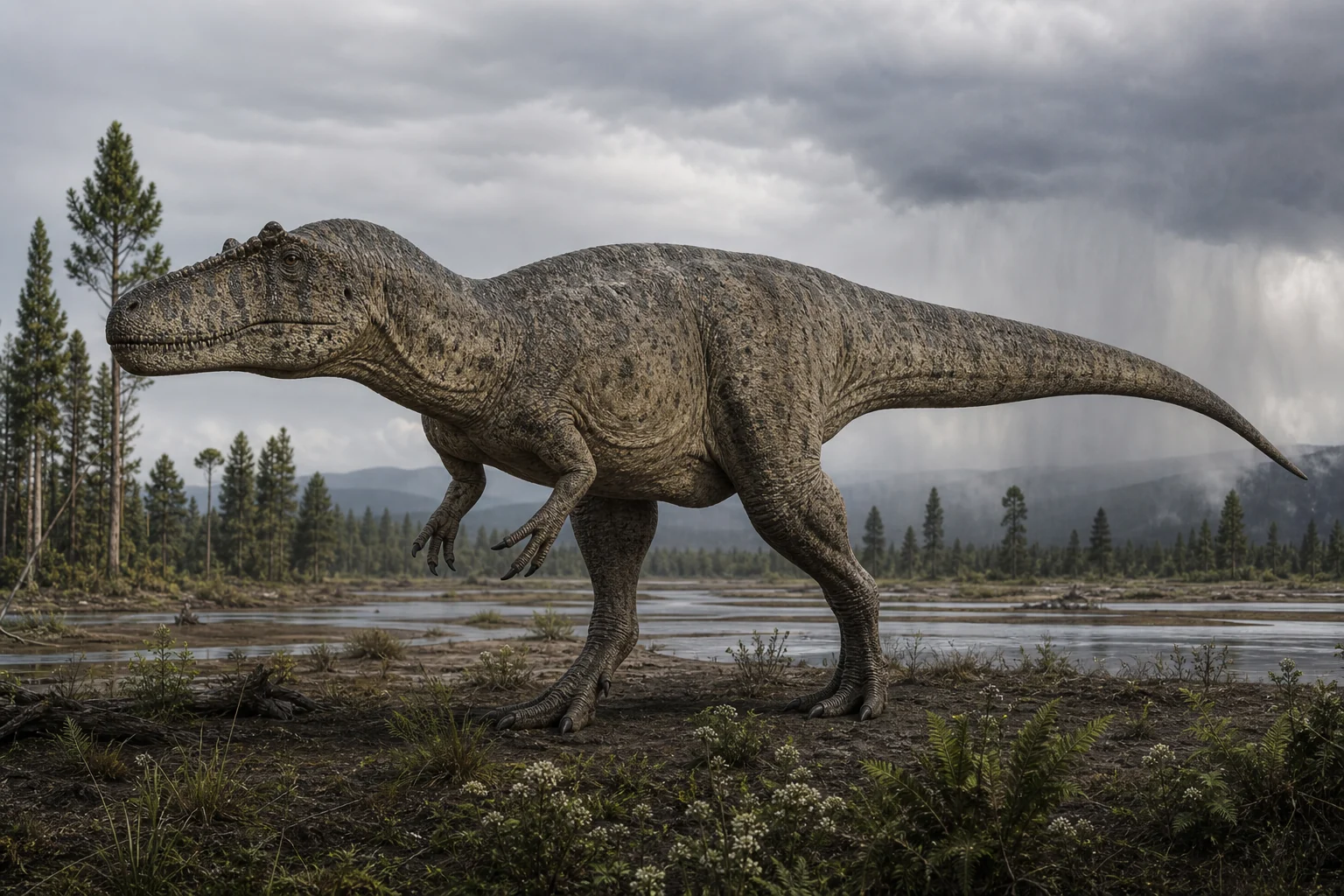 View full-resolution reconstruction ↗
This is an original generative reconstruction, not a photograph or scientific plate. Measurements and interpretations below are tied to named sources.
01 / HOLOTYPE
How complete is the main skeleton?
The holotype preserves much of the skull, vertebral column, pelvis and limbs but is not complete. Missing portions are reconstructed from symmetry and related carcharodontosaurids.
02 / LENGTH
How long was Giganotosaurus?
About 12–13 metres is a defensible range for the holotype. Larger numbers often scale from an isolated referred lower jaw whose proportions and individual identity add uncertainty.
03 / MASS
How much did it weigh?
Volumetric and limb-based methods commonly produce several tonnes, often around six to eight for large specimens. Body outline and reconstruction explain why published values differ.
04 / SKULL
What shape was the head?
The skull was long and relatively low, with extensive air spaces and a strong but differently constructed rear braincase from tyrannosaurids. Exact total skull length depends on restored gaps.
05 / TEETH
How did the teeth cut?
Laterally compressed crowns carried serrated edges, producing knife-like slicing along a bite. They differ from the thicker, more bone-resistant teeth of Tyrannosaurus.
06 / BODY
What completed the predator?
Long hind limbs, a balancing tail and a deep torso supported terrestrial pursuit. Three-fingered forelimbs were larger relative to the body than tyrannosaurid arms but still not the primary killing weapon.
FREQUENTLY ASKED QUESTIONS
Questions readers ask
How long was Giganotosaurus?
At least about 12 metres; higher estimates are debated.
Was it bigger than T. rex?
It may have been longer, while the largest T. rex was likely heavier.
Did they fight?
No. They lived on different continents about 30 million years apart.
What did it eat?
Large Patagonian herbivores were likely prey or carrion.
Did it hunt Argentinosaurus?
Possible ecological overlap exists, but no direct attack fossil is known.
Did it hunt in packs?
There is no direct Giganotosaurus evidence for coordinated packs.
SOURCES & FURTHER READING
Evidence used in this guide
Measurements and interpretations are tied to museum resources or peer-reviewed studies; disputed conclusions include evidence on both sides.
- 01Giganotosaurus ↗Natural History Museum, London
Museum overview of discovery, age, habitat and predator status.
- 02The braincase of Giganotosaurus carolinii ↗Journal of Vertebrate Paleontology
Skull-length revision and diagnostic braincase anatomy.
- 03Giganotosaurus carolinii ↗Nature
Original description of the holotype giant theropod.