
GIGANOTOSAURUS TOPIC HUB · COMPARISON
Giganotosaurus vs Tyrannosaurus: Size, Bite and Evidence
Compare two giant theropods separated by continents and nearly 30 million years, using specimens rather than movie battles.
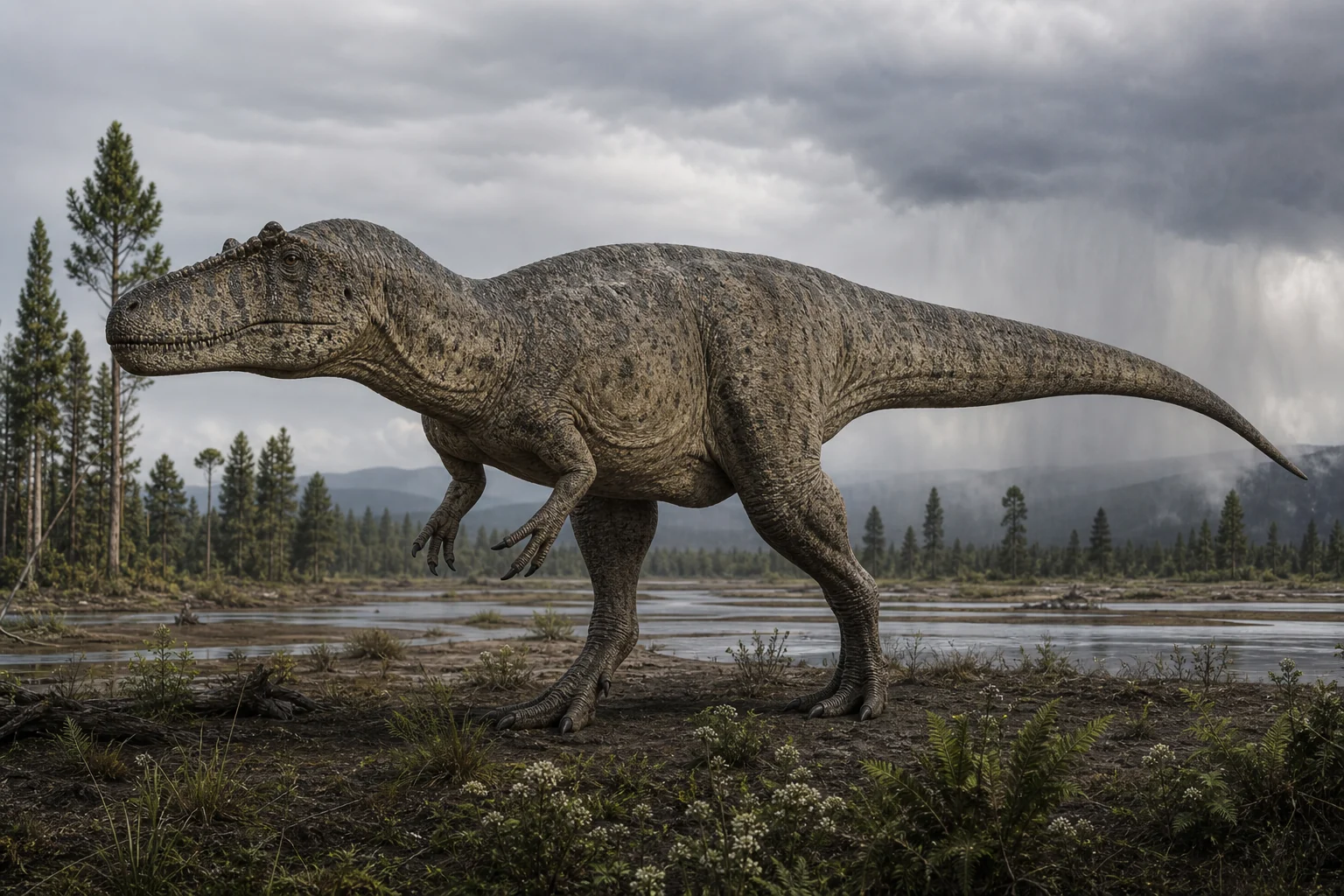 View full-resolution reconstruction ↗
This is an original generative reconstruction, not a photograph or scientific plate. Measurements and interpretations below are tied to named sources.
01 / TIME & PLACE
Could they have met?
No. Giganotosaurus lived in South America about 98 million years ago; Tyrannosaurus lived in North America near 68–66 million years ago. They were separated by geography and roughly 30 million years.
02 / SIZE
Which was bigger?
Length estimates overlap around 12–13 metres, but exceptionally robust Tyrannosaurus skeletons yield greater mass. Fragmentary maxima make a simple species-wide winner misleading.
03 / SKULL
How did skull design differ?
Giganotosaurus had a long low carcharodontosaurid skull; Tyrannosaurus had a broader, deeper skull reinforced for high loads. Both were effective within different feeding systems.
04 / BITE
Which had the stronger bite?
Biomechanical estimates consistently give Tyrannosaurus an exceptionally high bite and robust teeth. No equally secure complete Giganotosaurus skull model supports a higher value.
05 / PREY
What did each predator face?
Giganotosaurus shared ecosystems with giant sauropods and other herbivores; Tyrannosaurus attacked ceratopsians and hadrosaurs. Prey communities shaped different jaws and hunting opportunities.
06 / NO WINNER
Who would win a fight?
There is no scientific answer to an impossible encounter. Individual age, health and first contact would dominate; fossils can compare anatomy, not simulate a universal arena result.
FREQUENTLY ASKED QUESTIONS
Questions readers ask
How long was Giganotosaurus?
At least about 12 metres; higher estimates are debated.
Was it bigger than T. rex?
It may have been longer, while the largest T. rex was likely heavier.
Did they fight?
No. They lived on different continents about 30 million years apart.
What did it eat?
Large Patagonian herbivores were likely prey or carrion.
Did it hunt Argentinosaurus?
Possible ecological overlap exists, but no direct attack fossil is known.
Did it hunt in packs?
There is no direct Giganotosaurus evidence for coordinated packs.
SOURCES & FURTHER READING
Evidence used in this guide
Measurements and interpretations are tied to museum resources or peer-reviewed studies; disputed conclusions include evidence on both sides.
- 01Giganotosaurus ↗Natural History Museum, London
Museum overview of discovery, age, habitat and predator status.
- 02The braincase of Giganotosaurus carolinii ↗Journal of Vertebrate Paleontology
Skull-length revision and diagnostic braincase anatomy.
- 03Giganotosaurus carolinii ↗Nature
Original description of the holotype giant theropod.