
DIPLODOCUS TOPIC HUB · TAIL BIOMECHANICS
Did Diplodocus Use Its Tail Like a Whip?
Could a Diplodocus tail crack the sound barrier? Compare anatomy, historic simulations, the 2022 soft-tissue model and plausible defensive or social functions.
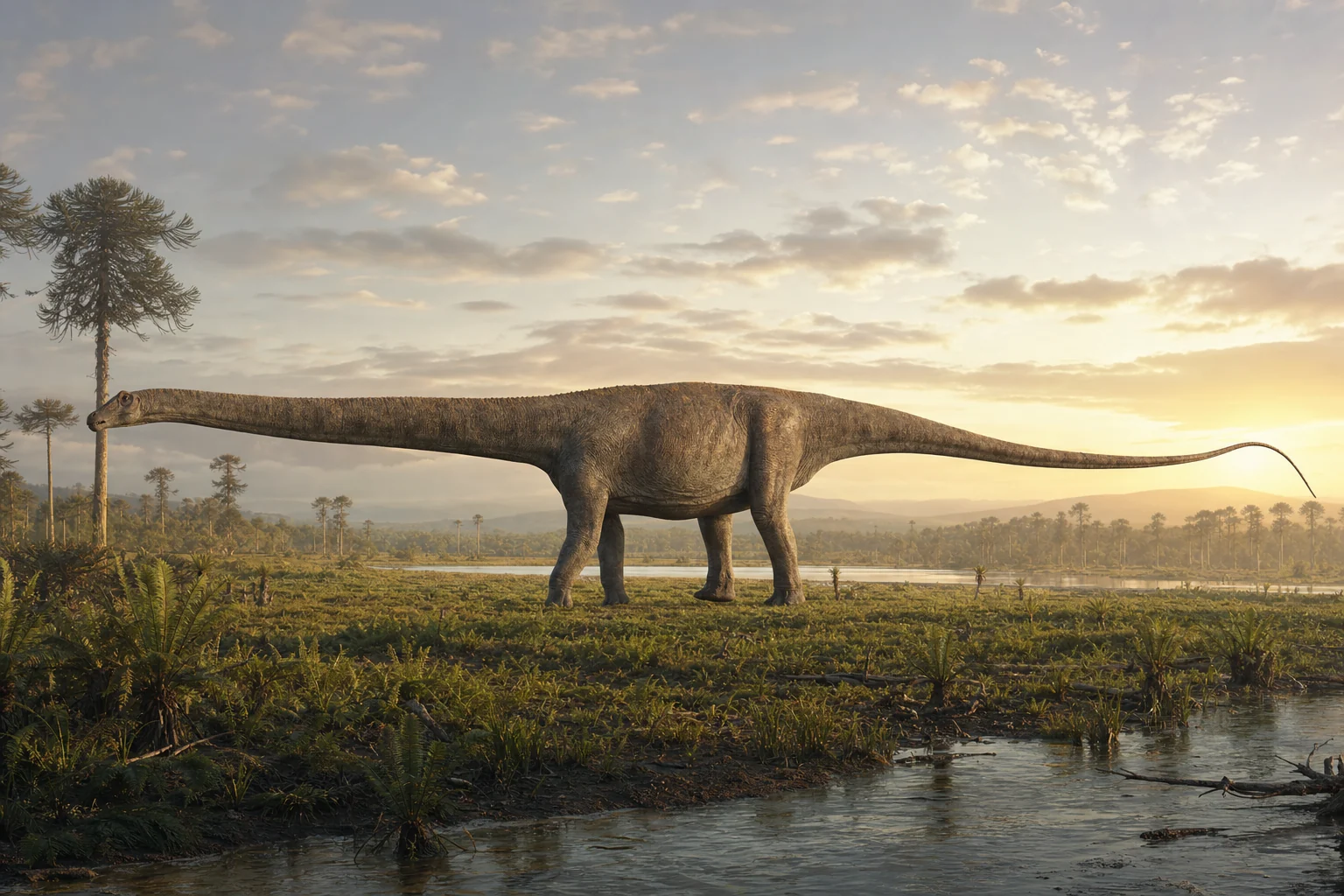 View full-resolution reconstruction ↗
This is an original generative reconstruction, not a photograph or scientific plate. Measurements and interpretations below are tied to named sources.
01 / ANATOMY
Why does the tail look like a whip?
A deep proximal section housed large muscles, followed by many vertebrae that became progressively lighter and narrower. The last rod-like caudals had very mobile joints and little room for bulky muscle. This geometry can transmit a travelling wave, but visual similarity alone cannot establish speed or function.
02 / ORIGINAL HYPOTHESIS
Where did the sonic-boom idea come from?
A 1997 segmented computer model added a hypothetical soft-tissue popper and reported a supersonic tip. The proposal was useful because it made a spectacular claim mechanically testable, but the popper is not preserved and the simplified segments did not model every vertebra, joint, tissue or aerodynamic load.
03 / 2022 RETEST
What changed in the newer model?
The 2022 study represented individual vertebrae, imposed joint limits, included air resistance and tested tensile strength for skin, tendon and ligament analogues. Peak tip speed was about 33 metres per second, roughly one tenth of sound speed. Adding a popper increased stress or drag rather than rescuing the sonic-boom result.
04 / TISSUE LIMITS
Would a supersonic tail injure itself?
At the required acceleration, distal connective tissues would exceed plausible failure strength. A larger tip raises inertial load, while a broad light tip acts as an air brake; either pathway undermines the required velocity. This is why a purely skeletal animation can overstate performance when living tissues are ignored.
05 / ALTERNATIVES
Could the tail still be useful?
Yes. A slower tail can balance the body, signal visually, maintain spacing or strike at close range. Yet direct-impact weapons are usually reinforced at contact surfaces, whereas diplodocid tips are delicate. Fossil injuries and trackways can test some ideas, but none currently identifies one exclusive function for Diplodocus.
06 / VERDICT
How should the claim be stated?
Say that Diplodocus possessed a highly elongated, mobile tail whose exact behavioural role is unresolved. A historical model proposed a supersonic crack; a more complete 2022 analysis rejected it on speed and tissue-strength grounds. Do not convert a plausible slower strike into a documented predator-defence scene without trace evidence.
FREQUENTLY ASKED QUESTIONS
Questions readers ask
How long was Diplodocus?
Well-known D. carnegii reconstructions are about 24–26 metres long.
Was Diplodocus the heaviest dinosaur?
No. Its long body was relatively slender; many titanosaurs and brachiosaurids were much heavier.
Did its tail make a sonic boom?
Current soft-tissue-aware modelling does not support supersonic speed.
Did Diplodocus drag its tail?
Skeletons and sauropod trackways support a tail held clear of the ground during normal walking.
Could it raise its neck vertically?
Some elevation was possible, but habitual near-vertical posture remains debated.
Did Diplodocus chew plants?
Its teeth mainly cropped or stripped vegetation; most processing likely occurred in the gut.
SOURCES & FURTHER READING
Evidence used in this guide
Measurements and interpretations are tied to museum resources or peer-reviewed studies; disputed conclusions include evidence on both sides.
- 01Diplodocus ↗Natural History Museum, London
Museum profile covering dimensions, age, range, teeth and posture.
- 02How big was Diplodocus carnegii? ↗Natural History Museum, London
Specimen-based discussion of 24–26 m length and mass estimates.
- 03Multibody analysis and soft tissue strength refute supersonic dinosaur tail ↗Scientific Reports
Peer-reviewed tail model incorporating air drag and soft-tissue failure.