
DIPLODOCUS TOPIC HUB · SIZE & POSTURE
Diplodocus Size, Neck, Tail and Posture
How large was Diplodocus? Use measured D. carnegii skeletons to examine length, mass, neck range, tail balance, walking posture and reconstruction uncertainty.
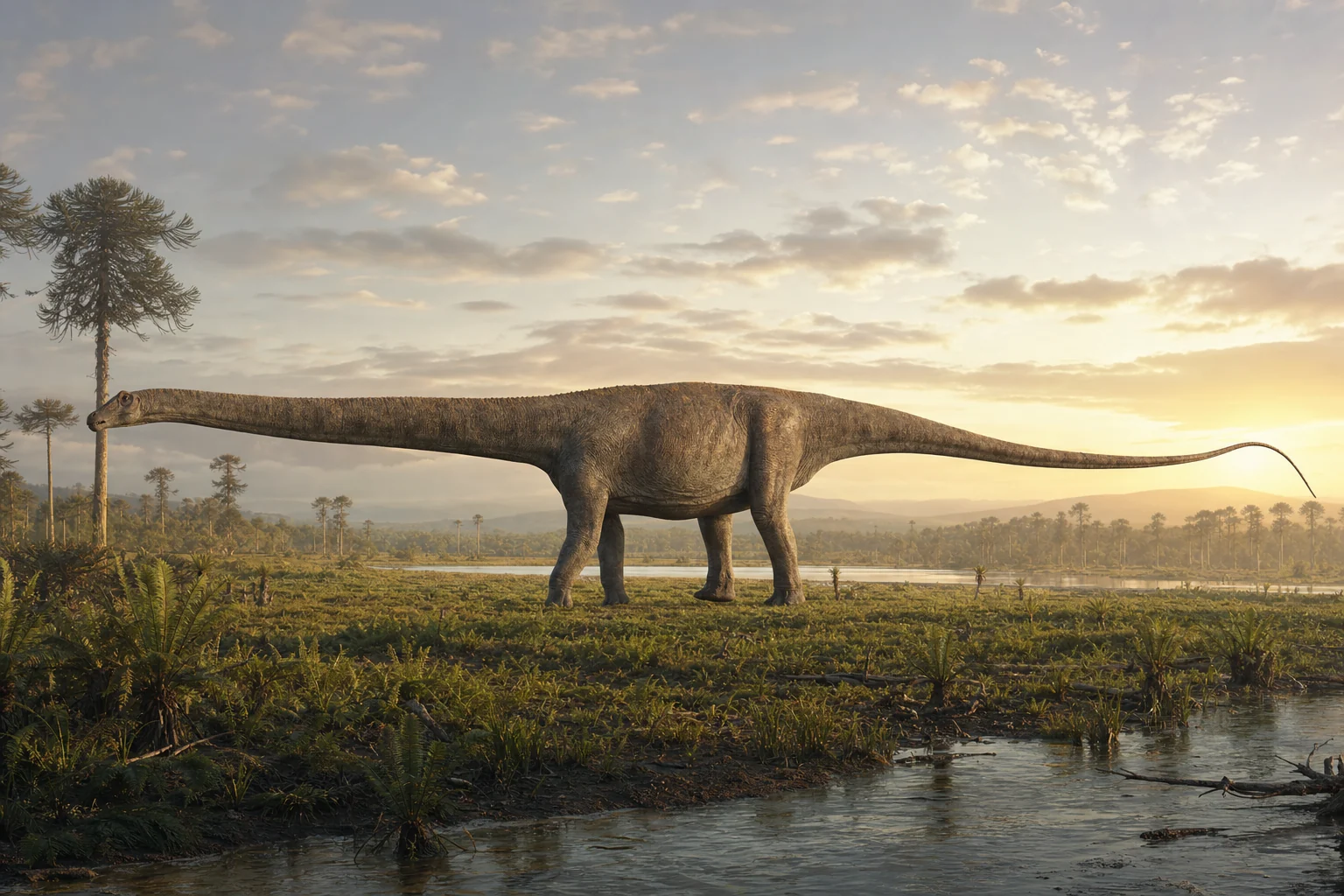 View full-resolution reconstruction ↗
This is an original generative reconstruction, not a photograph or scientific plate. Measurements and interpretations below are tied to named sources.
01 / SKELETONS
Which fossils define Diplodocus size?
Several overlapping Morrison Formation individuals preserve skulls, long vertebral series, limb bones and girdles. The famous D. carnegii mount combines a substantial skeleton with casts or reconstructed portions, so museum length is evidence-led but not a single untouched body. Comparing original elements rather than display outlines keeps estimates reproducible.
02 / LENGTH
Why is Diplodocus so long?
A small head, elongated cervical vertebrae and more than seventy tail vertebrae stretch the body to roughly 24–26 metres in D. carnegii. Length is not evenly distributed: torso and limbs occupy a modest central section while neck and tail extend far on either side. Rare larger diplodocid material should not automatically be assigned to this species.
03 / MASS
How can a 26-metre dinosaur weigh about 15 tonnes?
Diplodocus had a relatively narrow trunk and air-filled spaces in many vertebrae. Digital volumetric models wrap plausible soft-tissue outlines around mounted skeletons and apply tissue densities; different torso depth and respiratory assumptions create a range. Its great linear length therefore should not be confused with the much larger volume of giant titanosaurs.
04 / NECK
Did Diplodocus hold its neck upright?
Intervertebral joints constrain but do not reveal habitual posture by themselves because cartilage, ligaments and muscles are missing. A mostly horizontal neutral pose is common in current mounts, while moderate elevation and lateral sweeping expand the feeding envelope. A permanently swan-like vertical neck is not required to explain its anatomy.
05 / TAIL & BALANCE
What did the long tail do for posture?
The muscular tail base continued the horizontal line of the spine and counterbalanced the neck and head around the hips. Trackways lack a central tail groove, supporting a tail carried clear of the ground during ordinary walking. The slender end was mobile, but balance does not prove any specific defensive or acoustic behaviour.
06 / RECONSTRUCTION
What should a responsible Diplodocus reconstruction show?
Show a small low skull, columnar limbs, a relatively slender torso, a neck capable of a broad but not unlimited range, and a tail tapering far beyond the muscular base without dragging. Label 24–26 metres and 12–15 tonnes as species- and model-specific ranges. Colour, soft-tissue display structures and exact resting pose remain artistic choices.
FREQUENTLY ASKED QUESTIONS
Questions readers ask
How long was Diplodocus?
Well-known D. carnegii reconstructions are about 24–26 metres long.
Was Diplodocus the heaviest dinosaur?
No. Its long body was relatively slender; many titanosaurs and brachiosaurids were much heavier.
Did its tail make a sonic boom?
Current soft-tissue-aware modelling does not support supersonic speed.
Did Diplodocus drag its tail?
Skeletons and sauropod trackways support a tail held clear of the ground during normal walking.
Could it raise its neck vertically?
Some elevation was possible, but habitual near-vertical posture remains debated.
Did Diplodocus chew plants?
Its teeth mainly cropped or stripped vegetation; most processing likely occurred in the gut.
SOURCES & FURTHER READING
Evidence used in this guide
Measurements and interpretations are tied to museum resources or peer-reviewed studies; disputed conclusions include evidence on both sides.
- 01Diplodocus ↗Natural History Museum, London
Museum profile covering dimensions, age, range, teeth and posture.
- 02How big was Diplodocus carnegii? ↗Natural History Museum, London
Specimen-based discussion of 24–26 m length and mass estimates.
- 03Multibody analysis and soft tissue strength refute supersonic dinosaur tail ↗Scientific Reports
Peer-reviewed tail model incorporating air drag and soft-tissue failure.