
Explore this animal in Size of Extinct Animals ↗
83 / Paleozoic
Meganeura
Meganeura monyi
This griffinfly’s wings spanned roughly seventy centimeters above Carboniferous forests.
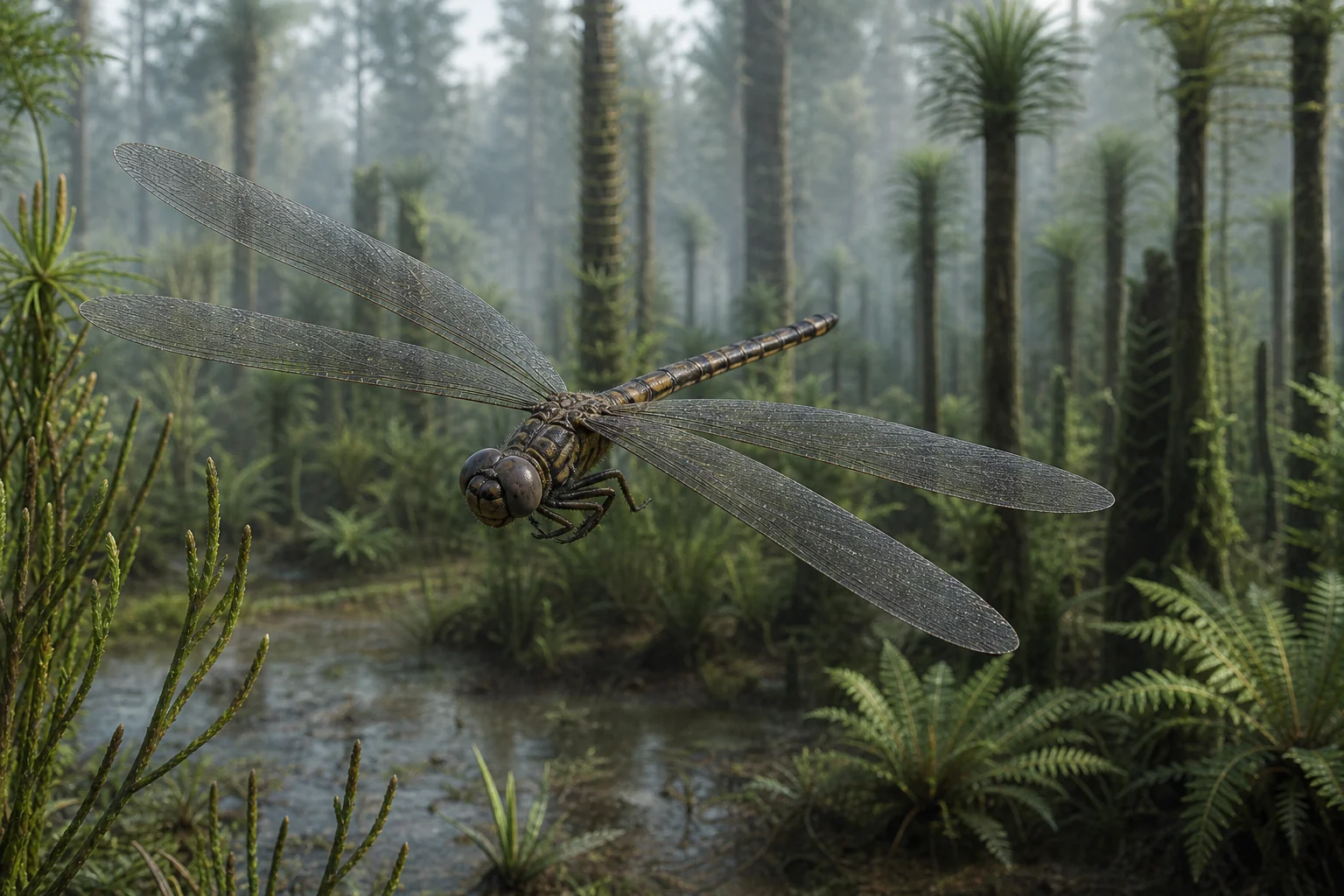 View original image · 1536 × 1024
- Time range
- About 305–299 million years ago
- Final stage
- End of the Carboniferous
- Geographic range
- Euramerican coal swamps · Present-day France
01 / ANSWER FIRST
What was Meganeura?
Meganeura monyi was a giant griffinfly from late Carboniferous France, with a reconstructed wingspan around 65 centimetres and an aerial predatory lifestyle.
It resembled a dragonfly but belonged to the extinct order Meganisoptera rather than the true dragonfly order Odonata. The often-quoted 71-centimetre extreme refers to the largest griffinflies generally, especially Meganeuropsis, not securely to every Meganeura monyi.
02 / QUICK FACTS
Meganeura at a glance
- Scientific name
- Meganeura monyi
- Age
- About 305–299 million years ago
- Wingspan
- About 65 cm reconstructed
- Identity
- Griffinfly, not a true dragonfly
- Diet
- Aerial insect predator
- Flight
- Likely an active aerial hawker
- Key fossil
- Commentry, France
- Oxygen
- Possible enabler, not a sole cause
03 / CORE QUESTION
Why were Carboniferous insects so large?
Late Carboniferous air contained more oxygen than today, which could increase diffusion through insect tracheae and reduce respiratory constraints. Fossil insect size broadly tracks oxygen in parts of the Paleozoic record.
That correlation is not a complete mechanism. Wing mechanics, prey, predators, development and lineage-specific anatomy also constrain size, and newer physiological work disputes simple oxygen ceilings. Meganeura should therefore be presented as a multi-factor evolutionary outcome.
Read the complete oxygen and gigantism guideHow to read the numbers
This page separates direct evidence, comparative inference and unresolved debate.
04 / LIFE & DISCOVERY TIMELINE
From Commentry wing to an icon of insect gigantism
Late Carboniferous skies
Griffinflies hunted over equatorial forests and wetlands.
Meganeura monyi described
A giant wing fossil from Commentry established the famous genus.
Larger relatives persist
Meganeuropsis shows that giant griffinflies continued after Meganeura itself.
Flight and oxygen retested
Large fossil datasets and aerodynamic models replace a single-cause story with interacting constraints.
05 / ANATOMY
A griffinfly built for aerial hunting
Four veined wings
Large membranous wings carried dense veins; fossil measurements reconstruct span but not colour or transparency exactly.
Mobile predatory legs
As in dragonfly-like hunters, spiny legs probably formed a basket for intercepting flying prey.
Large visual head
Prominent eyes supported tracking in flight, although no specimen yields modern measures of acuity or colour vision.
Elongate abdomen
A long segmented abdomen balanced the wings and housed the tracheal system; complete body proportions remain partly reconstructed.
06 / DIET & BEHAVIOUR
What did Meganeura eat?
Wing design and predatory mouthparts support aerial hawking of other insects. Exact prey species and whether it also took small ground animals are not directly preserved.
Read the complete guide07 / DIET & BEHAVIOUR
How did it fly?
Biomechanical studies favour active hawking rather than slow gliding. Large size raised inertial and power costs, so high speed and manoeuvrability should not simply be copied from small dragonflies.
08 / RANGE & HABITAT
Where did Meganeura live?
Meganeura monyi is anchored to the Commentry Lagerstätte in central France; related giant griffinflies broaden the geographic story but are different taxa.
Commentry, France
Fine late-Carboniferous deposits preserve the famous wing and a rich insect assemblage.
Equatorial Euramerica
Warm vegetated landscapes supported dense insect food webs.
Forest openings
Open flight corridors above water and vegetation are plausible hunting zones, not directly filmed habitats.
Relatives elsewhere
Griffinfly fossils from Europe and North America document the order, not M. monyi itself at every site.
09 / FOSSIL EVIDENCE
How do scientists know about Meganeura?
Wing fossils
Length, width and venation establish identity and provide the most direct size evidence.
Commentry collection
The French national collection preserves the type material and associated insect fauna.
Aerodynamic models
Wing loading and power estimates test whether giant griffinflies could hawk prey.
Atmospheric proxies
Geochemical oxygen reconstructions are compared with thousands of fossil insect wings through time.
10 / DISAPPEARANCE & DEBATE
Why did Meganeura disappear?
Meganeura itself is confined to the late Carboniferous, but giant griffinflies continued into the Permian; its disappearance was not a single sudden collapse of all giant insects.
Long-term oxygen decline, climate drying, habitat reorganisation and new aerial competitors or predators may have changed the costs of gigantism. The fossil record does not isolate one cause for the genus.
12 / FREQUENTLY ASKED QUESTIONS
Meganeura FAQ
How large was Meganeura?
Meganeura monyi is commonly reconstructed with a wingspan around 65 centimetres.
Was Meganeura a dragonfly?
No. It was a griffinfly in the extinct order Meganisoptera, close to but outside true Odonata.
Did Meganeura have a 71-centimetre wingspan?
About 71 cm is the upper range for giant griffinflies generally; M. monyi itself is more often reconstructed near 65 cm.
What did Meganeura eat?
It was probably an aerial predator of other insects, though exact prey is not preserved.
Did oxygen alone create giant insects?
No. High oxygen may have enabled larger bodies, but ecology, development and flight mechanics also mattered.
When did Meganeura live?
It lived in the late Carboniferous, roughly 305–299 million years ago.
04 / SOURCES & FURTHER READING
Check the source record
Use the scientific name to compare taxonomy, occurrence records and the fossil record. Database coverage and classifications may differ.
05 / REVISION HISTORY
How has this record changed?
- Rewrote an extinction cause that presented environmental or faunal turnover as established; it is now given as context the record does not prove.
- Expanded into a bilingual S-tier hub with flight and gigantism evidence guides.
- Verified authoritative entity sources and added three responsive reconstruction sizes.
- Initial bilingual species record published.
06 / CORRECTIONS & ADDITIONS