
ARTHROPLEURA TOPIC HUB · SIZE & ANATOMY
Arthropleura Size, Legs, Armour and Head
How do partial exoskeletons, trackways and juvenile heads reconstruct the largest known land arthropod without turning estimates into measurements?
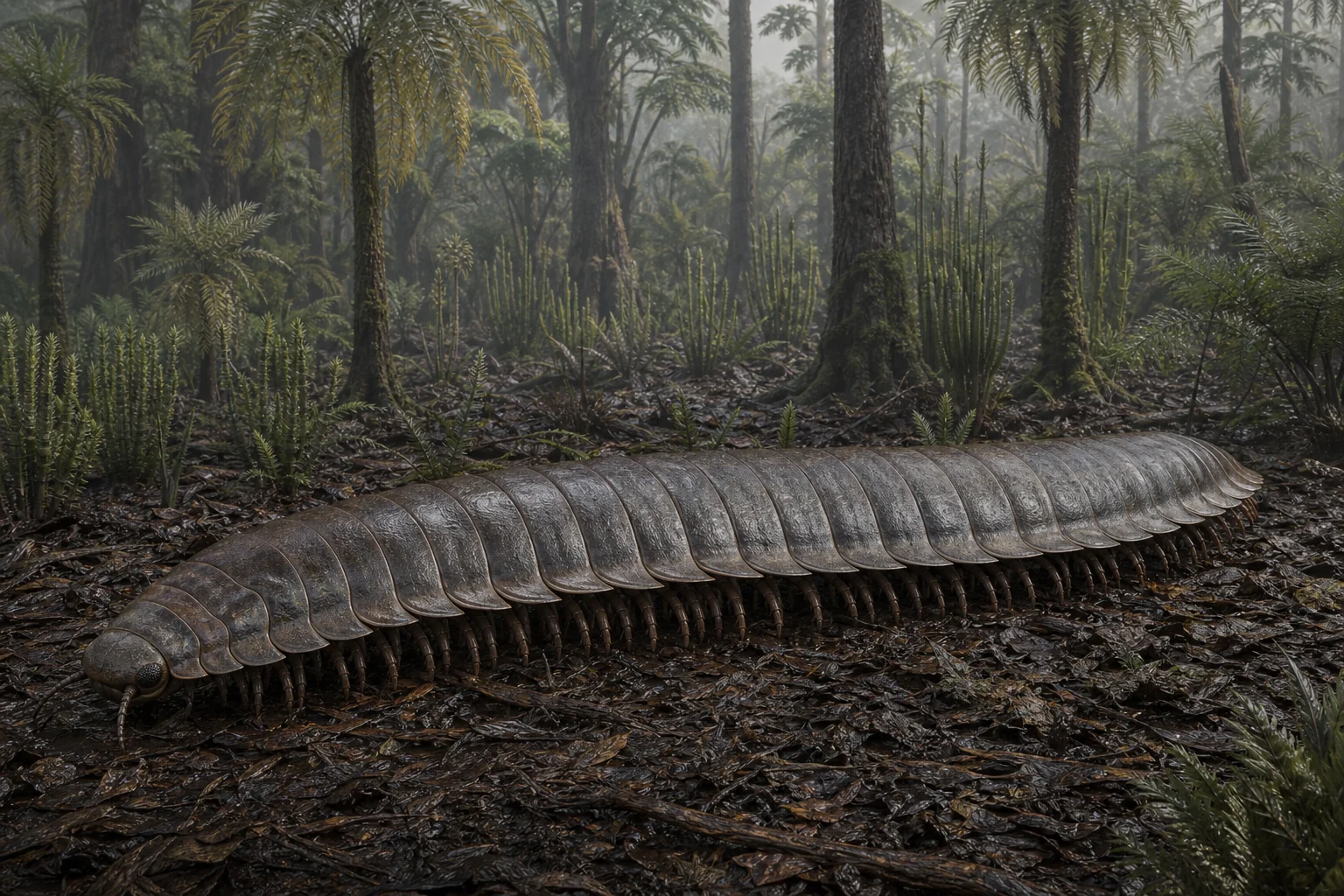 View full-resolution reconstruction ↗
This is an original generative reconstruction, not a photograph or scientific plate. Measurements and interpretations below are tied to named sources.
01 / DIRECT EVIDENCE
What parts of a giant are preserved?
Most giant fossils are isolated or articulated dorsal plates, not complete bodies. A large Howick section preserves several segments. Width and segment proportions can be measured; total length and mass must be scaled.
02 / SIZE MODEL
Where do 2.6 metres and 50 kilograms come from?
Researchers compared the partial Howick exoskeleton with more complete smaller Arthropleura and body proportions of living millipedes. The resulting upper estimate is plausible, not a measured complete specimen or average adult.
03 / ARMOUR
How did the wide plates articulate?
Each broad tergite overlapped adjacent segments while flexible membranes allowed the trunk to bend. Surface ornament and side plates made the body wider than the leg row and protected the joints.
04 / LEGS & TRACKS
What do trackways reveal?
Parallel footprint rows record many short limbs moving in coordinated waves across land. Track width estimates body width and direction, but substrate and overprinting prevent a precise maximum speed.
05 / JUVENILE HEADS
Why did the head remain unknown for so long?
Giant exoskeletons are usually headless molts. Three-dimensional juvenile fossils from France preserve stalked eyes, antennae and mouthparts, revealing a mosaic that combines millipede-like trunk traits with distinctive head anatomy.
06 / IDENTITY
Was it a giant centipede or millipede?
It was neither living group exactly. Phylogenetic evidence places Arthropleura among extinct myriapods close to millipedes. The Chinese name and older 'giant centipede' label should not override anatomical evidence.
FREQUENTLY ASKED QUESTIONS
Questions readers ask
How large was Arthropleura?
The largest partial fossil supports an estimate near 2.6 metres long and roughly 50 kilograms.
Was Arthropleura a centipede?
No. It was an extinct myriapod with stronger links to the millipede side, although its head was a mosaic.
What did Arthropleura eat?
The exact diet is unknown; plants and detritus are plausible but unconfirmed.
Did high oxygen make Arthropleura giant?
It may have helped, but giant specimens predate peak oxygen and other ecological factors mattered.
Could Arthropleura move quickly?
Trackways show coordinated walking, but short legs do not support a fast centipede-like sprint.
When did Arthropleura go extinct?
The youngest secure records are early Permian, roughly 290 million years old.
SOURCES & FURTHER READING
Evidence used in this guide
Measurements and interpretations are tied to museum resources or peer-reviewed studies; disputed conclusions include evidence on both sides.
- 01World's largest terrestrial arthropod was car-sized millipede ↗Natural History Museum, London
Museum account of the Howick fossil, 2.6-metre estimate and woodland setting.
- 02A giant millipede-like arthropod from the Carboniferous of northern England ↗Journal of the Geological Society
Primary description and body-size scaling of the Howick specimen.
- 03Head anatomy and phylogenomics of the giant Arthropleura ↗Science Advances · DOI 10.1126/sciadv.adp6362
Juvenile heads clarify mosaic anatomy, myriapod relationships and remaining diet limits.