
ARTHROPLEURA TOPIC HUB · DIET & GIGANTISM
What Did Arthropleura Eat, and Why Was It So Large?
Evaluate plant-eating evidence, missing adult mouthparts, Carboniferous oxygen, habitat and ecology behind Arthropleura gigantism.
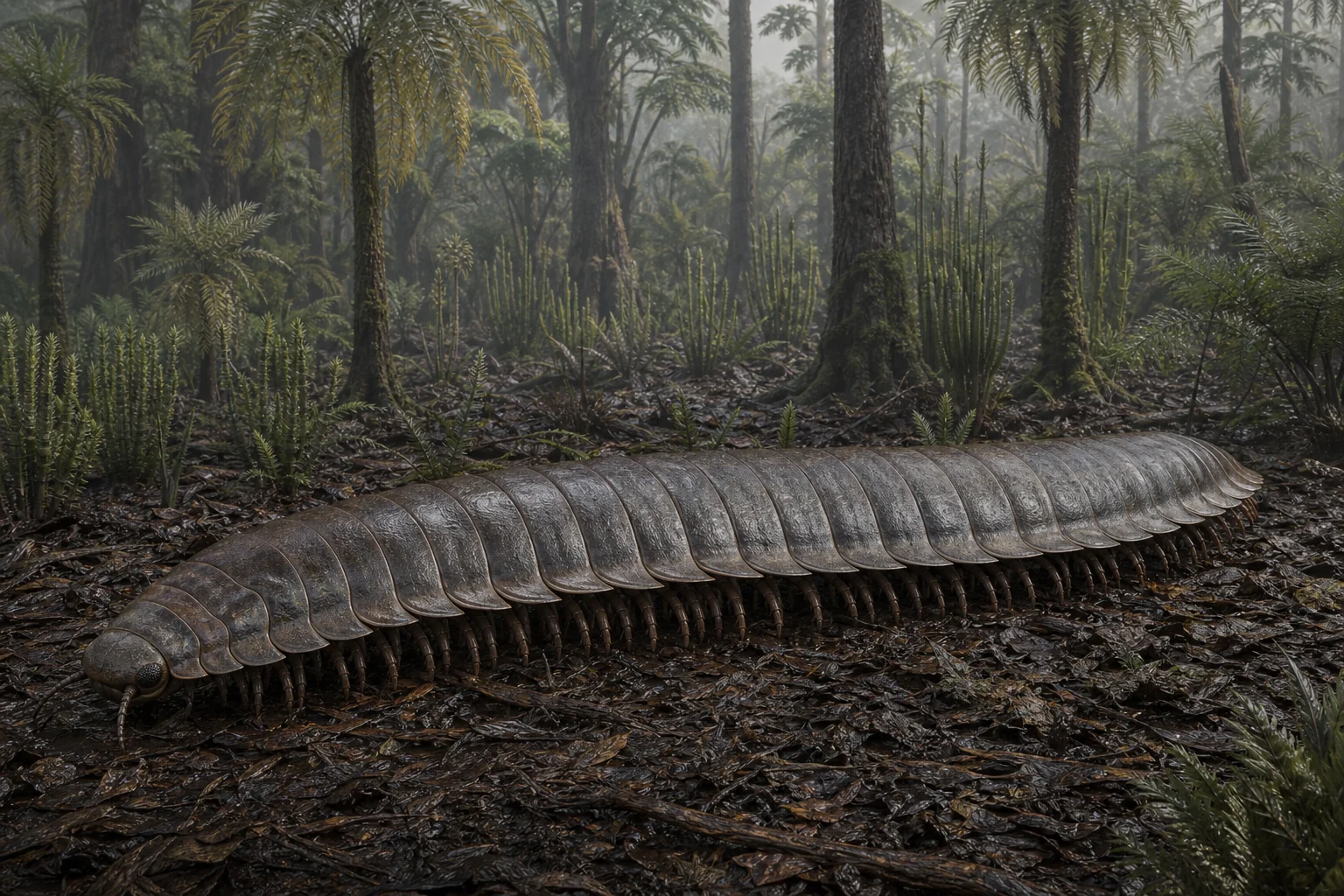 View full-resolution reconstruction ↗
This is an original generative reconstruction, not a photograph or scientific plate. Measurements and interpretations below are tied to named sources.
01 / MISSING MOUTHPARTS
Why is the diet uncertain?
The largest fossils lack complete heads and feeding organs. Juvenile heads clarify mandibles but may not represent adult proportions or diet. Without gut contents, coprolites or diagnostic bite traces, a specific menu remains inference.
02 / PLANT HYPOTHESIS
Why is herbivory often proposed?
Plant fragments occur near some remains, and millipede-like relatives commonly process decaying vegetation. These are ecological clues, not proof that the fossil and plants formed one meal or that every life stage ate alike.
03 / PREDATOR CLAIM
Could Arthropleura hunt animals?
Size alone does not make a predator. Short millipede-like legs and incomplete feeding structures do not support a fast centipede-style hunter. Opportunistic animal food is possible, but active macropredation is not demonstrated.
04 / OXYGEN
Did oxygen remove a size limit?
Carboniferous oxygen exceeded modern levels and may have improved tracheal supply. However, the early Howick giant lived before the later oxygen maximum, showing that oxygen concentration cannot be the only switch.
05 / HABITAT & RESOURCES
Did it require a coal swamp?
No. The Howick animal inhabited open woodland near a river channel. Humid vegetated mosaics could protect water balance and supply abundant food while allowing large arthropods to move outside permanent swamp forests.
06 / MULTI-FACTOR MODEL
What best explains its size?
A permissive atmosphere, humid habitat, plentiful resources, developmental construction and an ecological world with few large terrestrial vertebrate competitors likely interacted. No experiment or fossil isolates one necessary cause.
FREQUENTLY ASKED QUESTIONS
Questions readers ask
How large was Arthropleura?
The largest partial fossil supports an estimate near 2.6 metres long and roughly 50 kilograms.
Was Arthropleura a centipede?
No. It was an extinct myriapod with stronger links to the millipede side, although its head was a mosaic.
What did Arthropleura eat?
The exact diet is unknown; plants and detritus are plausible but unconfirmed.
Did high oxygen make Arthropleura giant?
It may have helped, but giant specimens predate peak oxygen and other ecological factors mattered.
Could Arthropleura move quickly?
Trackways show coordinated walking, but short legs do not support a fast centipede-like sprint.
When did Arthropleura go extinct?
The youngest secure records are early Permian, roughly 290 million years old.
SOURCES & FURTHER READING
Evidence used in this guide
Measurements and interpretations are tied to museum resources or peer-reviewed studies; disputed conclusions include evidence on both sides.
- 01World's largest terrestrial arthropod was car-sized millipede ↗Natural History Museum, London
Museum account of the Howick fossil, 2.6-metre estimate and woodland setting.
- 02A giant millipede-like arthropod from the Carboniferous of northern England ↗Journal of the Geological Society
Primary description and body-size scaling of the Howick specimen.
- 03Head anatomy and phylogenomics of the giant Arthropleura ↗Science Advances · DOI 10.1126/sciadv.adp6362
Juvenile heads clarify mosaic anatomy, myriapod relationships and remaining diet limits.