
Explore this animal in Size of Extinct Animals ↗
33 / Paleozoic
Jaekelopterus
Jaekelopterus rhenaniae
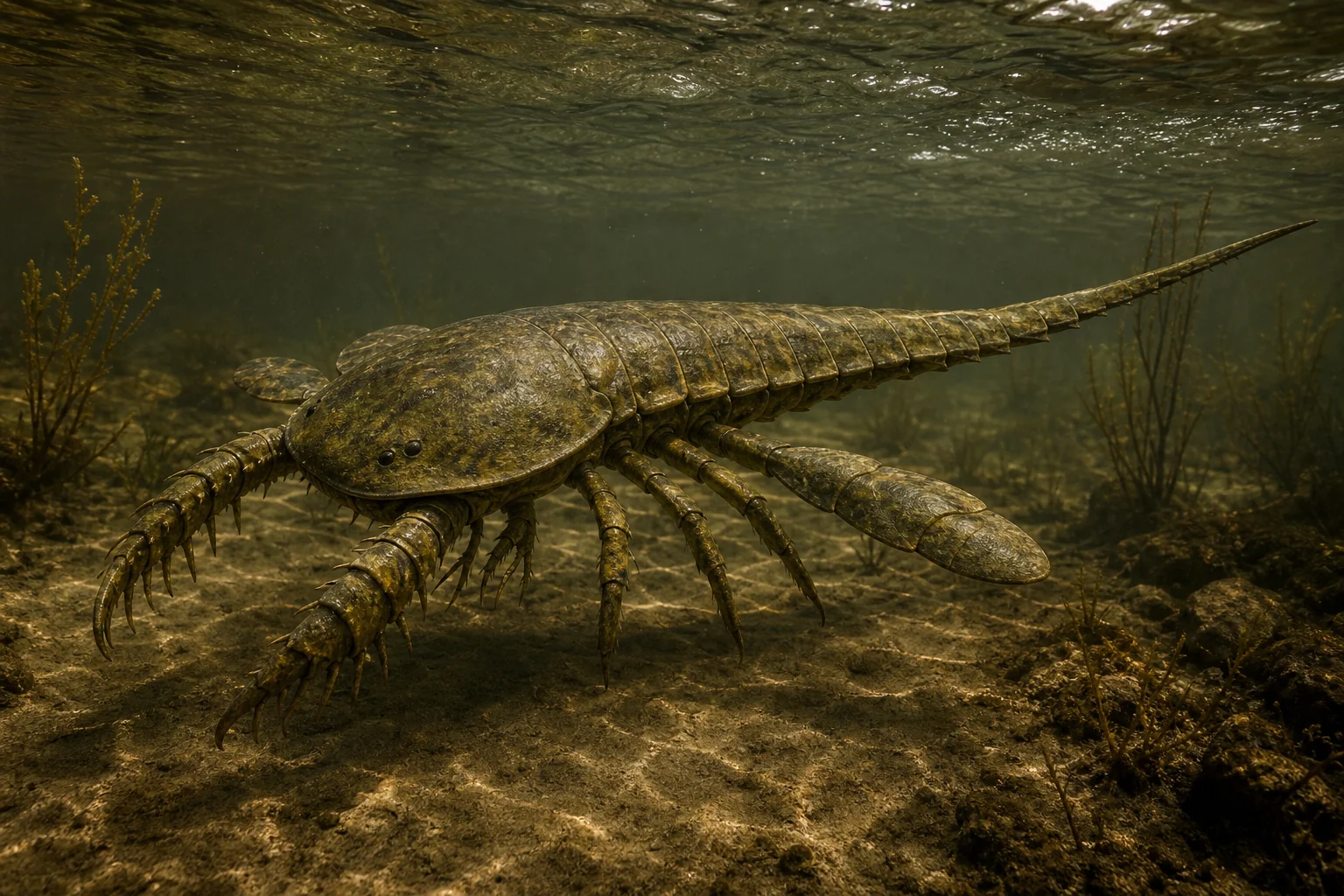
This giant sea scorpion may have exceeded two meters in length.
 View original image · 1536 × 1024
- Time range
- About 390 million years ago
- Final stage
- Early Devonian
- Geographic range
- Euramerican estuaries · Present-day Germany
01 / ANSWER FIRST
What was Jaekelopterus?
Jaekelopterus was a giant predatory eurypterid—an extinct aquatic chelicerate often called a sea scorpion—that lived in Early Devonian waterways.
A 46-centimetre claw fragment was scaled to an animal about 2.5 metres long, making it a candidate for the largest arthropod known. That total is an estimate from a fragment, not a measured complete body, and smaller specimens were certainly common.
02 / QUICK FACTS
Jaekelopterus at a glance
- Scientific name
- Jaekelopterus rhenaniae
- Age
- Early Devonian, about 390 million years ago
- Maximum estimate
- About 2.5 m from claw scaling
- Group
- Eurypterid chelicerate
- Diet
- Fish and aquatic arthropods
- Habitat
- Freshwater to brackish channels
- Fossil locality
- Rhineland, Germany
- Not a true scorpion
- An aquatic relative within Chelicerata
03 / ANATOMY
A giant chelicerate known from armour and claws
Enlarged grasping appendage
The famous chelicera carried inward-facing spines that could seize slippery prey rather than deliver a venomous scorpion sting.
Segmented armour
Overlapping plates protected a broad body while retaining flexibility through the trunk.
Swimming paddles
Flattened rear appendages helped steer and swim, although bottom-walking probably remained important.
Compound eyes
Large lateral eyes detected movement in turbid water; eye anatomy in eurypterids suggests visually guided predation.
04 / DIET & BEHAVIOUR
What did Jaekelopterus eat?
Its spined graspers suit fish and other sizeable aquatic animals. Direct gut contents are lacking, so prey choice is inferred from functional anatomy and the associated fauna.
05 / DIET & BEHAVIOUR
Did giant size change its role?
Large size increased reach and prey options but demanded oxygen, food and safe moulting space. Arthropod gigantism was therefore constrained by both physiology and ecosystem productivity.
06 / RANGE & HABITAT
Where did Jaekelopterus live?
The best-known material comes from Early Devonian deposits near Prüm in Germany, interpreted as river or lake-associated settings rather than an open ocean.
River channels
Flowing water concentrated fish and transported shed armour into sediment.
Lakes and floodplain water
Low-energy water improved preservation of isolated plates and appendages.
Brackish connections
Some eurypterids crossed salinity boundaries, so habitat labels should not imply one fixed chemistry.
07 / FOSSIL EVIDENCE
Why is the 2.5-metre estimate uncertain?
The 46 cm claw
The fossil is part of a grasping appendage. Its proportion to body length was estimated from more complete pterygotid relatives.
Scaling assumptions
Adults can change proportions as they grow, and related species do not share identical claws, so 2.5 metres is a defensible upper estimate rather than a precise measurement.
Fragmentary body record
Most remains are moulted or disarticulated armour. Complete outlines are reconstructed from multiple individuals and relatives.
Associated ecosystems
Sedimentology and nearby fish fossils show the water conditions and potential prey available to a giant predator.
08 / DISAPPEARANCE & DEBATE
Why did Jaekelopterus disappear?
No single event is known to have eliminated Jaekelopterus; it belongs to a broader eurypterid decline through changing Devonian aquatic ecosystems.
Expanding jawed fishes, altered habitats and later extinction crises changed predator guilds. These are plausible background pressures, not direct proof of the last population's cause.
09 / FREQUENTLY ASKED QUESTIONS
Jaekelopterus FAQ
Was Jaekelopterus a sea scorpion?
It was a eurypterid, commonly nicknamed a sea scorpion, but it was not a true scorpion and may have lived mainly in fresh water.
Was it really 2.5 metres long?
That is an upper estimate scaled from a very large claw fragment; no complete 2.5-metre body has been found.
What did its claws do?
Inward spines probably gripped and positioned fish or arthropod prey near the mouth.
Is Jaekelopterus the largest arthropod ever?
It is a leading candidate by estimated length, but the fragmentary evidence makes rankings approximate.
04 / SOURCES & FURTHER READING
Check the source record
Use the scientific name to compare taxonomy, occurrence records and the fossil record. Database coverage and classifications may differ.
05 / REVISION HISTORY
How has this record changed?
- Rewrote an extinction cause that presented environmental or faunal turnover as established; it is now given as context the record does not prove.
- Expanded into a curated bilingual A-tier profile with anatomy, ecology, range, evidence, debate and FAQs.
- Verified authoritative entity sources and added three responsive reconstruction sizes.
- Initial bilingual species record published.
06 / CORRECTIONS & ADDITIONS