
ANKYLOSAURUS TOPIC HUB · SIZE & ANATOMY
Ankylosaurus Size, Armor and Tail Club Anatomy
How big was Ankylosaurus? Examine incomplete skeletons, body-mass models, skull armour, osteoderm placement and the construction of its tail club.
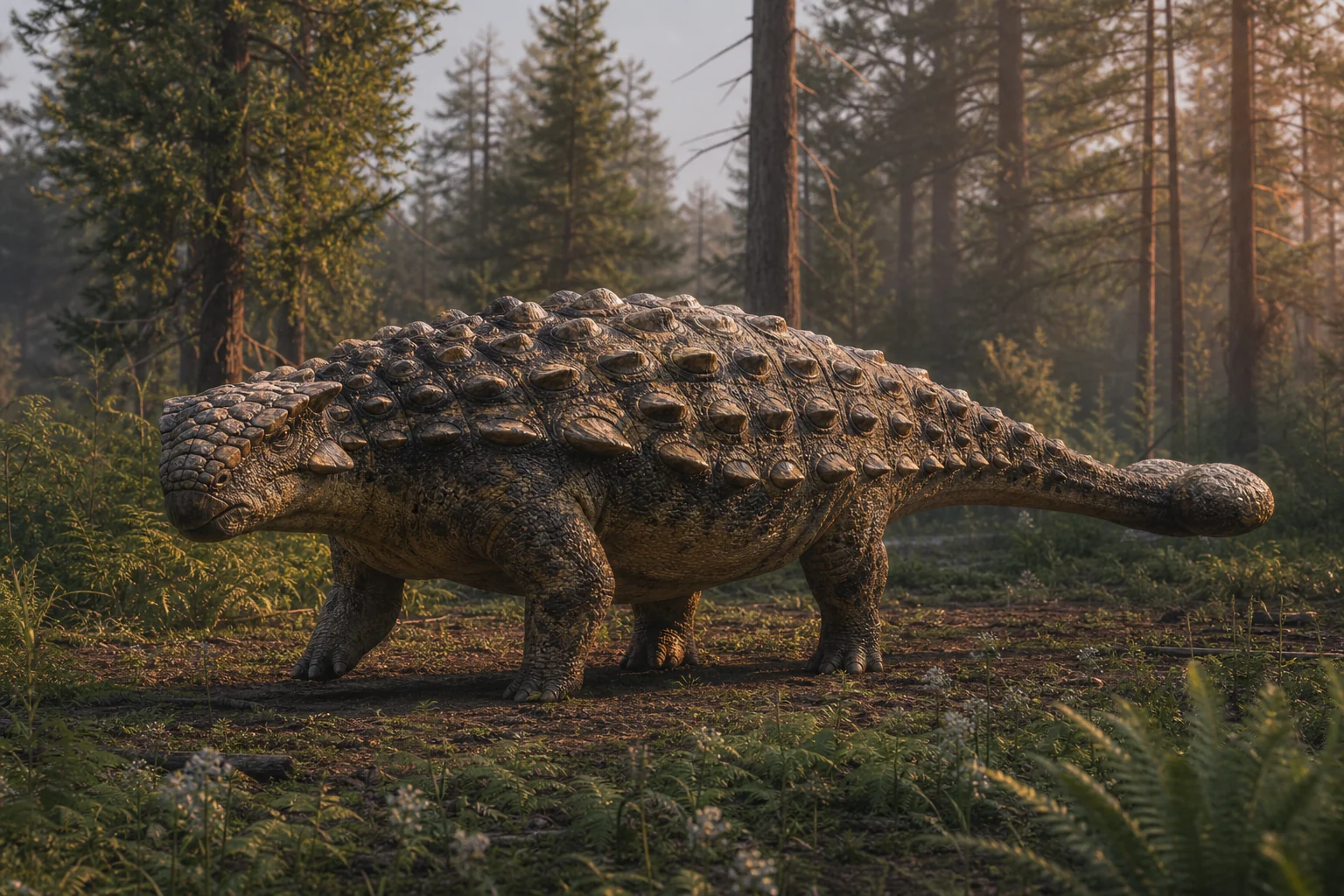 View full-resolution reconstruction ↗
This is an original generative reconstruction, not a photograph or scientific plate. Measurements and interpretations below are tied to named sources.
01 / FOSSIL RECORD
Why is Ankylosaurus size uncertain?
Known individuals preserve different combinations of skull, trunk, limbs, armour and tail. Researchers must scale overlapping bones and borrow only carefully from relatives, so total length and mass are ranges rather than measurements of one complete body.
02 / BODY SIZE
How big was Ankylosaurus?
Large reconstructions cluster around 8 metres, with several-tonne mass estimates. Wider ranges reflect different specimens and torso models; an unusually broad body increases mass rapidly even when length changes little.
03 / SKULL ARMOR
Was the skull one solid helmet?
Ornamented skull bones and fused accessory elements produced a strongly protected surface, including horn-like projections at the rear. Openings for the eyes, mouth and complex nasal passages remained, so it was reinforced rather than sealed.
04 / BODY ARMOR
How was the back armour arranged?
Osteoderms formed in skin and separated after death, leaving exact placement uncertain. Neck half-rings are better constrained, while broad back plates and small ossicles are positioned using shape, articulation and comparisons—not an intact shell.
05 / TAIL CLUB
How was the tail club constructed?
Free vertebrae and large muscles near the hips generated motion. Farther back, interlocking vertebrae and tendons stiffened a handle, while enlarged terminal osteoderms made the knob. The design transferred a lateral swing into a concentrated impact.
06 / RECONSTRUCTION
What should an accurate Ankylosaurus look like?
Use a low broad torso, short robust limbs, armoured skull and neck, skin-set osteoderms and a comparatively low tail club. Avoid a seamless turtle shell, spikes copied from another species or a club raised vertically like a scorpion.
FREQUENTLY ASKED QUESTIONS
Questions readers ask
How big was Ankylosaurus?
Large reconstructions are around 8 metres, but all skeletons are incomplete and mass estimates vary by model.
Was its whole body covered in solid shell?
No. Separate osteoderms sat in skin with flexible tissue between them; the belly was less protected.
Could the tail club break a T. rex leg?
Large ankylosaurid clubs could model bone-damaging impacts, but no Tyrannosaurus fracture is directly tied to an Ankylosaurus strike.
Did Ankylosaurus fight others of its own kind?
Possible. A related ankylosaur preserves flank injuries consistent with rival tail blows, but direct Ankylosaurus evidence is absent.
Did Ankylosaurus live with Tyrannosaurus?
Yes. Both occur in latest-Cretaceous western North American formations such as Hell Creek.
Why is no complete skeleton known?
Fossilization is rare, bodies disarticulate, and osteoderms separate from the skeleton after death.
SOURCES & FURTHER READING
Evidence used in this guide
Measurements and interpretations are tied to museum resources or peer-reviewed studies; disputed conclusions include evidence on both sides.
- 01Ankylosaurus ↗Natural History Museum, London
Museum overview of size, age, diet, discovery and tail-club interpretation.
- 02Unusual cranial and postcranial anatomy in Ankylosaurus magniventris ↗FACETS
Open peer-reviewed redescription of all major specimens and revised body reconstruction.
- 03Estimating Impact Forces of Tail Club Strikes by Ankylosaurid Dinosaurs ↗PLOS ONE
CT-based comparative biomechanics of ankylosaurid tail clubs and impact limits.