
ANKYLOSAURUS TOPIC HUB · DEFENCE EVIDENCE
Could Ankylosaurus Defend Itself Against Tyrannosaurus?
Tail-club biomechanics, armour coverage, shared Hell Creek habitat, possible strike targets and why fossils do not record a confirmed Ankylosaurus–Tyrannosaurus battle.
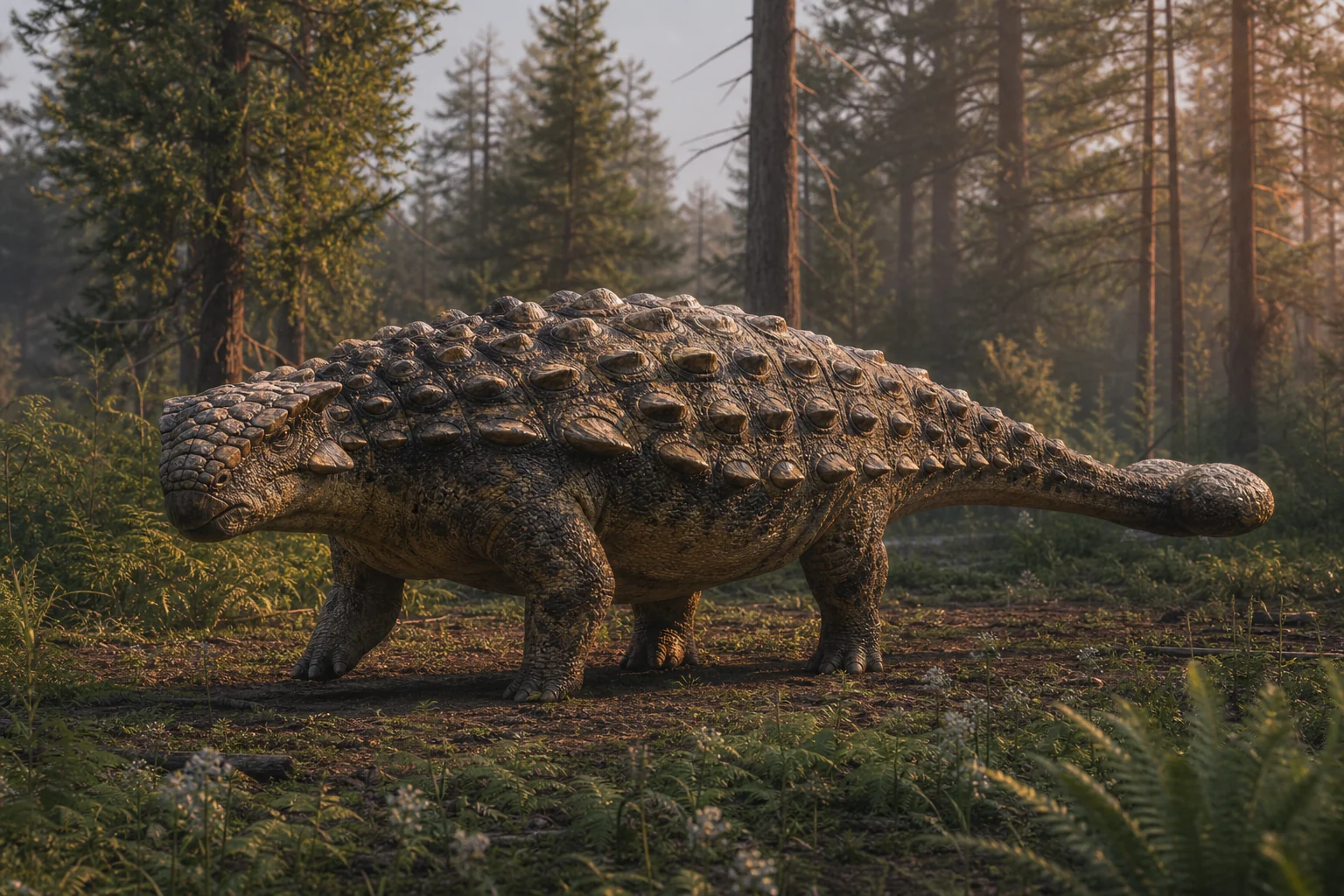 View full-resolution reconstruction ↗
This is an original generative reconstruction, not a photograph or scientific plate. Measurements and interpretations below are tied to named sources.
01 / COEXISTENCE
Did Ankylosaurus meet Tyrannosaurus?
Yes. Both occur in latest-Cretaceous formations of western North America, including Hell Creek. Coexistence makes encounters possible, but it does not prove that Tyrannosaurus regularly hunted adult Ankylosaurus.
02 / IMPACT FORCE
Could a tail club damage bone?
CT-based models of large Euoplocephalus and Dyoplosaurus clubs produced forces capable of damaging bone. These results demonstrate ankylosaurid capability, but species differences and unknown muscle activation prevent a precise Ankylosaurus strike value.
03 / TARGETS
Would the club aim for a predator's legs?
The club's low height and lateral arc make lower limbs a plausible target, while a predator approaching from behind entered the widest swing zone. Fossils preserve neither aim nor strategy, so this is geometry rather than observed behaviour.
04 / ARMOR LIMITS
Was Ankylosaurus invulnerable?
No. Armour covered the upper body and neck but retained joints and gaps, while the belly and parts of the limbs were less protected. A large predator could test edges, juveniles or injured individuals without biting through the thickest plates.
05 / RIVAL COMBAT
Was the club mainly for fighting other ankylosaurs?
Healed flank injuries in the related ankylosaur Zuul fit repeated blows from rivals and support sexual or social combat. Defensive use against predators remains plausible; one weapon can serve deterrence, display and competition.
06 / EVIDENCE VERDICT
Who would win?
Science cannot score a universal winner. A healthy adult Ankylosaurus presented high risk, while Tyrannosaurus had powerful jaws, senses and behavioural flexibility. Size, angle, surprise, age and terrain would determine an encounter more than species names alone.
FREQUENTLY ASKED QUESTIONS
Questions readers ask
How big was Ankylosaurus?
Large reconstructions are around 8 metres, but all skeletons are incomplete and mass estimates vary by model.
Was its whole body covered in solid shell?
No. Separate osteoderms sat in skin with flexible tissue between them; the belly was less protected.
Could the tail club break a T. rex leg?
Large ankylosaurid clubs could model bone-damaging impacts, but no Tyrannosaurus fracture is directly tied to an Ankylosaurus strike.
Did Ankylosaurus fight others of its own kind?
Possible. A related ankylosaur preserves flank injuries consistent with rival tail blows, but direct Ankylosaurus evidence is absent.
Did Ankylosaurus live with Tyrannosaurus?
Yes. Both occur in latest-Cretaceous western North American formations such as Hell Creek.
Why is no complete skeleton known?
Fossilization is rare, bodies disarticulate, and osteoderms separate from the skeleton after death.
SOURCES & FURTHER READING
Evidence used in this guide
Measurements and interpretations are tied to museum resources or peer-reviewed studies; disputed conclusions include evidence on both sides.
- 01Ankylosaurus ↗Natural History Museum, London
Museum overview of size, age, diet, discovery and tail-club interpretation.
- 02Unusual cranial and postcranial anatomy in Ankylosaurus magniventris ↗FACETS
Open peer-reviewed redescription of all major specimens and revised body reconstruction.
- 03Estimating Impact Forces of Tail Club Strikes by Ankylosaurid Dinosaurs ↗PLOS ONE
CT-based comparative biomechanics of ankylosaurid tail clubs and impact limits.