
LYSTROSAURUS TOPIC HUB · SURVIVAL
How Did Lystrosaurus Survive the Mass Extinction?
Combine strata, physiology, range and recovery ecology.
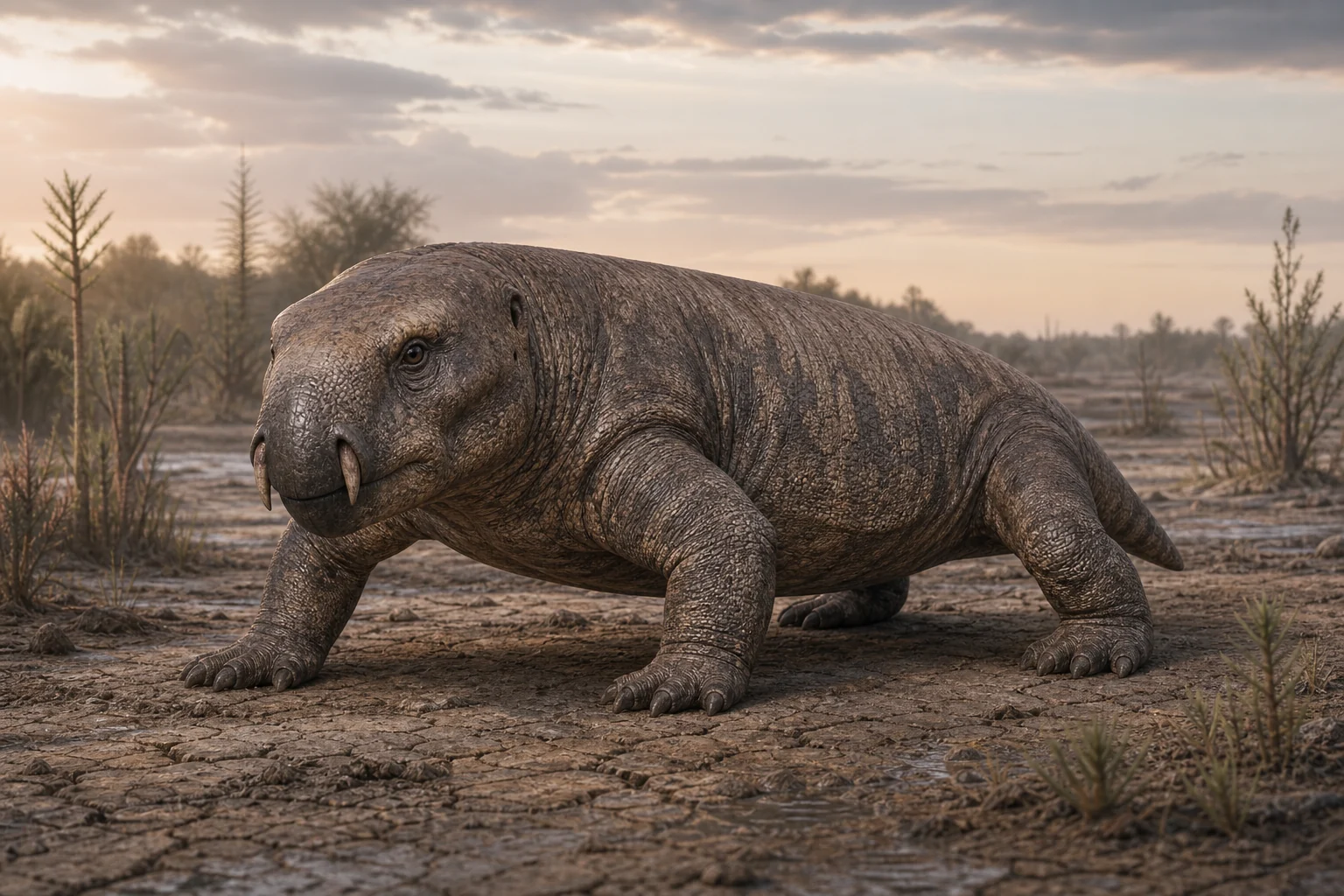 View full-resolution reconstruction ↗
This is an original generative reconstruction, not a photograph or scientific plate. Measurements and interpretations below are tied to named sources.
01 / SHORT ANSWER
How did Lystrosaurus survive the mass extinction?
The end-Permian crisis brought extreme warming, aridity, wildfire and food-web collapse. Lystrosaurus crossed the boundary and rapidly dominated many Early Triassic assemblages, suggesting ecological flexibility and a capacity to recover quickly.
Robust forelimbs support digging, continuously growing tusks preserve seasonal growth, and Antarctic records show prolonged stress or torpor-like intervals. No single trait is proven to explain survival everywhere.
02 / ECOLOGY
What did Lystrosaurus eat and how did it live?
What did Lystrosaurus eat?: Its beak cropped low vegetation and roots in disturbed landscapes; jaw motion and gut volume support bulk herbivory.
Did it hibernate?: Antarctic tusk growth shows repeated stress intervals consistent with torpor, but it does not reveal exact body temperature, duration or whether every population behaved alike.
03 / PLACE & TIME
Where did Lystrosaurus live?
Fossils occur across former southern Pangaea, including South Africa, Antarctica, India and Russia, helping confirm continental connections.
Karoo Basin: Dense boundary records document survival and recovery.
Antarctica: Polar tusks preserve seasonal physiology.
India: Shared species helped support Gondwanan correlations.
Floodplains: Disturbed river landscapes supplied hardy plants.
04 / SOURCE RECORD
How do scientists know about Lystrosaurus?
Bonebeds: Thousands of specimens reveal abundance and variation.
Boundary sections: Stratigraphy tracks survival across the extinction.
Tusk histology: Growth layers record stress and seasonality.
Limb anatomy: Muscle and joint form test digging behaviour.
05 / SCIENTIFIC DEBATE
What remains uncertain?
Which traits mattered most for survival.
Extent of burrowing.
Interpretation of torpor signals.
Species-level taxonomy.
06 / EVIDENCE VERDICT
Was Lystrosaurus the only survivor?
No. Many plants and animals crossed the boundary, but Lystrosaurus became unusually dominant in several regions during a simplified recovery ecosystem.
Its dominance is evidence of ecological filtering, not a claim that one species covered the whole planet or caused other extinctions.
FREQUENTLY ASKED QUESTIONS
Questions readers ask
Was Lystrosaurus a dinosaur?
No, it was a dicynodont synapsid on the mammal side of the tree.
When did it live?
Across the latest Permian and Early Triassic.
How did it survive?
Flexible feeding, rapid recovery, broad range and stress tolerance probably combined.
Did it hibernate?
Antarctic tusks support torpor-like seasonal physiology.
What did it eat?
Low plants, roots and other tough vegetation.
Why is it so common?
It flourished in simplified post-extinction ecosystems.
SOURCES & FURTHER READING
Evidence used in this guide
Measurements and interpretations are tied to museum resources or peer-reviewed studies; disputed conclusions include evidence on both sides.
- 01Torpor in the tusks of Lystrosaurus ↗Communications Biology
Primary study of Antarctic tusk growth and torpor-like physiology.
- 02Fossil tusks reveal seasonal torpor ↗University of Washington
Institutional explanation of the polar evidence.
- 03Lystrosaurus ↗Paleobiology Database
Taxonomic and occurrence record.