
LYSTROSAURUS TOPIC HUB · BODY & BURROWING
Lystrosaurus Size, Tusks, Beak and Burrowing
Read its compact anatomy and seasonal growth record.
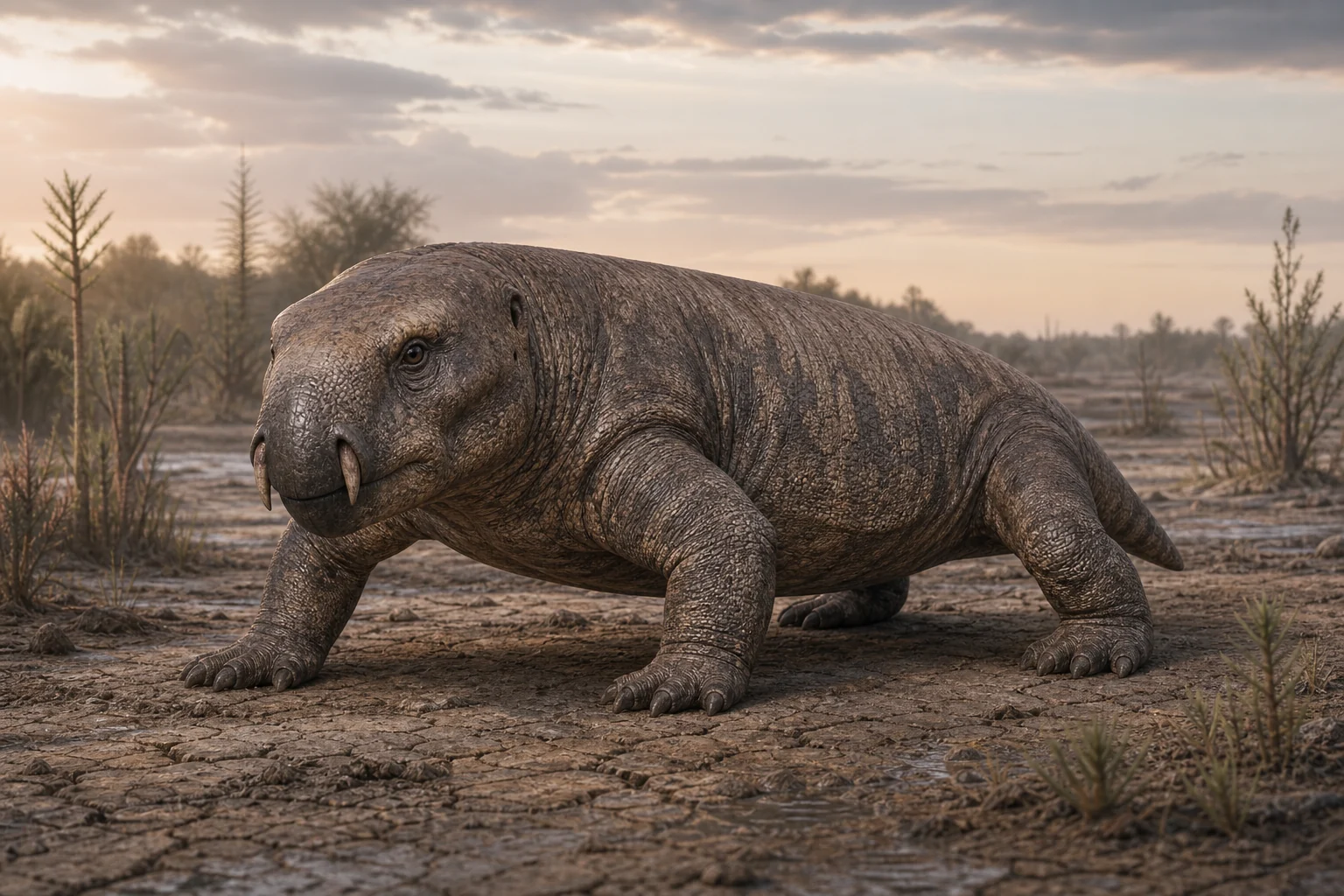 View full-resolution reconstruction ↗
This is an original generative reconstruction, not a photograph or scientific plate. Measurements and interpretations below are tied to named sources.
01 / QUICK ANSWER
What was Lystrosaurus?
Lystrosaurus was a pig-sized tusked dicynodont synapsid that survived the end-Permian mass extinction and became one of the most abundant land vertebrates of the earliest Triassic.
It was neither a dinosaur nor a direct mammal ancestor, but a relative on the broader mammal-line branch. Its success probably reflects flexible feeding, rapid growth, broad range and tolerance of harsh seasonal conditions rather than one miracle adaptation.
02 / MEASUREMENTS
How large was Lystrosaurus?
Scientific name: Lystrosaurus murrayi · Age: ~255–247 million years ago · Length: Usually ~0.6–2.5 m by species · Identity: Dicynodont therapsid · Mouth: Horny beak and two tusks · Diet: Herbivorous · Behaviour: Burrowing plausible; torpor evidence · Range: Africa, India, Antarctica and beyond
03 / ANATOMY
A compact herbivore with a beak, tusks and digging limbs
Horny beak: A toothless cutting edge cropped tough vegetation.
Two tusks: Continuously growing canines recorded life history.
Barrel trunk: A broad ribcage housed a fermenting gut.
Strong forelimbs: Broad hands and muscle attachments suit digging.
04 / FUNCTION
How did Lystrosaurus survive the mass extinction?
The end-Permian crisis brought extreme warming, aridity, wildfire and food-web collapse. Lystrosaurus crossed the boundary and rapidly dominated many Early Triassic assemblages, suggesting ecological flexibility and a capacity to recover quickly.
Robust forelimbs support digging, continuously growing tusks preserve seasonal growth, and Antarctic records show prolonged stress or torpor-like intervals. No single trait is proven to explain survival everywhere.
05 / FOSSIL EVIDENCE
How do scientists know about Lystrosaurus?
Bonebeds: Thousands of specimens reveal abundance and variation.
Boundary sections: Stratigraphy tracks survival across the extinction.
Tusk histology: Growth layers record stress and seasonality.
Limb anatomy: Muscle and joint form test digging behaviour.
06 / EVIDENCE VERDICT
Was Lystrosaurus the only survivor?
No. Many plants and animals crossed the boundary, but Lystrosaurus became unusually dominant in several regions during a simplified recovery ecosystem.
Its dominance is evidence of ecological filtering, not a claim that one species covered the whole planet or caused other extinctions.
FREQUENTLY ASKED QUESTIONS
Questions readers ask
Was Lystrosaurus a dinosaur?
No, it was a dicynodont synapsid on the mammal side of the tree.
When did it live?
Across the latest Permian and Early Triassic.
How did it survive?
Flexible feeding, rapid recovery, broad range and stress tolerance probably combined.
Did it hibernate?
Antarctic tusks support torpor-like seasonal physiology.
What did it eat?
Low plants, roots and other tough vegetation.
Why is it so common?
It flourished in simplified post-extinction ecosystems.
SOURCES & FURTHER READING
Evidence used in this guide
Measurements and interpretations are tied to museum resources or peer-reviewed studies; disputed conclusions include evidence on both sides.
- 01Torpor in the tusks of Lystrosaurus ↗Communications Biology
Primary study of Antarctic tusk growth and torpor-like physiology.
- 02Fossil tusks reveal seasonal torpor ↗University of Washington
Institutional explanation of the polar evidence.
- 03Lystrosaurus ↗Paleobiology Database
Taxonomic and occurrence record.