
ALLOSAURUS TOPIC HUB · SIZE & ANATOMY
Allosaurus Size, Skull, Arms and Body
How large was Allosaurus fragilis and what do abundant Morrison fossils reveal about its skull, three-fingered arms and growth?
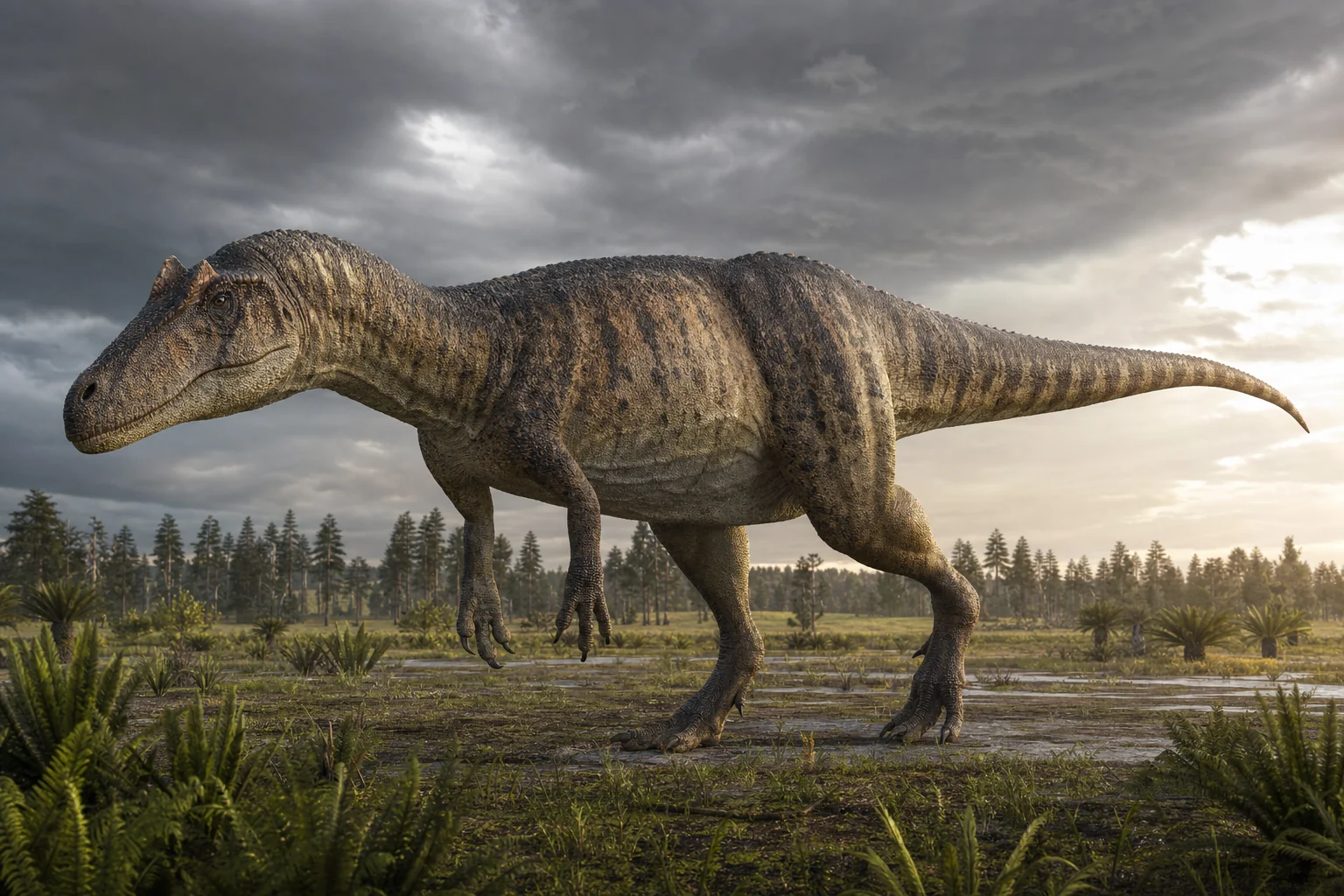 View full-resolution reconstruction ↗
This is an original generative reconstruction, not a photograph or scientific plate. Measurements and interpretations below are tied to named sources.
01 / FOSSIL SAMPLE
Why is Allosaurus unusually measurable?
Dozens of individuals from the Morrison Formation preserve juveniles, adults and many body regions. The sample reveals variation but also mixes age, deformation and possibly more than one species.
02 / SIZE
How big was a typical adult?
Many adults fall near eight to nine metres and roughly 1.5–2.5 tonnes. Famous specimens above ten metres represent upper individuals, not the default body plan.
03 / SKULL
What were the brow crests for?
Paired lacrimal crests rose above the eyes and differed among individuals. Display is plausible, while direct combat, sex identification and colour remain unproven.
04 / JAWS
Was the skull weak?
The skull was lighter than a tyrannosaur's but braced for repeated loading. Moderate bite force combined with a wide gape, neck muscles and slicing teeth rather than relying on one crushing bite.
05 / ARMS
Could the arms grasp prey?
Three clawed fingers and strong flexor attachments support grasping or holding at close range. Reach was limited, and fossils do not show the arms acting alone as the killing mechanism.
06 / GROWTH
How did the body change with age?
Bone histology records years of rapid growth before adult slowing. Juveniles were lighter and relatively long-legged, so one silhouette should not represent every life stage.
FREQUENTLY ASKED QUESTIONS
Questions readers ask
How large was Allosaurus?
Typical adults were roughly 8–10 metres and 1.5–3 tonnes.
Was it bigger than T. rex?
No. Typical Allosaurus was substantially smaller and lighter.
How many fingers did it have?
Three clawed fingers on each hand.
Did it hunt Stegosaurus?
Bite traces show interaction and feeding, but do not identify every encounter as a live hunt.
Did it hunt in packs?
Coordinated pack hunting remains unproven.
What was Big Al?
A subadult Allosaurus skeleton with numerous healed and active injuries.
SOURCES & FURTHER READING
Evidence used in this guide
Measurements and interpretations are tied to museum resources or peer-reviewed studies; disputed conclusions include evidence on both sides.
- 01Allosaurus ↗Natural History Museum, London
Museum synthesis of size, prey evidence, pack uncertainty and taxonomy.
- 02Multibody dynamics model of Allosaurus feeding ↗Palaeontologia Electronica · DOI 10.26879/338
CT-based head and neck model testing feeding movements.
- 03Cranial anatomy of Allosaurus jimmadseni ↗PeerJ · PMC6984342
Detailed skull anatomy, specimens and revised species context.