
ALLOSAURUS TOPIC HUB · FEEDING
How Did Allosaurus Hunt, Bite and Feed?
Use skull mechanics, tooth marks, injuries and prey remains to test hatchet-bite, pack-hunting and sauropod-attack claims.
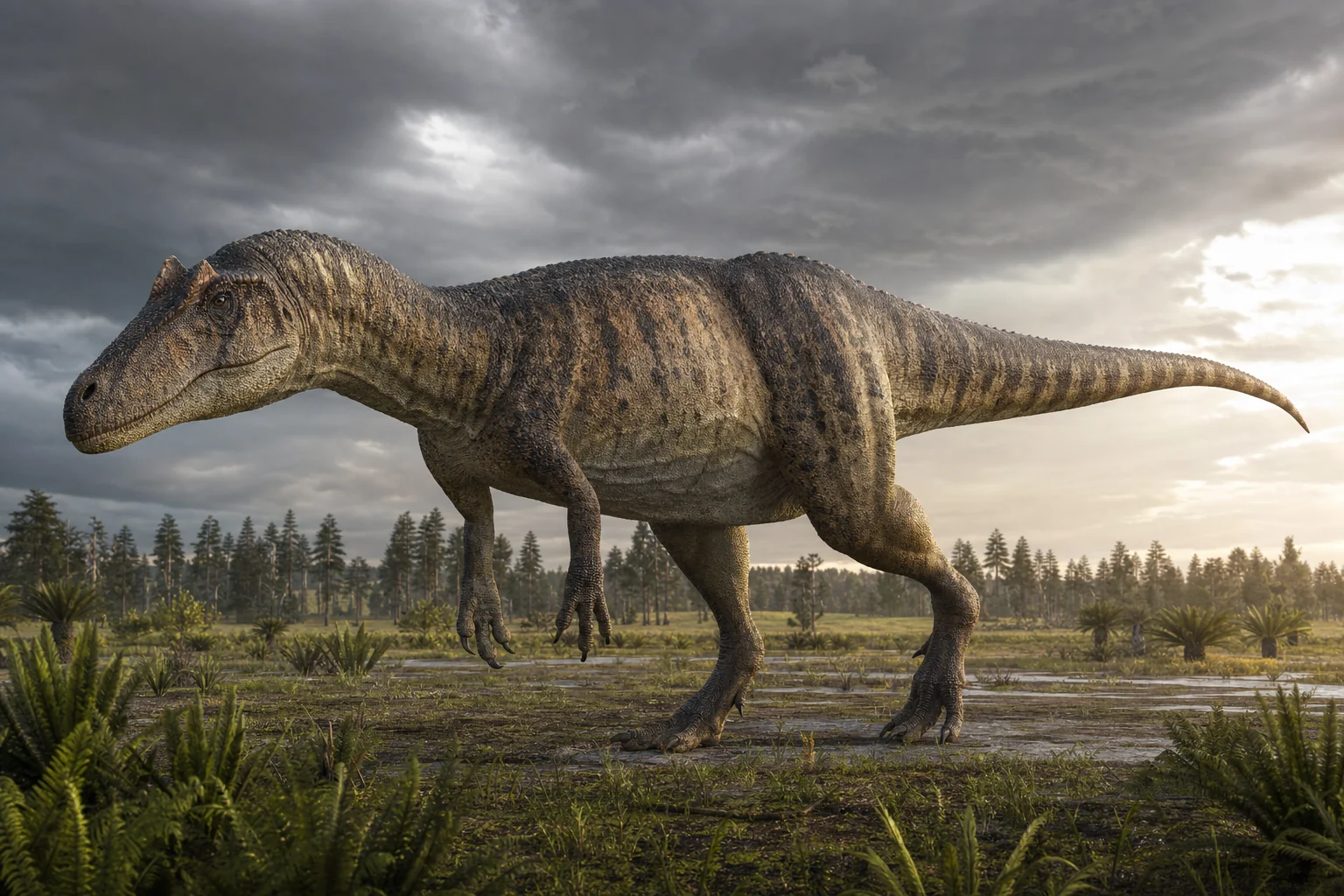 View full-resolution reconstruction ↗
This is an original generative reconstruction, not a photograph or scientific plate. Measurements and interpretations below are tied to named sources.
01 / BITE
How powerful was the bite?
Finite-element and muscle models suggest a lower raw bite force than giant tyrannosaurids. That does not mean poor feeding performance: tooth sharpness, gape and repeated cuts matter.
02 / HATCHET MODEL
Did it swing the upper jaw like a hatchet?
Some models found the skull could tolerate vertical loading and proposed neck-driven strikes. Later work favours a broader range of pulling and biting behaviours; a literal high-speed hatchet blow is not directly observed.
03 / PREY
What did Allosaurus eat?
Allosaurus tooth marks occur on sauropod and stegosaur bones, and shed teeth occur at feeding sites. Marks prove carcass access, but cannot always separate hunting from scavenging.
04 / SAUROPODS
Could one attack a giant sauropod?
Adults could wound juveniles or vulnerable individuals and feed on large carcasses. Evidence does not require routinely killing healthy full-grown giants alone.
05 / SOCIAL HUNTING
Did Allosaurus hunt in packs?
Multiple individuals at sites such as Cleveland-Lloyd show aggregation, not necessarily cooperative packs. Drought, traps, carcasses or repeated visits can concentrate predators without wolf-like teamwork.
06 / INJURIES
What do healed wounds reveal?
Broken ribs, infected feet and healed skull injuries show risky lives and survival after trauma. They document resilience and contact, but usually cannot identify the opponent or exact behaviour.
FREQUENTLY ASKED QUESTIONS
Questions readers ask
How large was Allosaurus?
Typical adults were roughly 8–10 metres and 1.5–3 tonnes.
Was it bigger than T. rex?
No. Typical Allosaurus was substantially smaller and lighter.
How many fingers did it have?
Three clawed fingers on each hand.
Did it hunt Stegosaurus?
Bite traces show interaction and feeding, but do not identify every encounter as a live hunt.
Did it hunt in packs?
Coordinated pack hunting remains unproven.
What was Big Al?
A subadult Allosaurus skeleton with numerous healed and active injuries.
SOURCES & FURTHER READING
Evidence used in this guide
Measurements and interpretations are tied to museum resources or peer-reviewed studies; disputed conclusions include evidence on both sides.
- 01Allosaurus ↗Natural History Museum, London
Museum synthesis of size, prey evidence, pack uncertainty and taxonomy.
- 02Multibody dynamics model of Allosaurus feeding ↗Palaeontologia Electronica · DOI 10.26879/338
CT-based head and neck model testing feeding movements.
- 03Cranial anatomy of Allosaurus jimmadseni ↗PeerJ · PMC6984342
Detailed skull anatomy, specimens and revised species context.