
Explore this animal in Size of Extinct Animals ↗
56 / Mesozoic
Pteranodon
Pteranodon longiceps
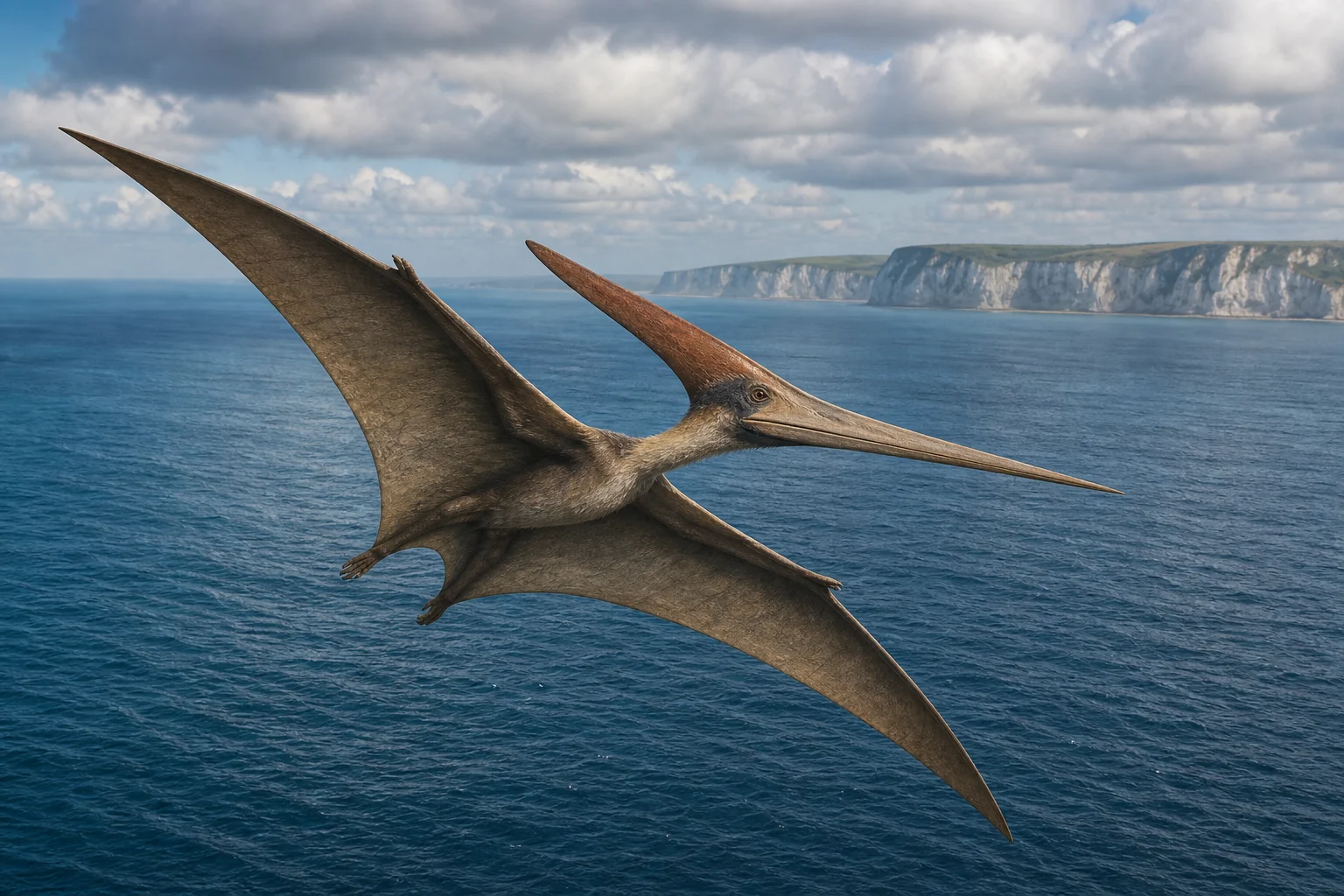
Pteranodon was a toothless pterosaur above the Late Cretaceous seas of North America. It was a flying reptile, not a bird or a dinosaur.
 View original image · 1536 × 1024
Structured expansion · editorial review pending
- Time range
- About 86–84 million years ago
- Final stage
- Late Cretaceous
- Geographic range
- Western Interior Seaway of North America
01 / ANSWER FIRST
What does the evidence show about Pteranodon?
Pteranodon was a toothless pterosaur above the Late Cretaceous seas of North America. It was a flying reptile, not a bird or a dinosaur.
Its long crest and membranous wings are familiar, but fish remains provide more direct evidence of diet than an illustration of a hunting dive.
02 / QUICK FACTS
Pteranodon at a glance
- Scientific name
- Pteranodon longiceps
- Research focus
- Toothless beak
03 / ANATOMY
How was Pteranodon built?
Toothless beak
Pteranodon's jaws lacked teeth. The backward-projecting crest is especially recognizable in P. longiceps.
A finger-supported wing
A greatly elongated fourth finger supported the outer wing membrane, unlike a bird's feathered wing.
04 / DIET & BEHAVIOUR
Fish as food
NHM reports fish remains among fossilized stomach contents attributed to Pteranodon.
05 / DIET & BEHAVIOUR
Soaring over water
Long wings fit reconstructions of marine soaring. The exact takeoff and capture techniques are behavioral interpretations.
06 / RANGE & HABITAT
Where and when did Pteranodon live?
Kansas was beside and beneath an inland sea when the fossils formed. AMNH places P. longiceps at about 85 million years ago.
07 / FOSSIL EVIDENCE
What evidence supports reconstructions of Pteranodon?
Kansas discoveries
The early western Kansas finds established a very large pterosaur, later surpassed in known wingspan by other discoveries.
Diet versus technique
Stomach contents support fish eating; they do not alone distinguish diving, surface capture or scavenging.
08 / DISAPPEARANCE & DEBATE
What remains uncertain?
P. longiceps predates the end-Cretaceous crisis. Its disappearance must be separated from the later extinction of all surviving pterosaurs.
The linked sources support the specific observations above. An occurrence record alone does not identify an extinction mechanism.
09 / FREQUENTLY ASKED QUESTIONS
Pteranodon FAQ
Was it a flying dinosaur?
No. Pterosaurs form a separate reptile lineage from dinosaurs.
Did its beak contain teeth?
No; Pteranodon had toothless jaws.
04 / SOURCES & FURTHER READING
Check the source record
Use the scientific name to compare taxonomy, occurrence records and the fossil record. Database coverage and classifications may differ.
05 / REVISION HISTORY
How has this record changed?
- Replaced repeated expansion text with specimen-specific evidence, linked research and explicit limits; independent editorial review is pending.
- Completed an AI-assisted bilingual audit of the archive record, corrected identified issues and clarified evidence limits; independent editorial review is pending.
- Expanded into a structured bilingual profile with anatomy, ecology, range, evidence, debate and FAQs; independent editorial review is pending.
- Verified authoritative entity sources and added three responsive reconstruction sizes.
- Initial bilingual species record published.
06 / CORRECTIONS & ADDITIONS