Giants of deep time
Largest Flying Animals Ever: Wingspan Estimates
Compare the giant pterosaur Quetzalcoatlus with Pelagornis, Argentavis and Teratornis. Published wingspan estimates show both the scale of these animals and the uncertainty in reconstructing flight.
Explore the animals 4 ↘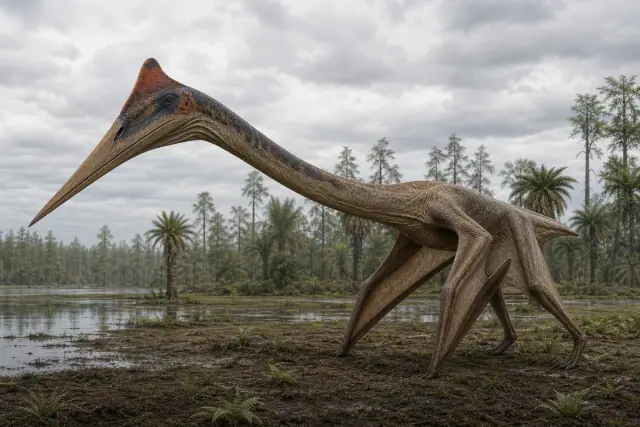
How this list was selected
Selected large flyers with published wingspan estimates, ordered by the upper cited value. Ranges overlap, so this does not establish a definitive winner among birds. Argentavis uses the 7 m flight-model estimate; Teratornis spans the text estimate and model value in that paper. Wingspan is not body length or mass. Pterosaurs were flying reptiles, not birds or dinosaurs; the list is not exhaustive.
What were the biggest flying dinosaurs?
This question often points to Quetzalcoatlus, but it was a pterosaur: a flying reptile outside Dinosauria. Birds are living dinosaurs, so Pelagornis and Argentavis belong to the dinosaur branch in a way that pterosaurs do not. Compare the wingspan estimates below within each group; overlapping estimates cannot establish one definitive largest bird, and wingspan does not measure weight.
In this guide 4
Explore the animals
4 atlas recordsAbout 68–66 million years ago
Quetzalcoatlus
Quetzalcoatlus northropi
Estimated wingspan≈ 10–11 mOne of the largest known flying animals stood as tall as a giraffe on the ground.
Inland wetlands of North America
Natural History Museum of Los Angeles County — Pterosaurs ↗
About 25–24 million years ago
Sanders's Pelagornis
Pelagornis sandersi
Estimated wingspan≈ 6.4–7.4 mIts estimated wingspan exceeded six meters, while bony pseudoteeth lined a beak adapted to slippery marine prey.
North Atlantic coasts and open ocean · Southeastern USA
The Charleston Museum — Pelagornis sandersi ↗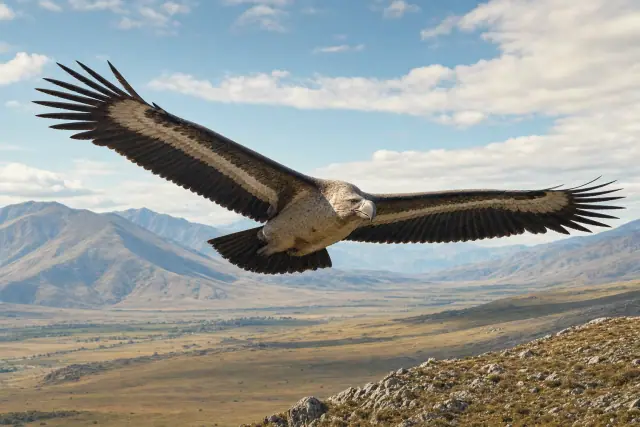
About 8–6 million years ago
Argentavis
Argentavis magnificens
Estimated wingspan≈ 7 mArgentavis magnificens was a giant bird from Late Miocene Argentina. Its flight is reconstructed from incomplete fossils and aerodynamic models, not observations of a living bird.
South America · Present-day Argentina
Chatterjee et al. (2007), PNAS — Argentavis flight model ↗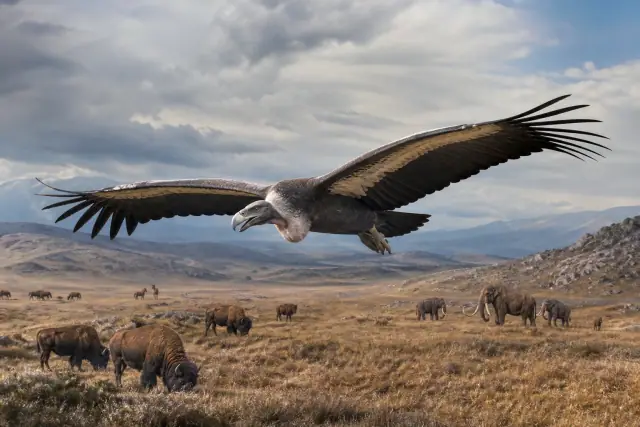
About 2.5 million–11,000 years ago
Teratornis
Teratornis merriami
Estimated wingspan≈ 3.5–3.93 mA large soaring bird with an estimated 11–12 ft wingspan; its diet involved more than a simple vulture comparison.
Grassland and open woodland · North America
Chatterjee et al. (2007), PNAS — text and Table 1 ↗