
QUETZALCOATLUS TOPIC HUB · SIZE & FLIGHT
Quetzalcoatlus Size, Wingspan and Flight
How big was Quetzalcoatlus? Separate the giant Q. northropi wing, smaller Q. lawsoni skeletons, wingspan scaling, mass, wing loading and flight evidence.
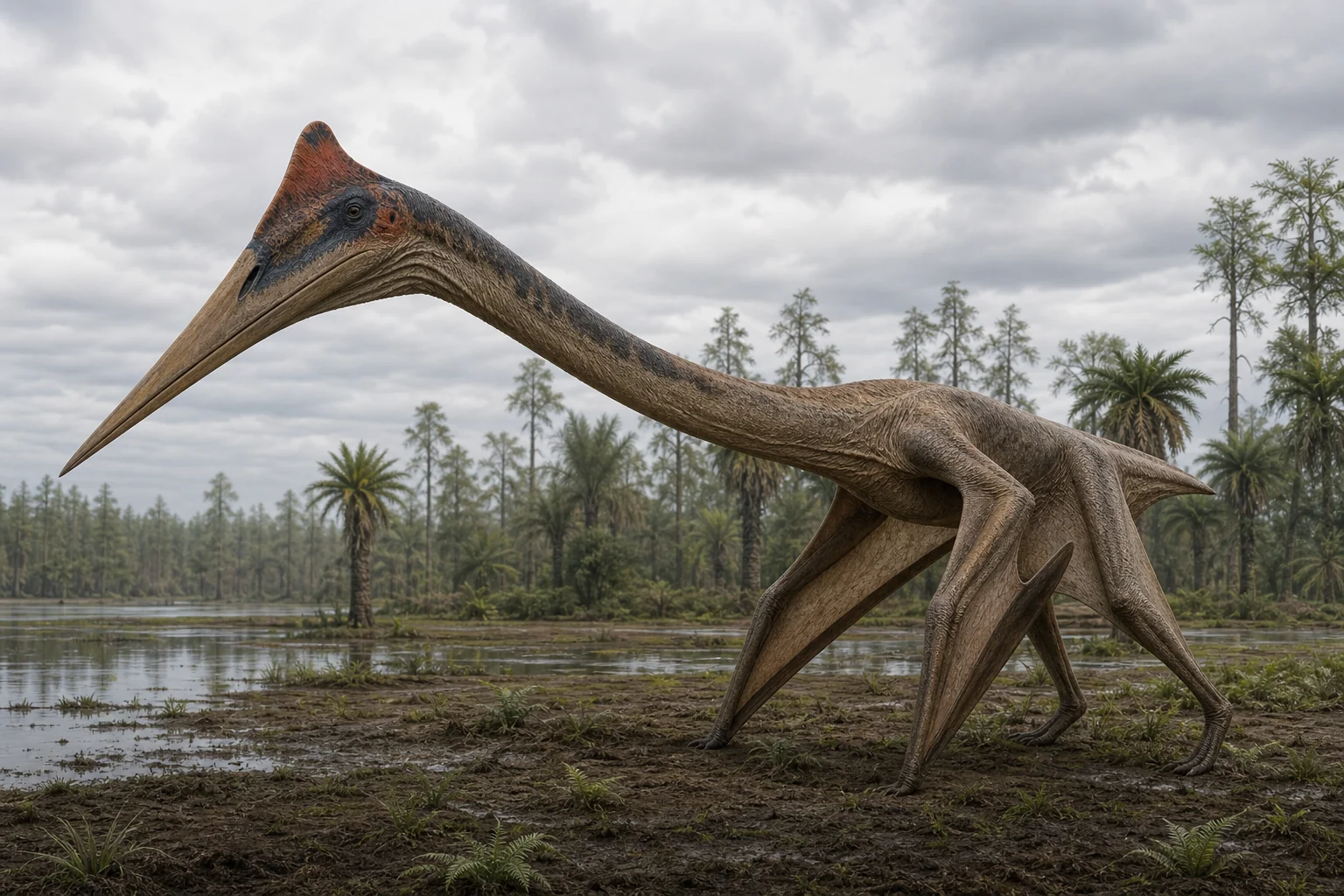 View full-resolution reconstruction ↗
This is an original generative reconstruction, not a photograph or scientific plate. Measurements and interpretations below are tied to named sources.
01 / FOSSIL SAMPLE
Why is the giant species incomplete?
The Q. northropi holotype is dominated by enormous wing elements apparently separated from the body before burial. Smaller associated skeletons preserve far more of the skull, neck and limbs and were named Q. lawsoni in 2021. Reconstructions must disclose when smaller-species anatomy fills gaps in the giant.
02 / WINGSPAN
Where does 10–11 metres come from?
Researchers compare the dimensions of giant humerus and wing bones with better-known azhdarchids. Different assumed proportions produce estimates around ten to eleven metres, while older values near twelve metres are less favoured. Because the complete left-to-right wing is absent, every precise decimal would overstate the fossil.
03 / BODY MASS
How heavy could a giant pterosaur be?
Volumetric models combine reconstructed torso volume, tissue density and air-filled regions. Values around 200–250 kilograms are common orientations, but alternative body depths and soft tissues widen the range. The frequently repeated idea that pterosaurs had to be extremely light is not required by modern launch mechanics.
04 / FLIGHT APPARATUS
What anatomy supports flight?
The shoulder, reinforced humerus, elongated fourth finger and broad membrane attachment belong to an active flier, not a vestigial-winged walker. Pneumatic bones reduce skeletal mass while strong forelimbs serve both terrestrial support and launch. Missing membrane outlines leave exact wing shape uncertain.
05 / FLIGHT PERFORMANCE
Did Quetzalcoatlus soar across continents?
Large wings could exploit rising air and reduce the energetic cost of travel, but performance depends on mass, wing area, wind and launch assumptions. Some models predict efficient soaring; others emphasize limited low-altitude flapping or sensitivity to gusts. Fossils confirm capacity better than daily range.
06 / RECONSTRUCTION
What should an accurate giant look like?
Show a giraffe-height quadruped with a long stiff neck, toothless pointed skull, compact torso, folded wing fingers on land and a roughly 10–11 metre membrane span in flight. Keep the body robust enough for powerful launch muscles while retaining thin-walled bones. Crest, colour and exact membrane trailing edge are uncertain.
FREQUENTLY ASKED QUESTIONS
Questions readers ask
Was Quetzalcoatlus a dinosaur?
No. It was a pterosaur, a separate branch of flying reptiles.
What was its wingspan?
The giant species is commonly estimated at roughly 10–11 metres.
Could it really fly?
Wing anatomy strongly supports flight, although launch method and performance remain debated.
Did it skim fish from the sea?
Habitual skim-feeding is poorly supported; inland terrestrial foraging is a leading model.
How tall was it on the ground?
Its head could reach roughly giraffe-like height, depending on posture and the individual.
Why are giant fossils incomplete?
Thin-walled flight bones break easily and the original giant specimen preserved mostly a detached wing.
SOURCES & FURTHER READING
Evidence used in this guide
Measurements and interpretations are tied to museum resources or peer-reviewed studies; disputed conclusions include evidence on both sides.
- 01Pterosaurs in Big Bend ↗U.S. National Park Service
Official discovery, locality and fossil overview for Quetzalcoatlus.
- 02Functional morphology of Quetzalcoatlus ↗Journal of Vertebrate Paleontology
Peer-reviewed synthesis of anatomy, walking, feeding, launch and flight.
- 03Quadrupedal water launch capability demonstrated in small Late Jurassic pterosaurs ↗Scientific Reports
Comparative experimental context for four-limbed pterosaur launch models.