
Explore this animal in Size of Extinct Animals ↗
14 / Mesozoic
Mosasaurus
Mosasaurus hoffmannii
A giant marine lizard propelled by a deep tail fin patrolled Late Cretaceous seas.
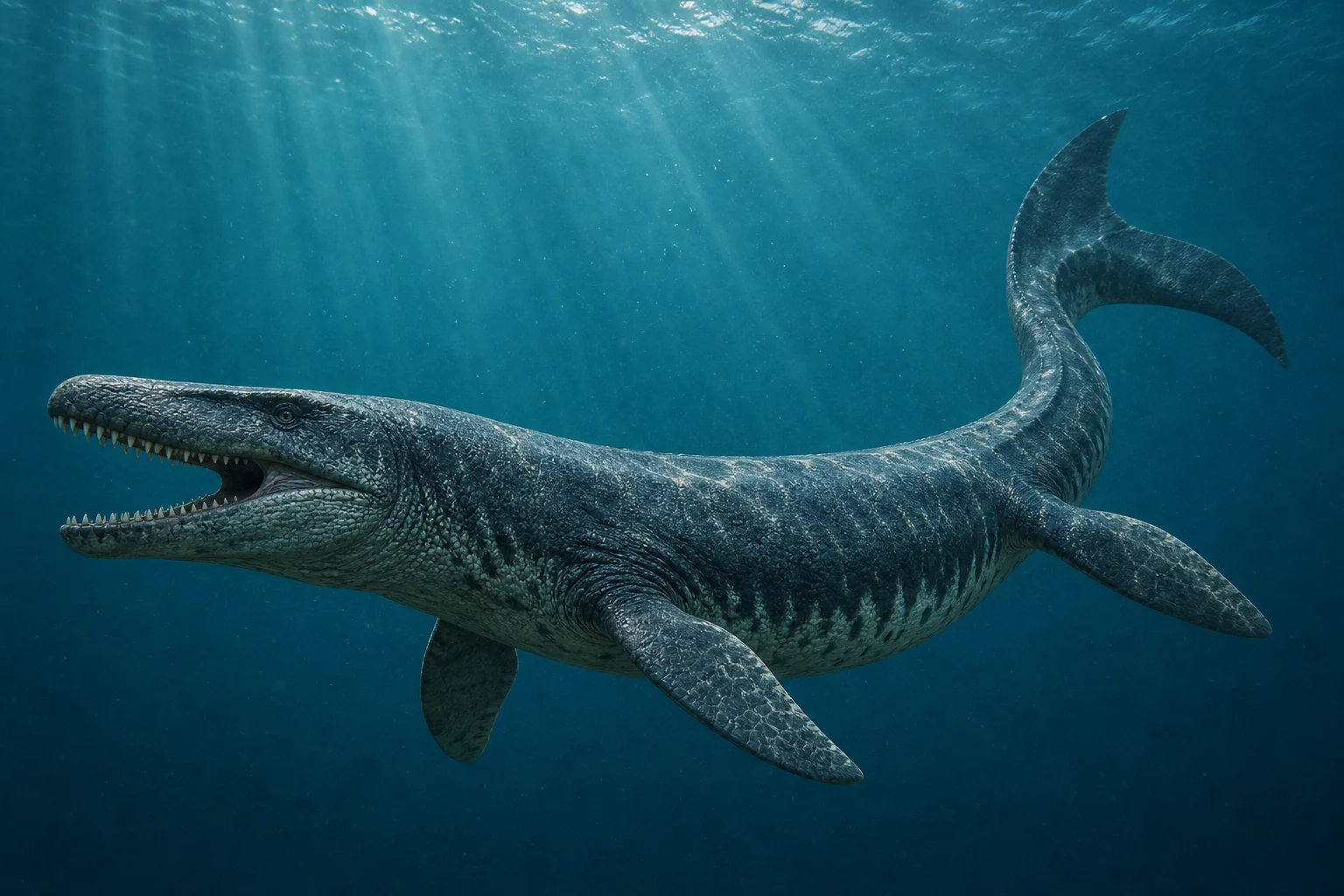 View original image · 1536 × 1024
- Time range
- About 82–66 million years ago
- Final stage
- End of the Cretaceous
- Geographic range
- Europe · North America · Open oceans
01 / ANSWER FIRST
What was Mosasaurus?
Mosasaurus was a giant fully marine squamate—a relative of lizards and snakes, not a dinosaur—that hunted in Late Cretaceous seas.
Its long skull, mobile jaws, backward-curving teeth, four flippers and powerful fluked tail formed a highly specialised open-water predator. Complete bodies are rare, so famous 17–18 metre claims remain less secure than estimates near 11–12 metres for large M. hoffmannii.
02 / QUICK FACTS
Mosasaurus at a glance
- Scientific name
- Mosasaurus hoffmannii
- Age
- About 82–66 million years ago
- Likely large-adult length
- About 11–12 m; larger values debated
- Animal group
- Marine squamate reptile
- Diet
- Fish, turtles, ammonites, birds and marine reptiles
- Range
- Atlantic and adjacent Late Cretaceous seas
- Swimming
- Tail-driven with four steering flippers
- Extinction
- K–Pg mass extinction, 66 Ma
03 / CORE QUESTION
How big was Mosasaurus—and did it resemble the movie animal?
Mosasaurus hoffmannii had a skull approaching two metres in the largest material, but total length must be scaled from incomplete skeletons and related mosasaurs. Published proportions support a very large animal without requiring blue-whale dimensions.
Rare soft tissues in derived mosasaurs show a bilobed tail fin and a streamlined trunk. The body was more shark-like in swimming performance than the long eel-like shape common in older art.
Read the complete size, anatomy and movie-myth guideHow to read the numbers
This page separates direct evidence, comparative inference and unresolved debate.
04 / LIFE & DISCOVERY TIMELINE
From Maastricht discovery to a modern swimmer
First famous skull
Quarry workers near Maastricht exposed one of the earliest celebrated large-vertebrate fossils.
Mosasaurus named
The genus name means ‘Meuse lizard’, reflecting its Dutch discovery region.
Tail-fin evidence
A soft-tissue mosasaur confirmed a hypocercal bilobed fluke in derived forms.
Ocean crisis
The K–Pg impact ended Mosasaurus and every other mosasaur lineage.
05 / ANATOMY
A lizard rebuilt for the ocean
Kinetic skull
Mobile joints let parts of the skull flex while recurved teeth controlled struggling prey.
Palatal teeth
Extra teeth on the roof of the mouth helped move slippery prey backwards.
Four flippers
Flattened limbs steered and stabilised rather than supplying the main thrust.
Tail fluke
A down-bent vertebral tip supported an asymmetric two-lobed propulsive fin.
06 / DIET & BEHAVIOUR
What did Mosasaurus eat?
Mosasaurus was carnivorous, with fish consumption documented in M. missouriensis. Broader lists of turtles, birds and marine reptiles combine records from other mosasaur genera and are not all direct evidence for M. hoffmannii.
Read the complete guide07 / DIET & BEHAVIOUR
How did it hunt?
A powerful tail delivered acceleration while the jaws seized and held prey. Ambush, pursuit and scavenging probably varied with prey and setting; no fossil records one universal sequence.
08 / RANGE & HABITAT
Where did Mosasaurus live?
Mosasaurus fossils occur around the Atlantic realm and neighbouring epicontinental seas during the final Cretaceous.
Maastricht seas
Chalk and limestone in the Netherlands and Belgium preserve classic M. hoffmannii material.
North Atlantic margins
European and North American finds trace connected warm marine habitats.
North African coasts
Moroccan phosphate deposits preserve diverse mosasaurs and abundant prey.
Open and shelf seas
Its anatomy supports capable offshore swimming, though many fossils accumulated on productive shelves.
09 / FOSSIL EVIDENCE
What evidence reconstructs Mosasaurus?
Skulls and teeth
They provide direct feeding anatomy but can exaggerate certainty about total body length.
Associated skeletons
Partial trunks and tails constrain proportions better than isolated jaws.
Soft-tissue relatives
A related derived mosasaur preserves the first indisputable tail-fluke outline.
Bite and gut evidence
Damaged shells, bones and stomach remains reveal diet without proving hunting method in every case.
10 / DISAPPEARANCE & DEBATE
Why did Mosasaurus go extinct?
Mosasaurus disappeared in the end-Cretaceous mass extinction 66 million years ago.
Impact-driven darkness and cooling collapsed marine photosynthesis and food webs. Large specialist predators could not survive the resulting loss of prey and ecosystem structure; no mosasaur lineage crossed the boundary.
12 / FREQUENTLY ASKED QUESTIONS
Mosasaurus FAQ
Was Mosasaurus a dinosaur?
No. It was a marine squamate reptile, part of the wider lizard-and-snake lineage.
How big was Mosasaurus?
Large M. hoffmannii is defensibly reconstructed around 11–12 metres; 17–18 metre values remain debated.
Did it have a tail fin?
Yes. Soft tissue in a derived relative confirms a bilobed fluke supported by a downturned tail tip.
Could it swallow a T. rex?
No evidence supports that cinematic scale or encounter; the animals occupied different habitats.
What did it eat?
Fish consumption is documented in M. missouriensis. The broader mosasaur family exploited many other prey types, but these records are not all from M. hoffmannii.
Why did it go extinct?
The K–Pg impact disrupted marine production and food webs; all mosasaurs vanished at the boundary.
04 / SOURCES & FURTHER READING
Check the source record
Use the scientific name to compare taxonomy, occurrence records and the fossil record. Database coverage and classifications may differ.
05 / REVISION HISTORY
How has this record changed?
- Expanded answers to reader questions, clarified the scope of fossil evidence and improved routes to related explanations.
- Upgraded to a bilingual S-tier topic hub with two independent evidence guides.
- Verified authoritative entity sources and added three responsive reconstruction sizes.
- Initial bilingual species record published.
06 / CORRECTIONS & ADDITIONS