
QUETZALCOATLUS TOPIC HUB · LOCOMOTION & DIET
How Did Quetzalcoatlus Walk, Launch and Feed?
Evidence for Quetzalcoatlus locomotion and diet: quadrupedal gait, rival launch models, inland floodplains, terrestrial stalking and limits of skim-feeding scenes.
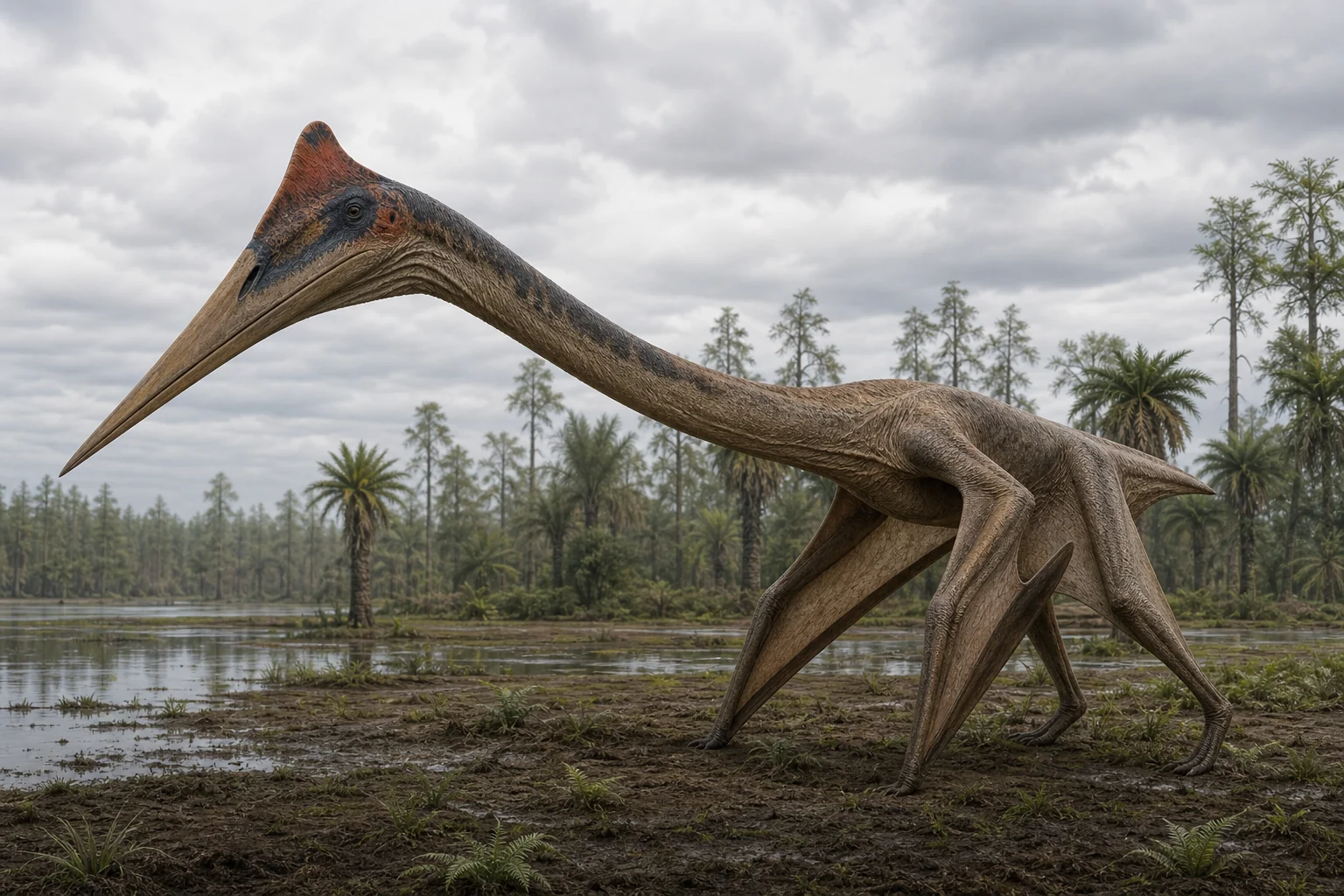 View full-resolution reconstruction ↗
This is an original generative reconstruction, not a photograph or scientific plate. Measurements and interpretations below are tied to named sources.
01 / WALKING
How did folded wings become front legs?
On land, pterosaurs placed the hind feet and the knuckle region of the folded wing on the ground. Joint surfaces and trackways support an erect, coordinated quadrupedal gait. Long limbs gave Quetzalcoatlus a large stride and kept the body clear of vegetation without turning it into a bipedal dinosaur.
02 / FOURLIMB MODEL
What is quadrupedal vault launch?
This model stores elastic and muscular work in the strong forelimbs, which vault the body upward after a hind-limb impulse. The wings then unfold into the first downstroke. It explains why pterosaur forelimb bones are disproportionately strong and avoids demanding bird-like hind limbs from a much larger animal.
03 / BIPEDAL MODEL
Why did the 2021 monograph favour a jump?
Its authors argued that the long wings needed clearance before a full stroke and reconstructed a standing hind-limb jump followed by rapid wing deployment. Critics note that the required vertical leap and forelimb proportions may favour a four-limbed alternative. Neither sequence is preserved as a trace fossil tied to Quetzalcoatlus.
04 / HABITAT
Why does Big Bend geology matter?
Javelina Formation bones occur in river-channel and floodplain deposits far from open marine settings. That does not forbid flight to water, but it makes an exclusively oceanic skimmer ecology unlikely. Terrestrial prey, carrion, pools and channel margins were all available within its home landscape.
05 / FEEDING
What could the toothless beak capture?
Azhdarchid proportions support walking while visually locating small vertebrates, large invertebrates or carrion and seizing them with the long jaws. Aquatic prey could also be picked from shallow water. Repeated high-speed skim-feeding would load the long neck and jaw and lacks specialised anatomical support.
06 / EVIDENCE LIMITS
What can we say without inventing behaviour?
Quetzalcoatlus was a competent quadrupedal walker, an anatomically flight-capable pterosaur and an inland predator or scavenger with a versatile toothless beak. State launch and prey choice as competing hypotheses, not documentary footage. Trackways, more complete giant bones or preserved stomach contents could change the balance.
FREQUENTLY ASKED QUESTIONS
Questions readers ask
Was Quetzalcoatlus a dinosaur?
No. It was a pterosaur, a separate branch of flying reptiles.
What was its wingspan?
The giant species is commonly estimated at roughly 10–11 metres.
Could it really fly?
Wing anatomy strongly supports flight, although launch method and performance remain debated.
Did it skim fish from the sea?
Habitual skim-feeding is poorly supported; inland terrestrial foraging is a leading model.
How tall was it on the ground?
Its head could reach roughly giraffe-like height, depending on posture and the individual.
Why are giant fossils incomplete?
Thin-walled flight bones break easily and the original giant specimen preserved mostly a detached wing.
SOURCES & FURTHER READING
Evidence used in this guide
Measurements and interpretations are tied to museum resources or peer-reviewed studies; disputed conclusions include evidence on both sides.
- 01Pterosaurs in Big Bend ↗U.S. National Park Service
Official discovery, locality and fossil overview for Quetzalcoatlus.
- 02Functional morphology of Quetzalcoatlus ↗Journal of Vertebrate Paleontology
Peer-reviewed synthesis of anatomy, walking, feeding, launch and flight.
- 03Quadrupedal water launch capability demonstrated in small Late Jurassic pterosaurs ↗Scientific Reports
Comparative experimental context for four-limbed pterosaur launch models.