
Explore this animal in Size of Extinct Animals ↗
39 / Paleozoic
Scutosaurus
Scutosaurus karpinskii
A barrel-bodied herbivore carried bony armor beneath its skin.
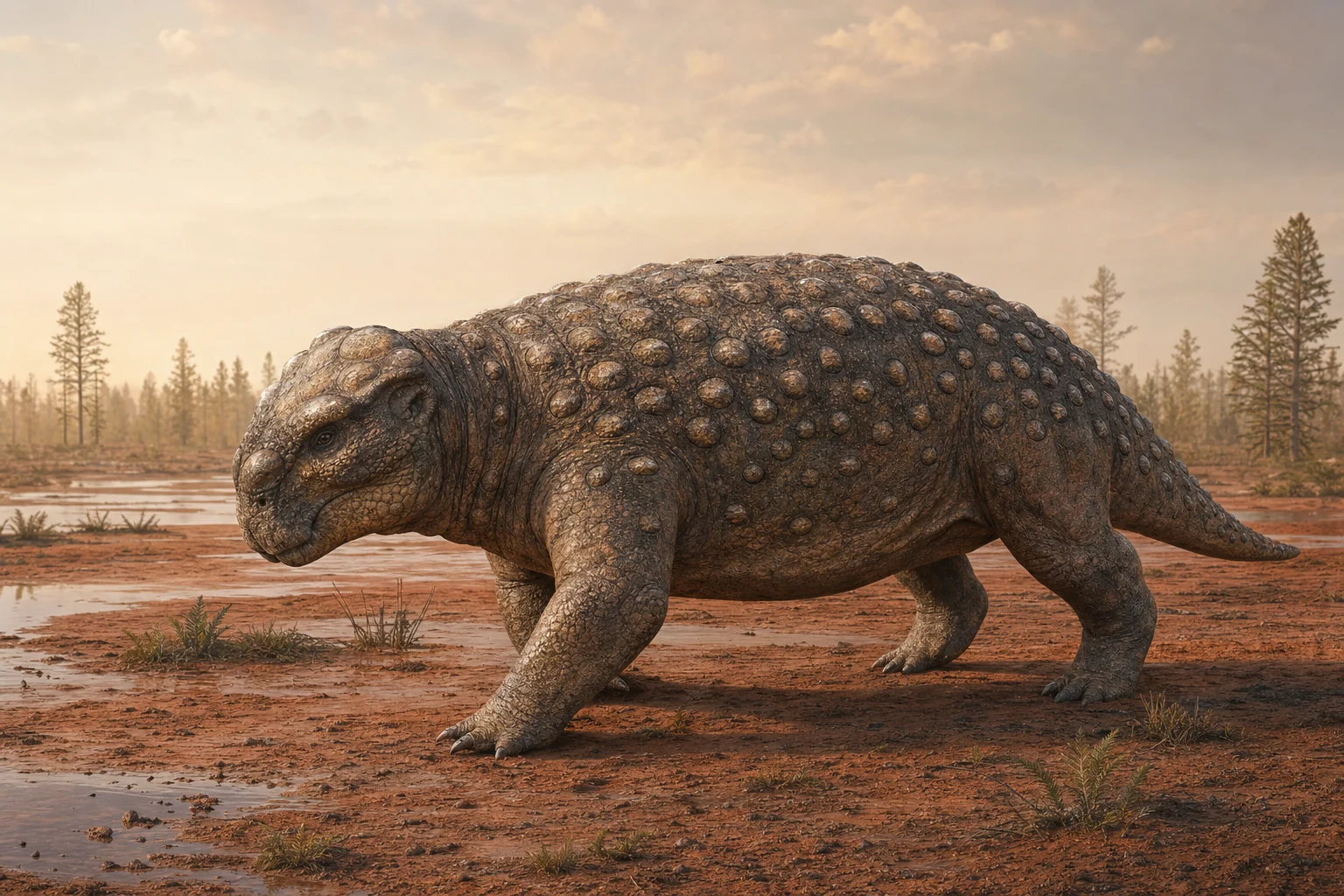 View original image · 1536 × 1024
- Time range
- About 259–252 million years ago
- Final stage
- End of the Permian
- Geographic range
- Northern Pangaea · Present-day Russia
01 / ANSWER FIRST
What was Scutosaurus?
Scutosaurus was a large barrel-bodied pareiasaur herbivore with bony nodules in its skin, living on latest Permian floodplains of European Russia.
Despite its Chinese common name ending in 'dragon', it was neither a dinosaur nor a mammal-line synapsid. It belonged to Parareptilia and combined a broad skull, heavy trunk, robust limbs and scattered osteoderms rather than a continuous turtle shell.
02 / QUICK FACTS
Scutosaurus at a glance
- Scientific name
- Scutosaurus karpinskii
- Age
- Latest Permian, about 259–252 Ma
- Group
- Pareiasaur parareptile
- Length
- About 2.5–3 m
- Diet
- Low vegetation
- Range
- European Russia
- Armor
- Separate skin osteoderms
- Extinction
- End-Permian crisis
03 / ANATOMY
A heavy herbivore protected by skin bone
Broad ornamented skull
Bosses and projections strengthened a deep skull and provided identification features, though they were not a single solid helmet.
Leaf-shaped teeth
Crowned edges cropped and shredded vegetation; the jaws were built for repeated plant processing rather than a mammal-like chewing stroke.
Scattered osteoderms
Bony nodules embedded in skin added protection while retaining more flexibility than a fused carapace.
Robust limbs
Heavy limb bones and broad feet supported a large gut required to ferment fibrous plants.
04 / DIET & BEHAVIOUR
What did Scutosaurus eat?
Its beak-like front and leaf-shaped teeth fit low-growing plants. A large abdomen likely housed a long digestive tract, but exact plant species are not preserved in direct stomach contents.
05 / DIET & BEHAVIOUR
Did armor stop predators?
Osteoderms and a thick skull raised the cost of attack, but vulnerable neck, limb and belly regions remained. Large gorgonopsians such as Inostrancevia were plausible predators.
06 / RANGE & HABITAT
Where did Scutosaurus live?
Scutosaurus is best known from the North Dvina basin of European Russia, in seasonal continental deposits near the end of the Permian.
Dry floodplains
Seasonal rivers crossed broad plains that alternated between floods and drought.
Patchy vegetation
Plant food clustered near channels and wetter ground, shaping movement and herd concentration.
Multi-species assemblages
Dicynodonts, smaller tetrapods and gorgonopsian predators form the ecological context of the same rock sequence.
07 / FOSSIL EVIDENCE
What does the Scutosaurus fossil record preserve?
Skulls and skeletons
Multiple individuals provide proportions, growth differences and variation that isolated armor cannot reveal.
Osteoderms
Separate nodules document skin armor and show why it should not be reconstructed as a continuous turtle shell.
Tooth wear
Microscopic and gross wear support repeated plant processing and can reveal replacement patterns.
Stratigraphy
Rock-layer correlation tracks which pareiasaurs coexisted and how communities changed approaching the mass extinction.
08 / DISAPPEARANCE & DEBATE
Why did Scutosaurus go extinct?
Scutosaurus vanished in the end-Permian crisis as rapid warming, drought and vegetation collapse dismantled its terrestrial food web.
Large herbivores require abundant, reliable plant production. Volcanically driven climate and chemical disruption affected soils, rivers and vegetation, then propagated upward to predators.
09 / FREQUENTLY ASKED QUESTIONS
Scutosaurus FAQ
Was Scutosaurus a dinosaur?
No. It was a pareiasaur parareptile that lived before the first dinosaurs became established.
Did Scutosaurus have a shell?
It had separate bony skin nodules, not the fused dorsal and ventral shell of a turtle.
What ate Scutosaurus?
Large gorgonopsians such as Inostrancevia are plausible predators, although a direct kill association is not established.
How big was Scutosaurus?
Large adults are commonly reconstructed around 2.5–3 metres long with a heavy barrel-shaped body.
04 / SOURCES & FURTHER READING
Check the source record
Use the scientific name to compare taxonomy, occurrence records and the fossil record. Database coverage and classifications may differ.
05 / REVISION HISTORY
How has this record changed?
- Rewrote an extinction cause that presented environmental or faunal turnover as established; it is now given as context the record does not prove.
- Expanded into a curated bilingual A-tier profile with anatomy, ecology, range, evidence, debate and FAQs.
- Verified authoritative entity sources and added three responsive reconstruction sizes.
- Initial bilingual species record published.
06 / CORRECTIONS & ADDITIONS