
MOSASAURUS TOPIC HUB · SIZE & RECONSTRUCTION
Mosasaurus Size, Body Shape and Jurassic World Myths
How large was Mosasaurus hoffmannii? Compare complete skeletons, skull proportions, paddle limbs, tail evidence and its exaggerated movie version.
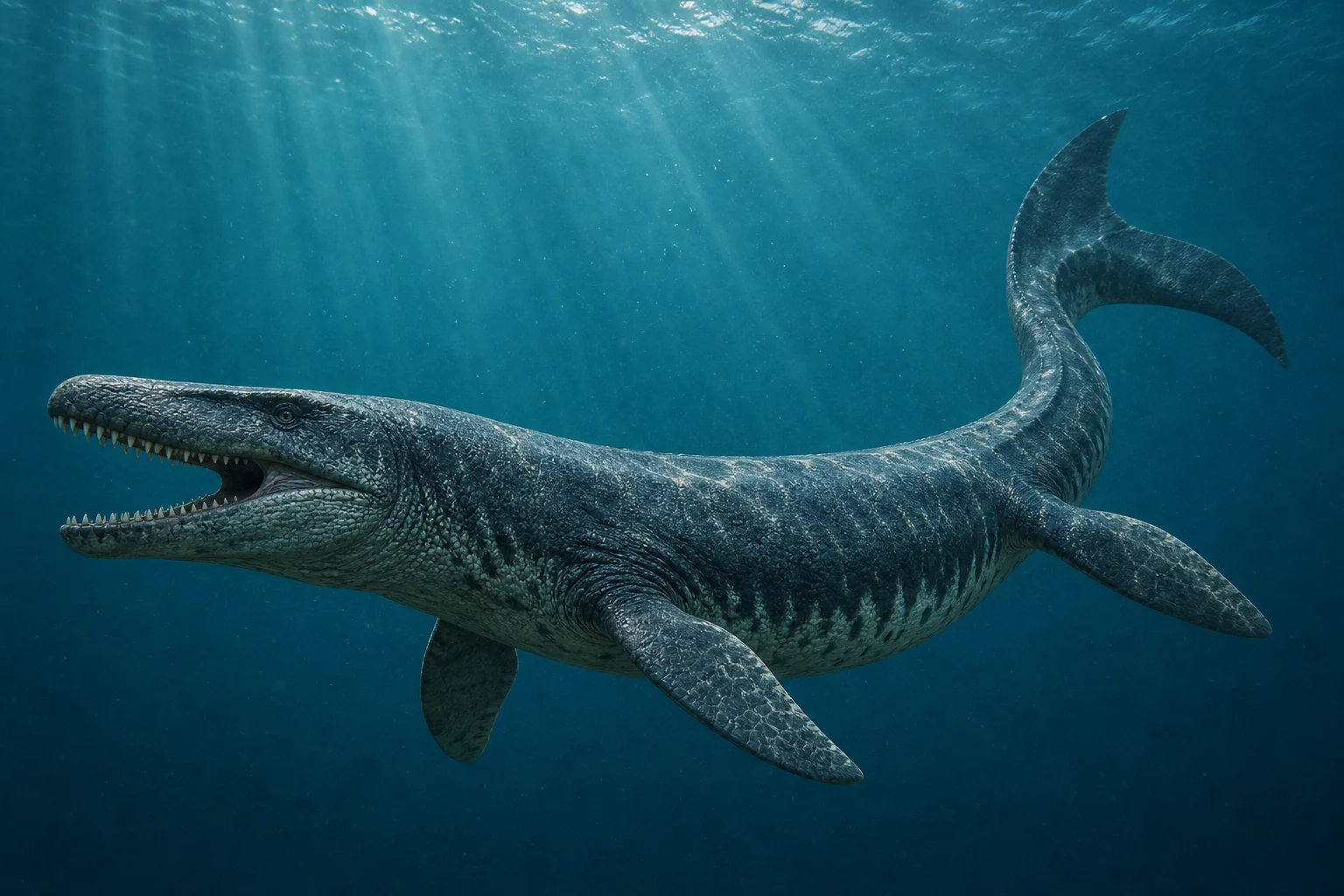 View full-resolution reconstruction ↗
This is an original generative reconstruction, not a photograph or scientific plate. Measurements and interpretations below are tied to named sources.
01 / SIZE
How big was Mosasaurus hoffmannii?
Well-proportioned skeletons support a large adult near 11–12 metres. Bigger figures usually scale isolated skulls or vertebrae, so they should be presented as uncertain extrapolations rather than measured bodies.
02 / BODY PLAN
What did the body look like?
Mosasaurus had an elongated trunk, a deep chest, four hydrofoil-like paddles and a powerful tail. Its limbs could steer but could not support normal walking on land.
03 / TAIL
Did Mosasaurus have a shark-like tail?
Soft-tissue outlines in related mosasaurs show a lower lobe supported by downturned tail vertebrae and an upper fleshy lobe. The exact outline in Mosasaurus remains reconstructed, but a simple snake-like tail is outdated.
04 / SKULL
Why was the skull so effective?
A long robust skull carried conical teeth on the jaws and palate. Flexible joints aided swallowing, but mosasaurs did not unhinge their jaws like a cartoon snake.
05 / MOVIE MYTH
Why is the Jurassic World animal too large?
The film changes scale between scenes and depicts an animal comparable to a large whale. Fossil-based reconstructions are still enormous, but substantially shorter and more slender than that cinematic version.
06 / EVIDENCE VERDICT
What is the responsible reconstruction?
Use articulated skeletons for proportions, related soft-tissue fossils for the tail and a plausible size range rather than one record number. Colour, dorsal contour and exact maximum length remain uncertain.
FREQUENTLY ASKED QUESTIONS
Questions readers ask
Was Mosasaurus a dinosaur?
No. It was a marine squamate reptile, part of the wider lizard-and-snake lineage.
How big was Mosasaurus?
Large M. hoffmannii is defensibly reconstructed around 11–12 metres; 17–18 metre values remain debated.
Did it have a tail fin?
Yes. Soft tissue in a derived relative confirms a bilobed fluke supported by a downturned tail tip.
Could it swallow a T. rex?
No evidence supports that cinematic scale or encounter; the animals occupied different habitats.
What did it eat?
Fish consumption is documented in M. missouriensis. The broader mosasaur family exploited many other prey types, but these records are not all from M. hoffmannii.
Why did it go extinct?
The K–Pg impact disrupted marine production and food webs; all mosasaurs vanished at the boundary.
SOURCES & FURTHER READING
Evidence used in this guide
Measurements and interpretations are tied to museum resources or peer-reviewed studies; disputed conclusions include evidence on both sides.
- 01What is a mosasaur? ↗Natural History Museum, London
Museum overview of taxonomy, size, discovery, ecology and movie myths.
- 02Soft tissue preservation in a fossil marine lizard with a bilobed tail fin ↗Nature Communications
Direct soft-tissue evidence for the tail fluke of a derived mosasaur.
- 03Mosasaurus hoffmannii ↗Paleobiology Database
Taxonomic and occurrence record for the focal species.