
Explore this animal in Size of Extinct Animals ↗
237 / Mesozoic
Plesiosaurus
Plesiosaurus dolichodeirus
Four long flippers flew through water while a long flexible neck carried the small head toward prey.
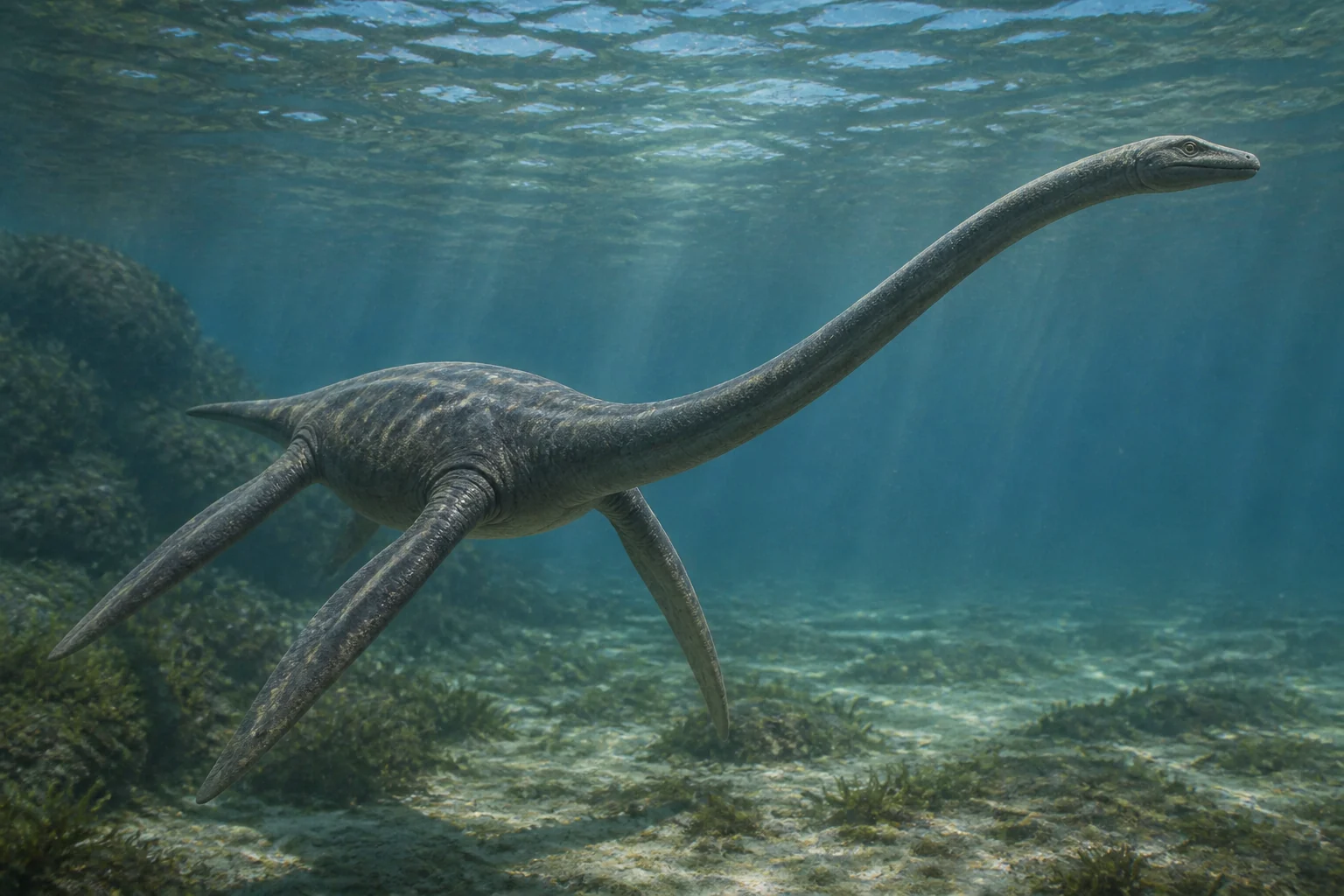 View original image · 1536 × 1024
- Time range
- About 201–183 million years ago
- Final stage
- Early Jurassic
- Geographic range
- Shallow sea and outer shelf · Present-day Britain
01 / ANSWER FIRST
What was Plesiosaurus?
Plesiosaurus was a roughly three-metre Early Jurassic marine reptile with a small head, long neck, broad trunk and four powerful flippers.
It was one genus within a diverse plesiosaur lineage, not a dinosaur and not the gigantic long-necked form used for every popular reconstruction. Complete skeletons from Britain make its proportions unusually well constrained.
02 / QUICK FACTS
Plesiosaurus at a glance
- Scientific name
- Plesiosaurus dolichodeirus
- Age
- ~201–183 million years ago
- Length
- About 3–3.5 m
- Neck
- Around 40 vertebrae
- Propulsion
- Four wing-like flippers
- Diet
- Fish and cephalopods
- Breathing
- Air-breathing lungs
- Range
- Early Jurassic Europe
03 / CORE QUESTION
How did Plesiosaurus swim and feed?
All four flippers generated lift-based thrust in an underwater flight stroke. Models differ over exact phasing, but the hind pair contributed power rather than merely steering like most living marine reptiles.
The neck probably positioned the small head near fish and cephalopods without a whole-body lunge. It was flexible across many joints but could not form the swan-like vertical curves common in old artwork.
Read the complete swimming and feeding guideHow to read the numbers
This page separates direct evidence, comparative inference and unresolved debate.
04 / LIFE & DISCOVERY TIMELINE
A four-flippered reptile that changed ideas about ancient seas
European shelf hunter
Plesiosaurus swims among ammonites and fish.
Complete skeleton found
Mary Anning uncovers the famous Lyme Regis specimen.
Genus described
William Conybeare presents the extraordinary body plan.
Four-flipper gait tested
Robots and simulations compare underwater strokes.
05 / ANATOMY
A small head carried far ahead of four underwater wings
Long neck
Many short vertebrae balanced reach with limited joint motion.
Small toothed head
Slender teeth formed a trap for small prey.
Four flippers
Flattened limb bones built paired hydrofoils.
Rigid trunk
Broad ribs and girdles resisted swimming forces.
06 / DIET & BEHAVIOUR
What did Plesiosaurus eat?
Fish, cephalopods and other small marine prey fit its fine teeth; gastroliths may have aided digestion or ballast in some plesiosaurs.
Read the complete guide07 / DIET & BEHAVIOUR
Did it come onto land?
Its stiff trunk and hydrofoil limbs were poorly suited to walking. Plesiosaurs reproduced at sea, with live birth known from a related specimen.
08 / RANGE & HABITAT
Where did Plesiosaurus live?
Secure Plesiosaurus fossils come from Early Jurassic marine rocks of southern Britain and nearby Europe, especially the Blue Lias.
Lyme Regis
Complete skeletons established the body plan.
Blue Lias
Alternating limestone and shale preserved marine life.
European shelf
Warm shallow seas covered large regions.
Open water
Ammonites, fish and ichthyosaurs shared the ecosystem.
09 / FOSSIL EVIDENCE
How do scientists know about Plesiosaurus?
Complete skeletons
Articulated specimens constrain neck and limb proportions.
Joint surfaces
Vertebrae limit plausible neck motion.
Flipper models
Hydrodynamic experiments test thrust and gait.
Teeth and contents
Dental form and rare meals reconstruct diet.
10 / DISAPPEARANCE & DEBATE
Could a Plesiosaurus survive in a modern lake?
There is no evidence that plesiosaurs survived beyond the end-Cretaceous extinction, and no modern lake has produced bones, DNA or a breeding population.
The classic long-necked silhouette helped shape lake-monster imagery, but resemblance is not survival evidence.
12 / FREQUENTLY ASKED QUESTIONS
Plesiosaurus FAQ
How big was Plesiosaurus?
About three to three-and-a-half metres long.
Was it a dinosaur?
No, it was a marine sauropterygian reptile.
How did it swim?
All four flippers generated underwater-flight thrust.
Could its neck bend like a swan?
Not vertically to that degree.
Did it breathe air?
Yes, with lungs.
Is Loch Ness evidence?
No reliable fossil or biological evidence supports survival.
04 / SOURCES & FURTHER READING
Check the source record
Use the scientific name to compare taxonomy, occurrence records and the fossil record. Database coverage and classifications may differ.
05 / REVISION HISTORY
How has this record changed?
- Expanded into a bilingual S-tier hub with two evidence-led guides.
- Verified authoritative entity sources and added three responsive reconstruction sizes.
- Initial bilingual species record published.
06 / CORRECTIONS & ADDITIONS