
MOSASAURUS TOPIC HUB · DIET & HUNTING
What Did Mosasaurus Eat and How Did It Hunt?
What did Mosasaurus eat? Compare fish fossils, tooth evidence and stomach contents from related mosasaurs, with each feeding record tied to its animal.
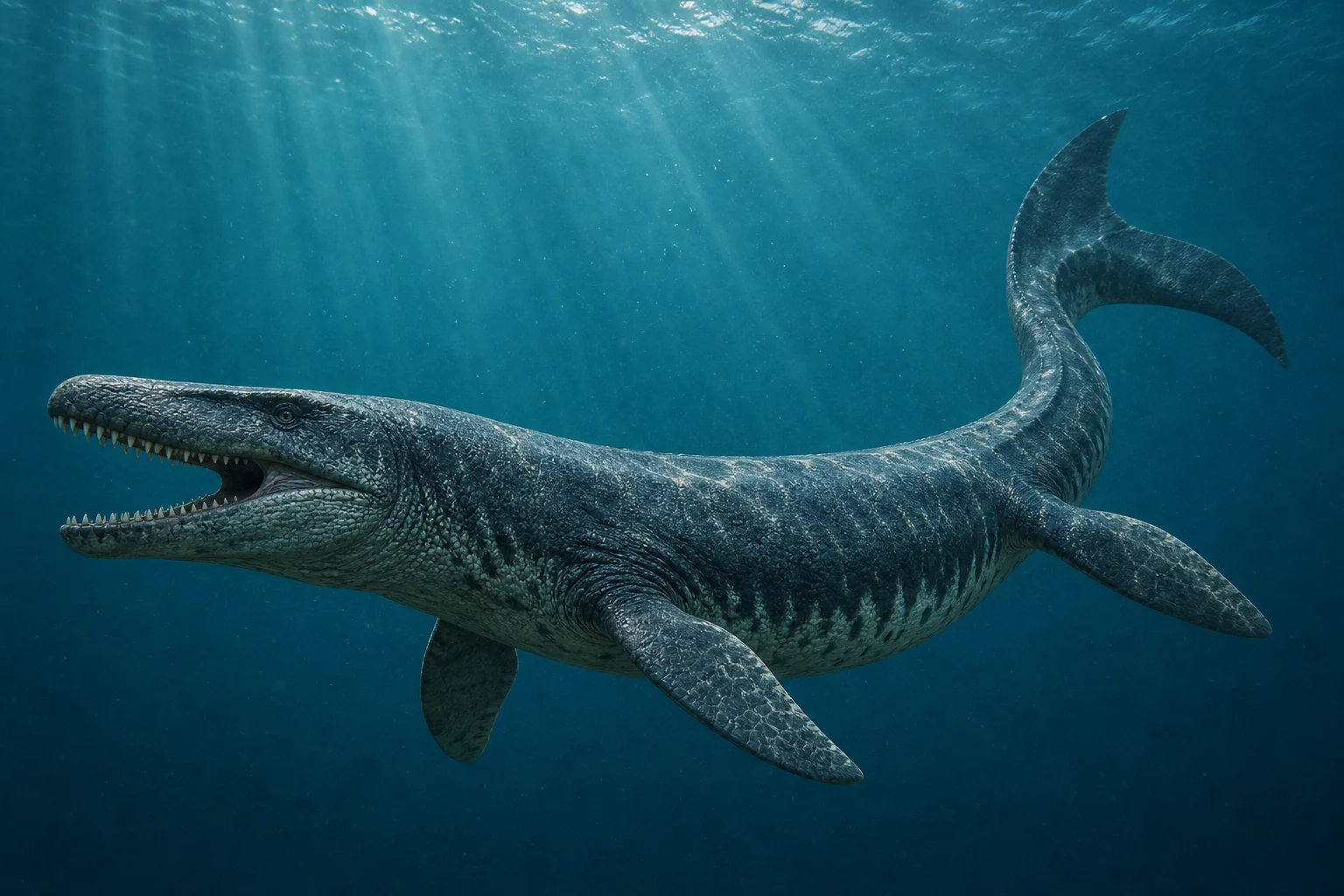 View full-resolution reconstruction ↗
This is an original generative reconstruction, not a photograph or scientific plate. Measurements and interpretations below are tied to named sources.
Mosasaurus diet: which fossil belongs to which predator?
Mosasaurus is one genus within Mosasauridae. A family-wide account is useful context, but it should retain the animal names attached to each feeding record.
| Predator | Preserved evidence | What it supports |
|---|---|---|
| Mosasaurus missouriensis | Fish bones, including a skull, associated with the ribcage and specimen | Supports fish consumption in this species; not a complete menu for M. hoffmannii Source ↗ |
| Prognathodon kianda | Several mosasaurs preserved in the stomach, including a juvenile Mosasaurus | Direct consumption evidence for Prognathodon; Mosasaurus is prey in this example Source ↗ |
A healed bite wound records survival after an injury; gut contents record consumption. Neither alone establishes a preferred hunting speed or whether every meal was caught alive.
01 / DIRECT EVIDENCE
What fossil evidence reveals its diet?
Gut contents, regurgitated remains and tooth-shaped wounds provide the strongest links between predator and prey. Each record captures one meal or encounter, so many specimens are needed to describe a whole diet.
03 / BITE
Did Mosasaurus crush or slice prey?
Mosasaurus teeth could grip and puncture; tooth form and cutting edges varied among species. Tooth breakage and wear show hard contact, while skull size supplied a wide gape and strong hold.
04 / ATTACK
How did it approach prey?
A streamlined body and tail-driven propulsion suit bursts of acceleration and pursuit. Whether an individual stalked, chased or scavenged depended on prey and opportunity; fossils rarely preserve the approach itself.
05 / FOOD WEB
Was it the only giant predator?
Late Cretaceous seas also held sharks, plesiosaurs and several mosasaur species. Tooth shape and body size partitioned resources, but overlap and scavenging likely produced competition.
06 / EVIDENCE VERDICT
What can fossils really prove?
They securely identify several prey categories and occasional violent encounters. Exact speed, bite force, hunting frequency and coordinated behaviour remain model-based rather than directly observed.
FREQUENTLY ASKED QUESTIONS
Questions readers ask
What did Mosasaurus eat?
It was a carnivorous marine reptile. Fish remains associated with a Mosasaurus missouriensis specimen provide genus-level feeding evidence. Wider lists of turtles, birds and other reptiles combine evidence from different mosasaur genera and cannot all be assigned to M. hoffmannii.
Did Mosasaurus eat other mosasaurs?
Some mosasaurs did: the Smithsonian specimen is Prognathodon kianda, with several mosasaurs in its stomach. A juvenile Mosasaurus is among the prey. That particular specimen does not make Mosasaurus the predator.
How do fossils show hunting rather than scavenging?
Gut contents show consumption but do not always show how prey was obtained. Tooth marks and injuries add context; a complete attack sequence and a measured hunting speed are not preserved.
SOURCES & FURTHER READING
Evidence used in this guide
Measurements and interpretations are tied to museum resources or peer-reviewed studies; disputed conclusions include evidence on both sides.
- 01What is a mosasaur? ↗Natural History Museum, London
Museum overview of taxonomy, size, discovery, ecology and movie myths.
- 02Soft tissue preservation in a fossil marine lizard with a bilobed tail fin ↗Nature Communications
Direct soft-tissue evidence for the tail fluke of a derived mosasaur.
- 03Mosasaurus hoffmannii ↗Paleobiology Database
Taxonomic and occurrence record for the focal species.
- 04A small, exquisitely preserved specimen of Mosasaurus missouriensis ... and the first stomach contents for the genus ↗Konishi et al. (2014), Journal of Vertebrate Paleontology
Fish remains associated with the ribcage of a named Mosasaurus specimen; not a universal diet for every species.
- 05Meals of the Mighty Mosasaur ↗Smithsonian Ocean
Identifies Prognathodon kianda as the animal containing three other mosasaurs, including a juvenile Mosasaurus.