
DUNKLEOSTEUS TOPIC HUB · SIZE & RECONSTRUCTION
Dunkleosteus Size, Armor and Body Shape
Why did Dunkleosteus shrink from 8–10 metres to about 3.4 metres? Examine preserved skulls, orbit-opercular scaling, deep-body reconstruction and remaining uncertainty.
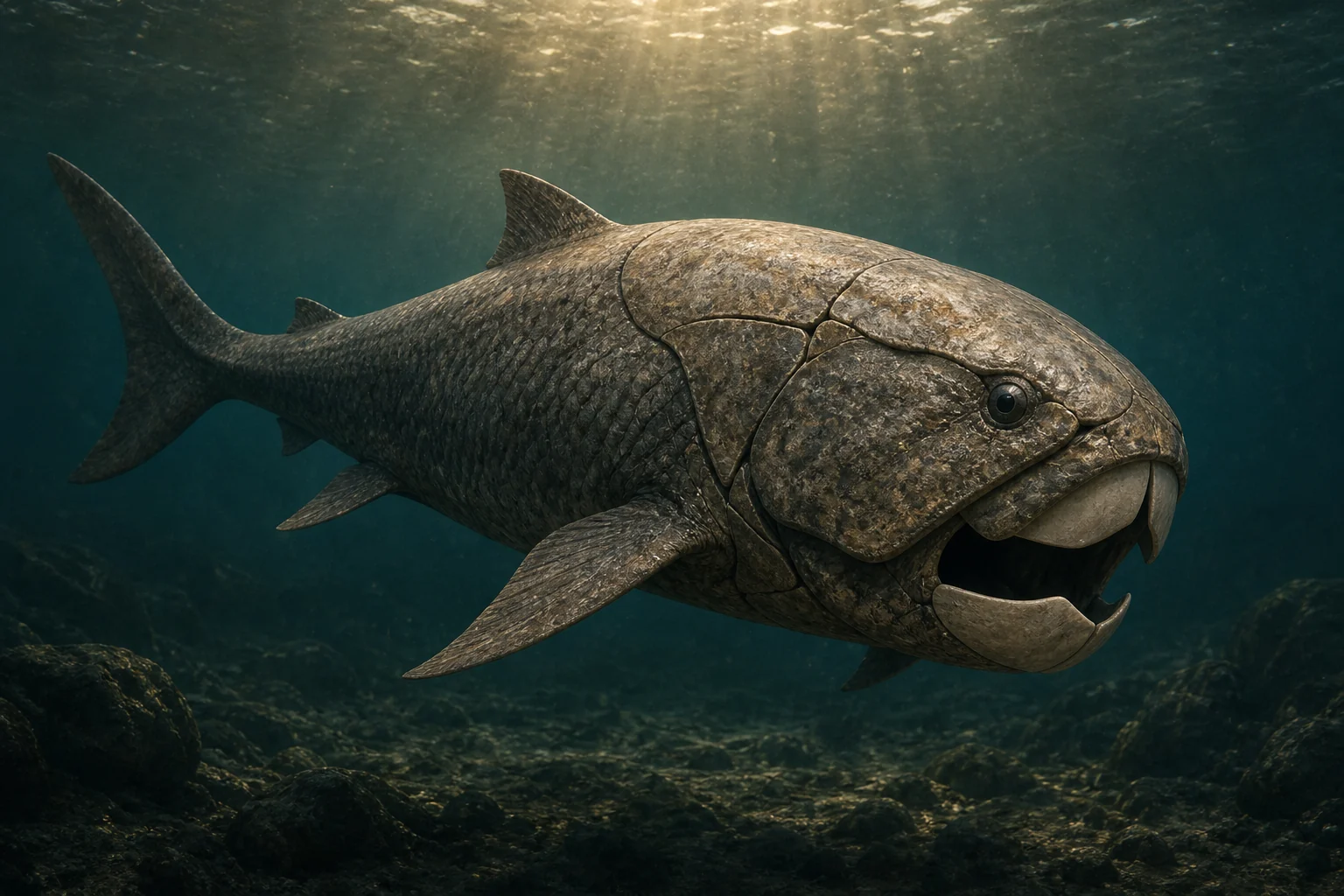 View full-resolution reconstruction ↗
This is an original generative reconstruction, not a photograph or scientific plate. Measurements and interpretations below are tied to named sources.
01 / PRESERVATION
Why do we mostly find a head?
Dermal skull and thoracic plates were heavily mineralised and often survived burial. The vertebral column and rear body were largely cartilaginous or weakly mineralised, so they decayed. As a result, skull dimensions are direct measurements while trunk length, fins and mass require comparisons.
02 / OLD ESTIMATES
How did 8–10 metres become popular?
Early restorations multiplied large jaw or armour dimensions using broad analogies with long-bodied sharks and incomplete arthrodires. Repetition turned upper estimates into a familiar silhouette even though no matching body existed. A predator can be formidable without every isolated head belonging to a bus-length fish.
03 / NEW METHOD
What is orbit-opercular length?
The distance from the rear of the eye region to the back of the gill cover tracks total length surprisingly consistently across a large sample of fishes. The 2023 study compiled thousands of measurements spanning nearly one thousand species and applied the relationship to articulated Dunkleosteus heads. This reduces dependence on one convenient living shark.
04 / REVISED BODY
What does a 3.4-metre Dunkleosteus look like?
The head occupies a larger fraction of total length and the trunk is deep rather than torpedo-like. This resembles compact pelagic fishes more than an elongated great white. Precise tail and fin outlines remain provisional because the method predicts length, not every anatomical contour.
05 / MASS & PERFORMANCE
Does shorter mean less dangerous?
No. A deep 3.4-metre fish can still carry substantial muscle and a massive armoured head. Shortening the body changes mass, turning radius, acceleration and previous bite-force scaling, so older performance numbers cannot simply be retained. Ecological power must be recalculated rather than judged by length alone.
06 / VERDICT
Which size should a modern page use?
Use about 3.4 metres for the largest well-measured D. terrelli under the currently published proportional model, while naming the method and uncertainty. Explain that old 8–10 metre figures came from different analogues. Show a deep compact body, but label tail, fins and exact mass as reconstructed pending better fossils.
FREQUENTLY ASKED QUESTIONS
Questions readers ask
How big was Dunkleosteus?
A 2023 proportional analysis estimates the largest measured D. terrelli near 3.4 m, not the older 8–10 m image.
Did it have teeth?
No conventional teeth; sharpened bony jaw plates formed the cutting edges.
Was the whole body armoured?
No. Heavy armour covered the head and front of the trunk; the rear body was largely unarmoured.
Did it have the strongest fish bite?
A 2006 model produced very high values, but revised anatomy and smaller body estimates mean the numbers require re-evaluation.
Did it look like a shark?
The preserved armour does not determine a shark-like trunk; current evidence favours a deeper, more compact body.
Why is the body missing?
Most post-thoracic tissues and internal skeleton were weakly mineralised and decayed before fossilization.
SOURCES & FURTHER READING
Evidence used in this guide
Measurements and interpretations are tied to museum resources or peer-reviewed studies; disputed conclusions include evidence on both sides.
- 01A Devonian Fish Tale: A New Method of Body Length Estimation ↗Diversity
Peer-reviewed orbit-opercular scaling study revising D. terrelli length and body form.
- 02Feeding mechanics and bite force modelling of Dunkleosteus terrelli ↗Biology Letters
Four-bar linkage model of rapid opening and blade force.
- 03Functional anatomy, jaw mechanisms, and feeding behavior of Dunkleosteus terrelli ↗The Anatomical Record
Recent reassessment of cranial joints, muscles, gape and feeding mechanics.