
DUNKLEOSTEUS TOPIC HUB · JAWS & HUNTING
How Did Dunkleosteus Bite and Hunt?
How did toothless Dunkleosteus feed? Follow bony blades, cranial joints, four-bar linkage models, prey evidence, bite-force revisions and hunting uncertainty.
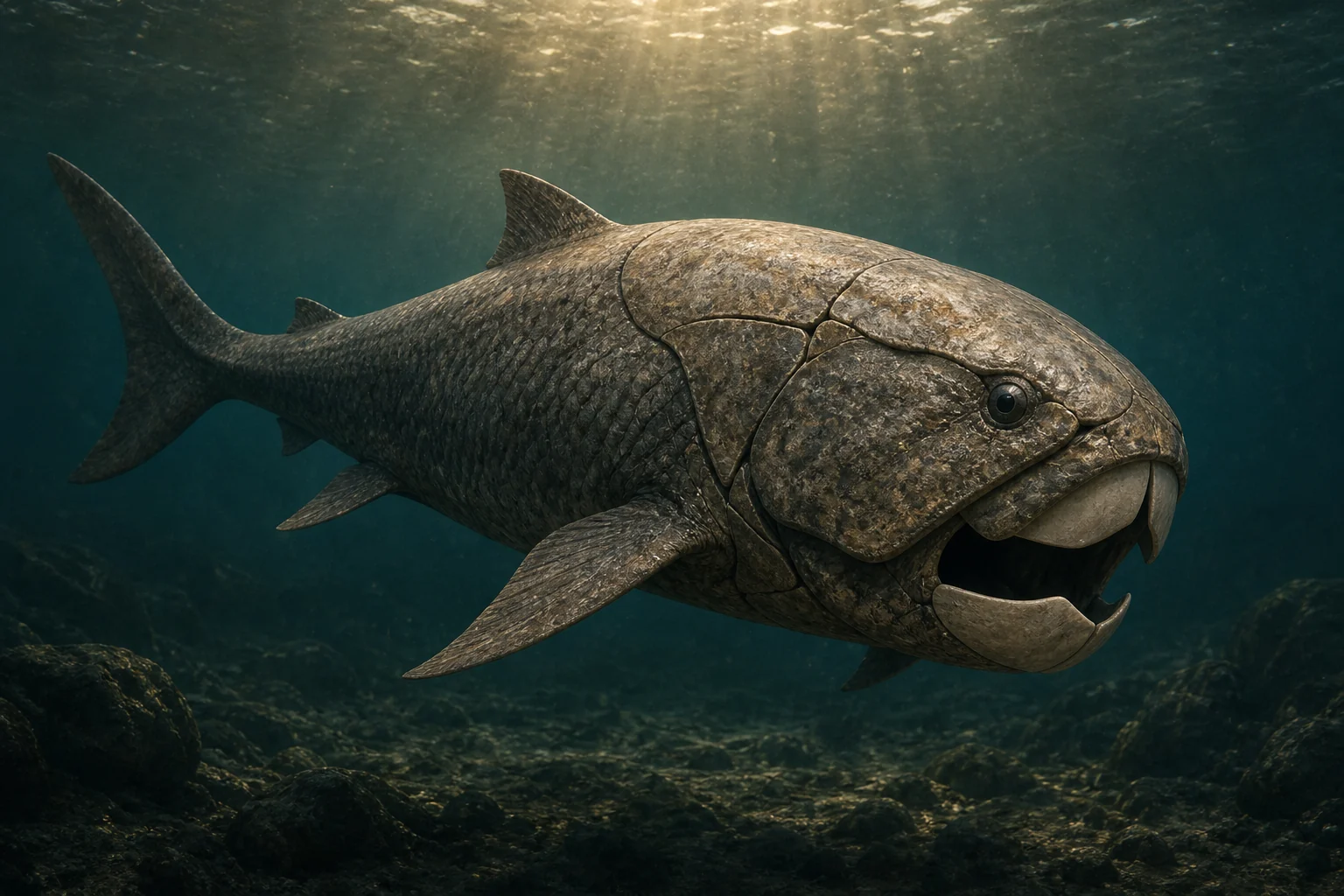 View full-resolution reconstruction ↗
This is an original generative reconstruction, not a photograph or scientific plate. Measurements and interpretations below are tied to named sources.
01 / BONY BLADES
How did it cut without teeth?
Gnathal plates extended from upper and lower jaw bones, meeting along sharp edges. Repeated contact maintained a functional cutting surface rather than replacing individual teeth. The front tips could pierce while posterior edges sliced, creating a double-bladed closure suited to fragmenting prey.
02 / FOUR-BAR LINKAGE
Why could the mouth open quickly?
The skull roof, cheek unit, lower jaw and thoracic joint form a linked mechanical system. Motion at the neck and cheek could rotate several elements together, expanding the mouth faster than a simple lower-jaw hinge. A rapid expansion may also have drawn water and prey inward before blade closure.
03 / FORCE MODEL
How powerful was the bite?
A 2006 model estimated more than 4,400 newtons at the tip and 5,300 newtons farther back for a six-metre individual. Those values demonstrated the linkage's mechanical potential, not a measured living bite. The assumed six-metre body, muscle geometry and attachment areas now require re-evaluation under newer reconstructions.
04 / PREY EVIDENCE
What did the blades process?
Late Devonian seas contained large fishes, arthrodires, early sharks and hard-bodied prey. Fossil boluses associated with Dunkleosteus have been interpreted as partially digested fish remains, and worn or damaged plates show repeated loading. Direct stomach contents tied to a complete individual remain rare.
05 / HUNTING STYLE
Was Dunkleosteus an ambush or pursuit predator?
Rapid jaw expansion and a deep muscular body could support short-range acceleration and powerful prey capture. Sustained open-ocean pursuit depends on an unknown tail and fins, so assigning tuna-like speed is premature. It may have taken live prey, scavenged carcasses and shifted strategy with size or opportunity.
06 / EVIDENCE VERDICT
What is established and what is not?
The armoured skull, moving joints and shearing jaw plates securely identify a powerful cutting predator. Four-bar mechanics offer a testable explanation for rapid opening, while exact bite force, suction contribution, swimming speed and preferred prey remain model-dependent. Modern content should keep those levels of confidence separate.
FREQUENTLY ASKED QUESTIONS
Questions readers ask
How big was Dunkleosteus?
A 2023 proportional analysis estimates the largest measured D. terrelli near 3.4 m, not the older 8–10 m image.
Did it have teeth?
No conventional teeth; sharpened bony jaw plates formed the cutting edges.
Was the whole body armoured?
No. Heavy armour covered the head and front of the trunk; the rear body was largely unarmoured.
Did it have the strongest fish bite?
A 2006 model produced very high values, but revised anatomy and smaller body estimates mean the numbers require re-evaluation.
Did it look like a shark?
The preserved armour does not determine a shark-like trunk; current evidence favours a deeper, more compact body.
Why is the body missing?
Most post-thoracic tissues and internal skeleton were weakly mineralised and decayed before fossilization.
SOURCES & FURTHER READING
Evidence used in this guide
Measurements and interpretations are tied to museum resources or peer-reviewed studies; disputed conclusions include evidence on both sides.
- 01A Devonian Fish Tale: A New Method of Body Length Estimation ↗Diversity
Peer-reviewed orbit-opercular scaling study revising D. terrelli length and body form.
- 02Feeding mechanics and bite force modelling of Dunkleosteus terrelli ↗Biology Letters
Four-bar linkage model of rapid opening and blade force.
- 03Functional anatomy, jaw mechanisms, and feeding behavior of Dunkleosteus terrelli ↗The Anatomical Record
Recent reassessment of cranial joints, muscles, gape and feeding mechanics.