
Explore this animal in Size of Extinct Animals ↗
37 / Paleozoic
Eusthenopteron
Eusthenopteron foordi
Bones inside its fleshy fins foreshadowed the limb pattern of land vertebrates.
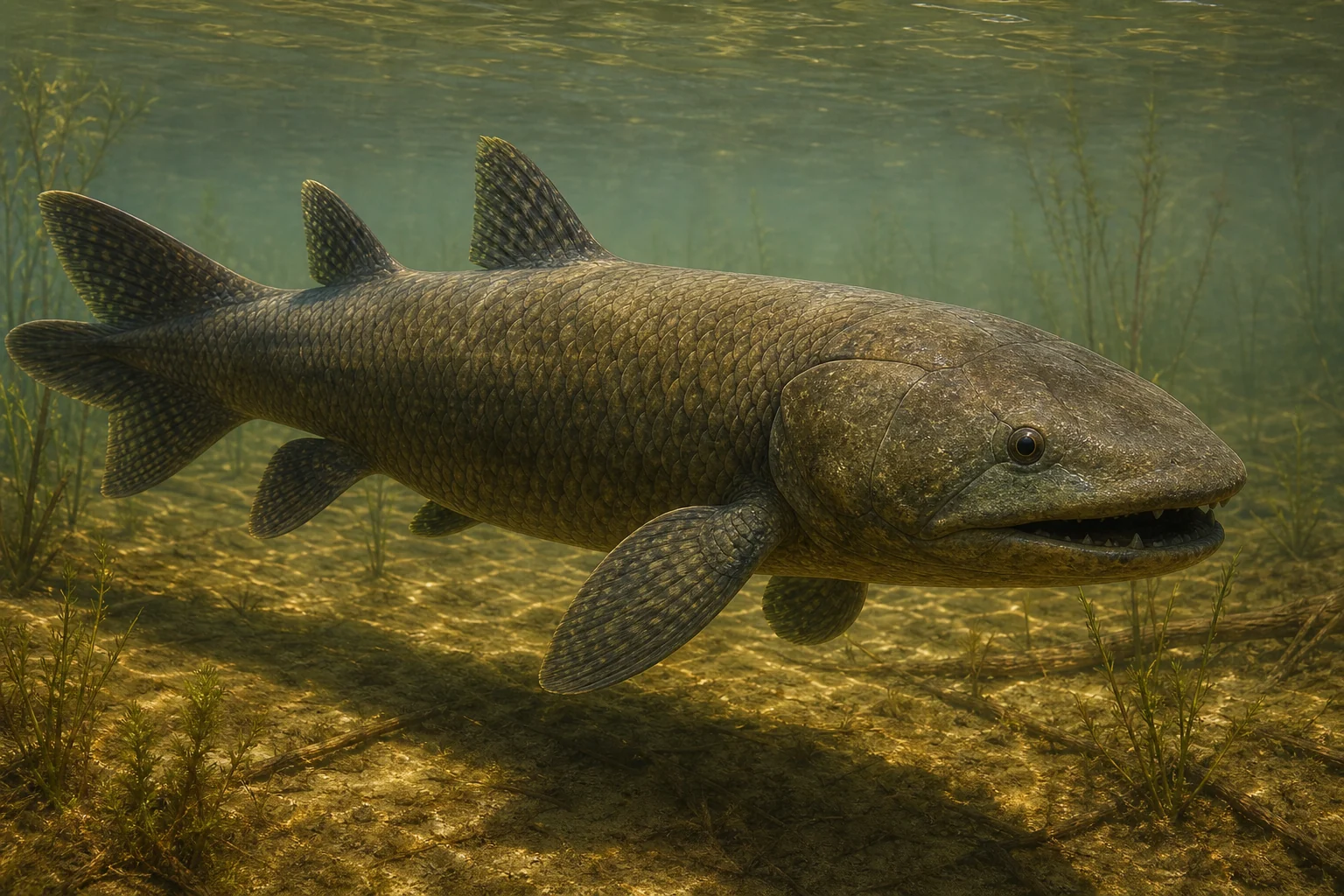 View original image · 1536 × 1024
- Time range
- About 385 million years ago
- Final stage
- Late Devonian
- Geographic range
- Euramerican estuaries · Present-day Canada
01 / ANSWER FIRST
What was Eusthenopteron?
Eusthenopteron was a Late Devonian predatory lobe-finned fish close to the evolutionary branch that produced tetrapods, but it was fully aquatic and did not walk on land.
Its fins contain bones homologous in broad pattern to the humerus, radius and ulna of limbs. Those similarities reveal shared ancestry, not a ladder in which Eusthenopteron itself became a modern amphibian.
02 / QUICK FACTS
Eusthenopteron at a glance
- Scientific name
- Eusthenopteron foordi
- Age
- Late Devonian, about 385 Ma
- Group
- Tetrapodomorph lobe-finned fish
- Length
- Commonly around 1 m
- Diet
- Fish and other aquatic prey
- Habitat
- Estuary or coastal freshwater system
- Key fossils
- Miguasha, Quebec, Canada
- Locomotion
- Swimming; fins not weight-bearing feet
03 / ANATOMY
A fish body containing the deep pattern of limbs
Lobed paired fins
Fleshy fin bases contained a chain of internal bones and muscles, but rays at the edge still formed a swimming surface.
Humerus-radius-ulna pattern
The pectoral fin includes one proximal bone followed by paired bones, a pattern elaborated in tetrapod limbs.
Fish-like skull and body
A streamlined trunk, fins, gill apparatus and tail show an aquatic animal, not a shoreline walker.
Internal nostril debate
Cranial canals and palatal openings help trace air-breathing anatomy, but individual features have been reinterpreted as new fossils and scans improved.
04 / DIET & BEHAVIOUR
What did Eusthenopteron eat?
A long predatory skull and conical teeth suit fish and other aquatic prey. Cannibalism and specific prey claims require direct gut evidence that is uncommon.
05 / DIET & BEHAVIOUR
Did it breathe air?
Close relatives had lungs or lung-derived organs, and Devonian water could become oxygen-poor. Exact breathing behaviour in Eusthenopteron is inferred rather than observed directly.
06 / RANGE & HABITAT
Where did Eusthenopteron live?
Hundreds of specimens come from the Escuminac Formation at Miguasha, a celebrated Late Devonian ecosystem in present-day Quebec.
Estuarine basin
Changing salinity and water level created a complex setting rather than one simple river channel.
Low-oxygen water
Seasonal or stratified conditions may explain both ecological stress and exceptional preservation.
Diverse fish community
Placoderms, ray-finned fish and other sarcopterygians supplied competitors and prey.
07 / FOSSIL EVIDENCE
Why is Eusthenopteron important to tetrapod evolution?
Three-dimensional skeletons
Fine preservation allows individual skull, vertebral and fin bones to be followed through growth.
Homologous fin bones
Bone correspondence shows how the tetrapod limb pattern was assembled before digits and land walking evolved.
Growth series
Juveniles and adults reveal changes that otherwise could be mistaken for separate species.
Phylogenetic comparison
Eusthenopteron is compared with Panderichthys, Tiktaalik and early tetrapods; no one fossil alone represents the entire transition.
08 / DISAPPEARANCE & DEBATE
Why did Eusthenopteron disappear?
Its species ended amid Late Devonian environmental and faunal turnover; there is no evidence for one isolated extinction event at Miguasha.
Changing water chemistry, climate and fish communities repeatedly reorganised aquatic ecosystems. Its evolutionary importance comes from anatomy, not from being the direct ancestor of every later tetrapod.
09 / FREQUENTLY ASKED QUESTIONS
Eusthenopteron FAQ
Did Eusthenopteron walk on land?
No. Its fins show limb-like internal bones but retained fin rays and were not feet built for terrestrial weight bearing.
Was it the ancestor of humans?
It is better treated as a close relative of the lineage leading to tetrapods, not a demonstrated direct ancestor of humans.
Why are its fins important?
They preserve the one-bone/two-bones pattern later elaborated into the upper arm and forearm of tetrapods.
Where are the best fossils found?
The classic specimens come from Miguasha in Quebec, Canada, where three-dimensional preservation is exceptional.
04 / SOURCES & FURTHER READING
Check the source record
Use the scientific name to compare taxonomy, occurrence records and the fossil record. Database coverage and classifications may differ.
05 / REVISION HISTORY
How has this record changed?
- Expanded into a curated bilingual A-tier profile with anatomy, ecology, range, evidence, debate and FAQs.
- Verified authoritative entity sources and added three responsive reconstruction sizes.
- Initial bilingual species record published.
06 / CORRECTIONS & ADDITIONS