
Explore this animal in Size of Extinct Animals ↗
36 / Paleozoic
Edestus
Edestus heinrichi
Opposing tooth blades projected from its jaws like curved shears.
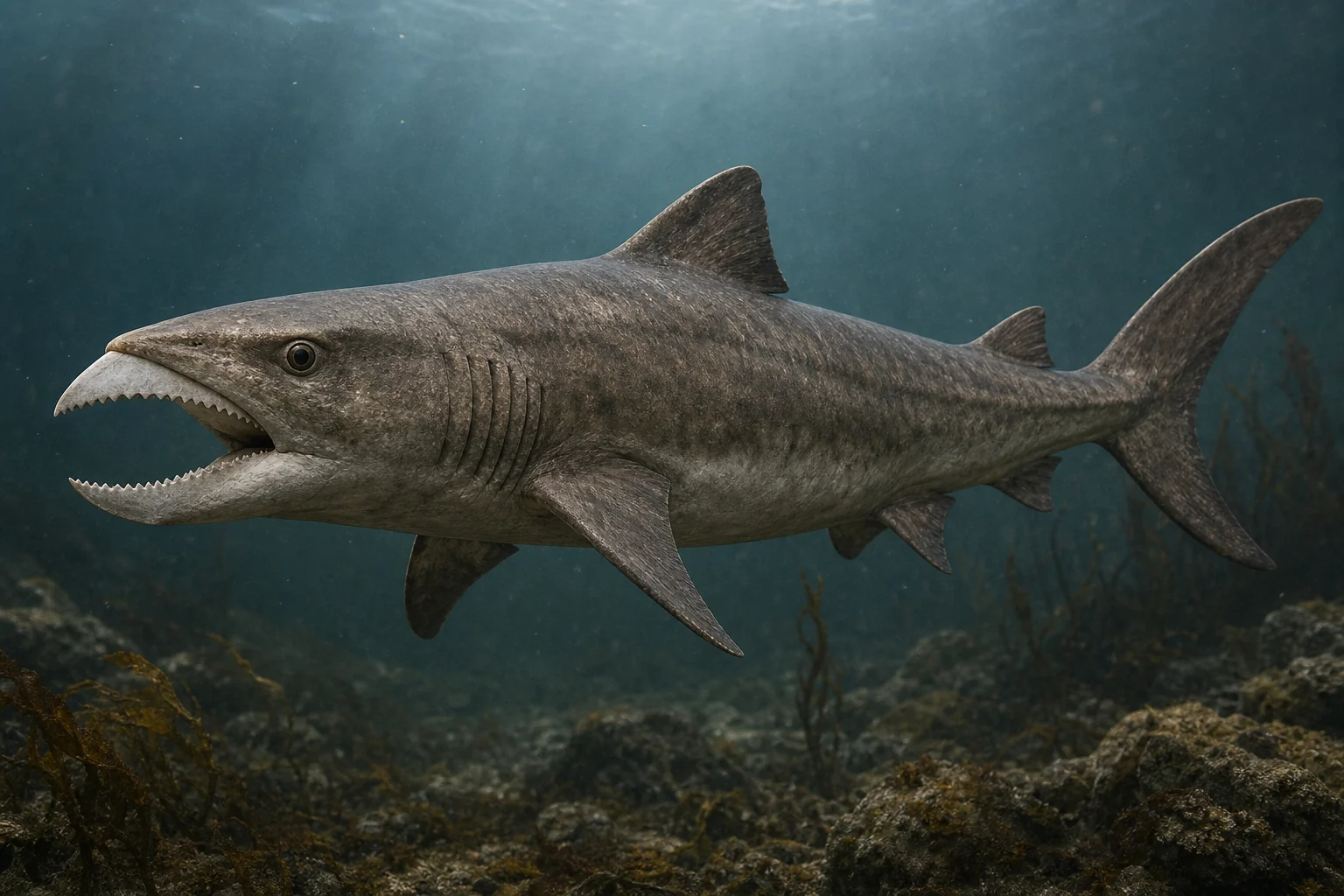 View original image · 1536 × 1024
- Time range
- About 313–307 million years ago
- Final stage
- Late Carboniferous
- Geographic range
- Euramerican seas · North America and Eastern Europe
Edestus: scissor teeth, tooth shedding and size
Edestus was a Carboniferous cartilaginous fish with a tooth blade in each jaw. New teeth formed at the back while older teeth were shed from the front; its blades were not Helicoprion's retained spiral.
How the 6.7-metre estimate was built
The 2019 study scaled a 43-cm lower tooth blade to a roughly 134-cm head, then assumed a 5:1 body-to-head ratio. The result describes a reconstruction of a large E. heinrichi, not a measured complete skeleton.
How the jaws worked
Jaw reconstructions test slicing movements using preserved anatomy. The nickname ‘scissor-tooth shark’ is memorable, but it does not mean the teeth operated exactly like a pair of household scissors.
01 / ANSWER FIRST
What was Edestus?
Edestus was a large Carboniferous eugeneodont cartilaginous fish with one curved blade of continuously added teeth in each jaw.
Known as the scissor-tooth shark, it belonged to an extinct cartilaginous-fish lineage. Unlike Helicoprion's retained spiral, its tooth blades grew at the back and shed older teeth at the front.
02 / QUICK FACTS
Edestus at a glance
- Scientific name
- Edestus heinrichi
- Age
- Late Carboniferous, about 313–307 Ma
- Group
- Eugeneodont cartilaginous fish
- Teeth
- Opposing curved tooth blades
- Diet
- Large fish and soft-bodied marine prey
- Range
- Euramerican tropical seas
- Body record
- Mostly teeth and jaw material
- Nickname
- Scissor-tooth shark
How big was Edestus?
Tapanila and Pruitt (2019) scaled a 43 cm lower tooth blade to a head about 134 cm long. Assuming a 5:1 body-to-head ratio gave a rough length of 6.7 m (22 ft) for a large E. heinrichi.
The missing body makes that ratio an assumption. Use this as a published reconstruction estimate, not a directly measured maximum or the size of every Edestus species.
03 / ANATOMY
How the scissor-tooth blades worked
Upper and lower blades
Each jaw carried a narrow tooth blade. A reconstruction based on preserved skull material places prey between opposing serrated crowns.
Continuous addition
New teeth formed at the back; old teeth were shed from the front. The blade did not retain every tooth for life.
Narrow cutting system
The blades were suited to slicing but poorly arranged for crushing broad hard shells.
Body silhouette uncertain
Cartilage rarely fossilised, so a streamlined shark-like body is inferred from relationships rather than known from a complete skeleton.
04 / DIET & BEHAVIOUR
How did Edestus feed?
The skull-based model in Saws, Scissors, and Sharks reconstructs a backward slicing motion of the lower blade during jaw closure. It challenges earlier head-slashing reconstructions based chiefly on isolated blades; the nickname is not proof of ordinary scissor-like motion.
05 / DIET & BEHAVIOUR
What prey could it handle?
Large fish and soft-bodied animals suit a slicing apparatus. Direct stomach contents are unavailable, so claims about any single favourite prey should remain cautious.
06 / RANGE & HABITAT
Where did Edestus live?
Tooth blades are known from Late Carboniferous marine rocks in North America and eastern Europe, then connected within equatorial Euramerican seas.
Warm epicontinental seas
Shallow tropical seas supported diverse fishes and cephalopods.
Open shelf water
Large mobile prey and broad distribution suggest movement beyond a single coastal nursery.
Fossil tooth deposits
Durable blades survive where the rest of the cartilaginous body vanished.
07 / FOSSIL EVIDENCE
What supports the scissor-jaw reconstruction?
Complete tooth files
Growth direction, root attachment and curvature show that the series formed a single jaw blade.
Paired jaw material
Specimens preserving upper and lower elements constrain how the two blades opposed one another.
Wear and breakage
Microscopic damage tests where teeth met prey, other teeth or sediment.
Mechanical modelling
Preserved jaw geometry constrains a slicing model more tightly than isolated teeth alone. Soft-tissue reconstruction still limits estimates of force and speed.
08 / DISAPPEARANCE & DEBATE
Why did Edestus disappear?
Edestus vanished during Late Carboniferous marine turnover; its exact extinction trigger is unknown.
Sea-level change, reorganised habitats and prey turnover altered equatorial marine ecosystems. Specialised feeding may have reduced flexibility, but this remains an ecological hypothesis rather than a fossilised cause.
09 / FREQUENTLY ASKED QUESTIONS
Edestus FAQ
Was Edestus the same as Helicoprion?
No. Both were eugeneodonts, but Edestus carried projecting opposing blades while Helicoprion formed a compact lower-jaw whorl.
Did Edestus shed its teeth?
Yes. New teeth formed at the rear of each blade, and older teeth were shed at the front. Retaining all old teeth describes Helicoprion better than Edestus.
How did the tooth blades cut?
A skull-based reconstruction proposes that the lower blade moved backward as the jaws closed, slicing prey between opposed crowns. The precise forces and speed remain uncertain.
How big was Edestus?
A 2019 study estimated about 6.7 m (22 ft) for a large E. heinrichi, using a tooth blade to infer head size and assumed body proportions. This is not a measured complete skeleton or an average adult length.
04 / SOURCES & FURTHER READING
Check the source record
Use the scientific name to compare taxonomy, occurrence records and the fossil record. Database coverage and classifications may differ.
05 / REVISION HISTORY
How has this record changed?
- Expanded answers to reader questions, clarified the scope of fossil evidence and improved routes to related explanations.
- Expanded into a curated bilingual A-tier profile with anatomy, ecology, range, evidence, debate and FAQs.
- Verified authoritative entity sources and added three responsive reconstruction sizes.
- Initial bilingual species record published.
06 / CORRECTIONS & ADDITIONS