
Explore this animal in Size of Extinct Animals ↗
232 / Mesozoic
Caudipteryx
Caudipteryx zoui
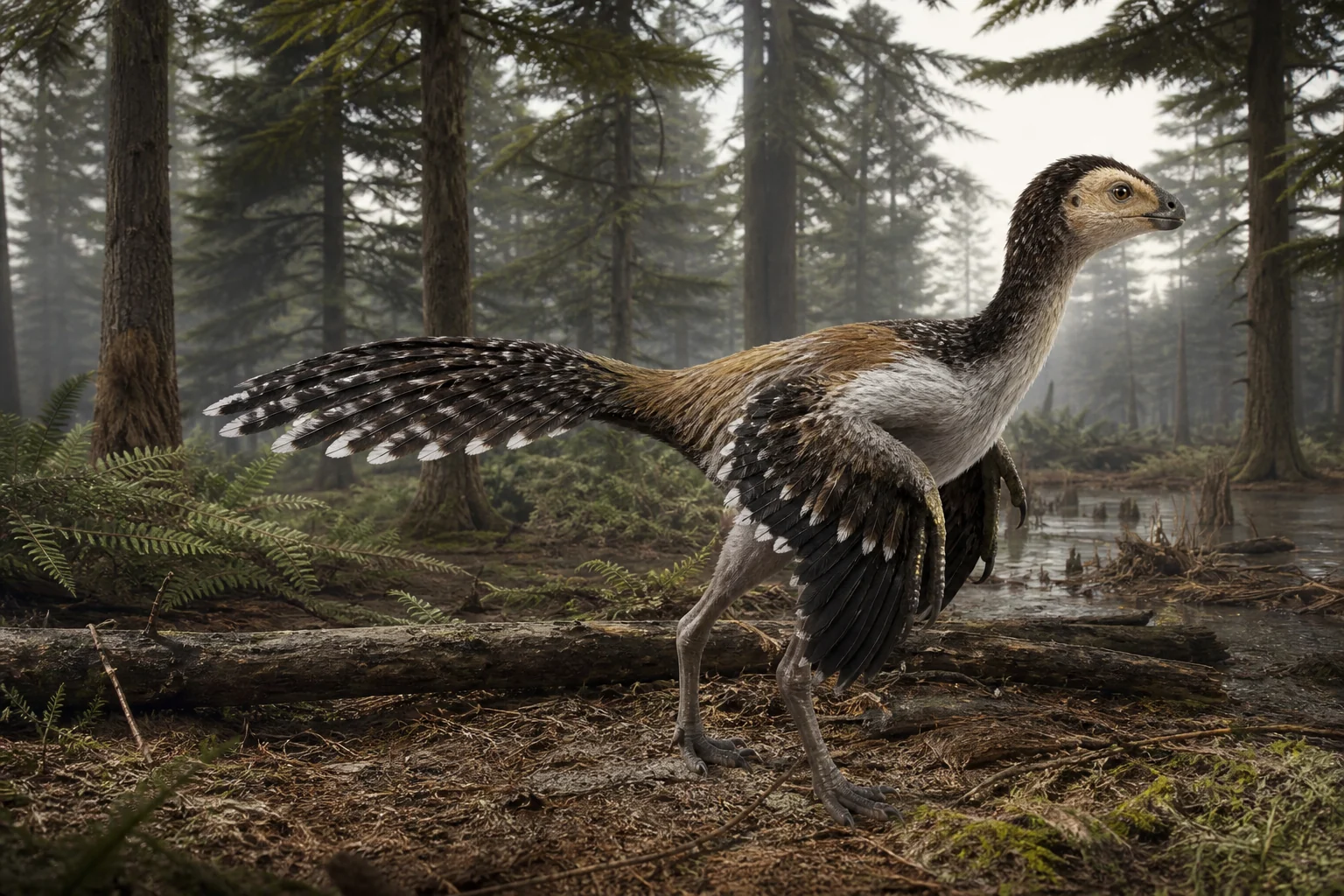
Orderly vaned feathers covered its arms and short tail, but symmetric feathers and body proportions prevented powered flight.
 View original image · 1536 × 1024
- Time range
- About 125 million years ago
- Final stage
- Early Cretaceous
- Geographic range
- Lakeside forest · Liaoning, China
01 / ANSWER FIRST
What was Caudipteryx?
Caudipteryx was a small, beaked Early Cretaceous theropod with symmetrical pennaceous feathers on its arms and tail, yet arms too short for powered flight.
The first specimens from Liaoning were announced in 1998 and became central to the evidence that complex feathers evolved in non-avian dinosaurs. Caudipteryx is generally placed among early oviraptorosaurs, close to but outside crown birds.
02 / QUICK FACTS
Caudipteryx at a glance
- Scientific name
- Caudipteryx zoui
- Age
- Early Cretaceous, about 125 million years ago
- Length
- About 1 metre
- Diet
- Likely omnivorous; direct gut evidence is limited
- Range
- Liaoning, northeastern China
- Feathers
- Body covering plus symmetrical arm and tail feathers
- Flight
- Flightless
- Major biota
- Jehol Biota
03 / ANATOMY
A feathered dinosaur built for running, not flying
Pennaceous feathers
Arm and tail feathers had a central shaft and interlocking vanes. Their symmetry differs from the strongly asymmetric flight feathers of many powered fliers.
Short forelimbs
The arms were proportionally short and lacked the flight apparatus needed to turn the feathered surface into a powered wing.
Beak and reduced teeth
A short skull and beak-like front fit oviraptorosaur anatomy; small teeth were retained toward the front of the upper jaw in some material.
Tail fan
Long feathers formed a fan near the tail tip. Display and signalling are plausible functions, but behaviour cannot be observed directly.
04 / DIET & BEHAVIOUR
What did Caudipteryx eat?
Its beak, small teeth and reported stomach-region stones are consistent with an omnivorous or plant-rich diet. Exact food items and whether stones functioned as gastroliths remain specimen-dependent.
05 / DIET & BEHAVIOUR
How did it move?
Long hindlimbs supported terrestrial walking and running. Feathers probably served insulation and display rather than lift-generating flight.
06 / RANGE & HABITAT
Where did Caudipteryx live?
Caudipteryx is known from the Yixian Formation of Liaoning, part of the Jehol Biota in northeastern China.
Volcanic lake basins
Fine lake sediments and volcanic ash promoted rapid burial and exceptional preservation of feathers.
Temperate forests
Plants indicate a seasonally cool landscape rather than a uniformly tropical dinosaur world.
Jehol food web
Fish, insects, mammals, pterosaurs, birds and feathered dinosaurs formed a densely documented Early Cretaceous ecosystem.
07 / FOSSIL EVIDENCE
Why is Caudipteryx important to feather evolution?
Feather impressions
Multiple articulated specimens preserve vaned feathers around the arms and tail rather than relying on isolated structures.
Skeleton and feathers together
The feather covering is directly associated with a clearly non-avian theropod skeleton, linking complex feathers to dinosaurs outside birds.
Phylogenetic analysis
Detailed skeletal characters place Caudipteryx among oviraptorosaurs in most analyses, although its bird-like appearance historically prompted alternative proposals.
Taphonomic context
Fine sediment and ash explain why soft feather outlines survived while most dinosaur sites preserve only hard tissues.
08 / DISAPPEARANCE & DEBATE
Why did Caudipteryx disappear?
No single extinction event is known for Caudipteryx; it disappears within ordinary Early Cretaceous faunal turnover long before the asteroid impact.
Its fossil range samples particular lake deposits, not the full lifespan of the lineage. Geological gaps prevent identification of a final population or direct cause.
09 / FREQUENTLY ASKED QUESTIONS
Caudipteryx FAQ
Could Caudipteryx fly?
No. It had complex feathers but arms and shoulder anatomy unsuitable for powered flight.
Was Caudipteryx a bird?
Most modern analyses identify it as a non-avian oviraptorosaurian theropod, although it possessed several bird-like features.
Why did a flightless dinosaur have feathers?
Feathers evolved before flight and could insulate, display, signal or cover eggs; flight was one later use of an existing structure.
Where was Caudipteryx found?
Articulated specimens come from the Yixian Formation in Liaoning Province, China.
04 / SOURCES & FURTHER READING
Check the source record
Use the scientific name to compare taxonomy, occurrence records and the fossil record. Database coverage and classifications may differ.
05 / REVISION HISTORY
How has this record changed?
- Rewrote an extinction cause that presented environmental or faunal turnover as established; it is now given as context the record does not prove.
- Expanded into a curated bilingual A-tier profile with anatomy, ecology, range, evidence, debate and FAQs.
- Verified authoritative entity sources and added three responsive reconstruction sizes.
- Initial bilingual species record published.
06 / CORRECTIONS & ADDITIONS