
Explore this animal in Size of Extinct Animals ↗
46 / Mesozoic
Oviraptor
Oviraptor philoceratops
The supposed egg thief was found above a nest that probably contained its own young.
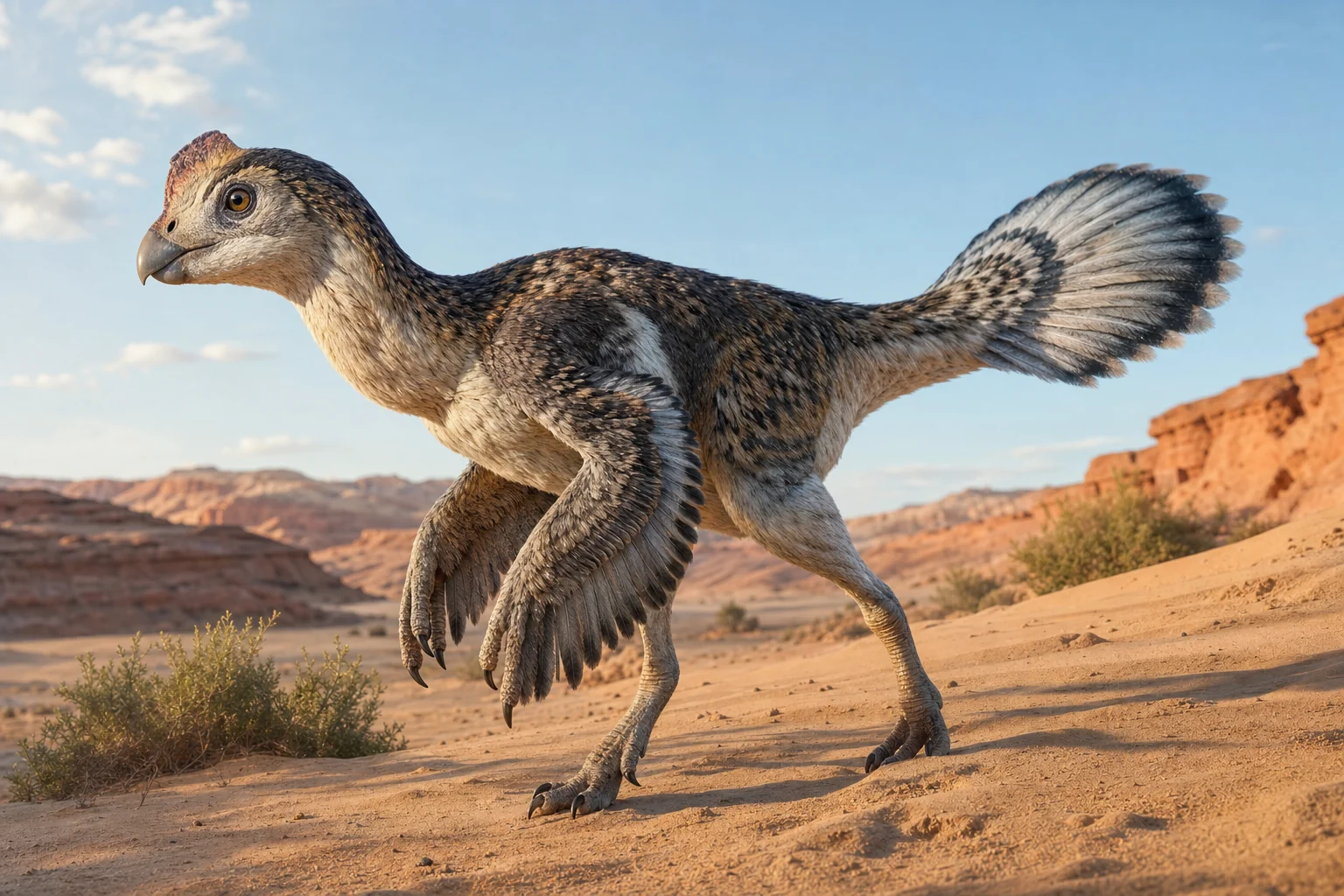 View original image · 1536 × 1024
- Time range
- About 75–71 million years ago
- Final stage
- Late Cretaceous
- Geographic range
- Mongolian Plateau
01 / ANSWER FIRST
What was Oviraptor?
Oviraptor was a roughly two-metre, feathered, toothless theropod from Late Cretaceous Mongolia whose misleading 'egg thief' name came from a nest misidentified in the 1920s.
The type specimen lay beside eggs then attributed to Protoceratops. Later embryos and brooding oviraptorids showed that this egg type belonged to oviraptorosaurs, making parental care more likely than theft, although the exact type-site behaviour remains unobservable.
02 / QUICK FACTS
Oviraptor at a glance
- Scientific name
- Oviraptor philoceratops
- Age
- ~75–71 million years ago
- Length
- About 1.6–2 m
- Mass
- Roughly 20–35 kg
- Mouth
- Toothless beak and robust palate
- Covering
- Feathers strongly supported by relatives
- Diet
- Uncertain omnivory or specialised feeding
- Range
- Gobi Desert, Mongolia
03 / CORE QUESTION
Was Oviraptor really stealing eggs?
The original eggs were assigned to abundant Protoceratops, so the nearby theropod was interpreted as a nest raider. Oviraptorid embryos later appeared inside the same elongate egg type, overturning the identification.
Adults of close relatives such as Citipati are preserved centred over circular clutches with arms spread around the eggs, a brooding posture comparable to birds. The name remains valid historically even though its literal story is no longer supported.
Read the complete egg-thief evidence guideHow to read the numbers
This page separates direct evidence, comparative inference and unresolved debate.
04 / LIFE & DISCOVERY TIMELINE
From accused nest robber to symbol of dinosaur parenting
Djadochta animal
Oviraptor lives among dunes and seasonal oases.
Type found
A crushed skeleton is excavated beside a nest.
Egg-thief name
The eggs are mistakenly assigned to Protoceratops.
Embryos revise the story
Oviraptorid embryos and brooding adults identify the eggs.
05 / ANATOMY
A bird-like theropod with a powerful toothless mouth
Toothless beak
A keratin sheath covered deep upper and lower jaws.
Palatal projections
Bony structures may have crushed or gripped food.
Feathered arms
Oviraptorosaur wings covered eggs and aided display.
Crest uncertainty
The type skull is crushed; large crests in art often follow relatives.
06 / DIET & BEHAVIOUR
What did Oviraptor eat?
The beak supports a varied or specialised diet, but plants, shellfish, small vertebrates and eggs remain competing possibilities.
Read the complete guide07 / DIET & BEHAVIOUR
Did it care for young?
Brooding is direct in close oviraptorid relatives; parental care in Oviraptor itself is strongly inferred, not directly preserved.
08 / RANGE & HABITAT
Where did Oviraptor live?
The type comes from Mongolia's Djadokhta Formation, an arid dune field crossed by episodic water and inhabited by small dinosaurs and mammals.
Flaming Cliffs
The classic expedition landscape yielded eggs and the type.
Sand dunes
Windblown deposits dominate the formation.
Seasonal water
Temporary wet periods supported nesting and food.
Gobi fauna
Protoceratops, Velociraptor and mammals shared the habitat.
09 / FOSSIL EVIDENCE
How do scientists know about Oviraptor?
Type skeleton
A crushed partial individual establishes the species.
Egg embryos
Related embryos identify elongate eggs as oviraptorosaur.
Brooding adults
Citipati specimens preserve bird-like nest posture.
Comparative skulls
Better oviraptorid skulls reconstruct missing beak and crest regions.
10 / DISAPPEARANCE & DEBATE
Why does the egg-thief myth persist?
The memorable name predates the embryo evidence, while popular images often combine Oviraptor with better-known Citipati anatomy.
Responsible pages retain the historical name but explain that the nest probably belonged to an oviraptorosaur and that diet remains open.
12 / FREQUENTLY ASKED QUESTIONS
Oviraptor FAQ
How big was Oviraptor?
About 1.6–2 metres long and roughly 20–35 kilograms.
Did it steal eggs?
The famous nest likely contained oviraptorosaur eggs, not stolen Protoceratops eggs.
Did it have feathers?
Feathered close relatives and brooding wings make feathers strongly supported.
Did it have teeth?
No; it had a deep toothless beak and specialised palate.
What did it eat?
Its precise diet remains uncertain and may have been omnivorous.
Was its crest like Citipati's?
Possibly, but the crushed type does not preserve the same complete crest evidence.
04 / SOURCES & FURTHER READING
Check the source record
Use the scientific name to compare taxonomy, occurrence records and the fossil record. Database coverage and classifications may differ.
05 / REVISION HISTORY
How has this record changed?
- Rewrote an extinction cause that presented environmental or faunal turnover as established; it is now given as context the record does not prove.
- Expanded into a bilingual S-tier hub with two evidence-led guides.
- Verified authoritative entity sources and added three responsive reconstruction sizes.
- Initial bilingual species record published.
06 / CORRECTIONS & ADDITIONS