
BRACHIOSAURUS TOPIC HUB · NECK & FEEDING
How Did Brachiosaurus Hold Its Neck and Feed?
Neck posture, high browsing, tooth replacement, air sacs, blood pressure and why Brachiosaurus did not need to hold one rigid pose.
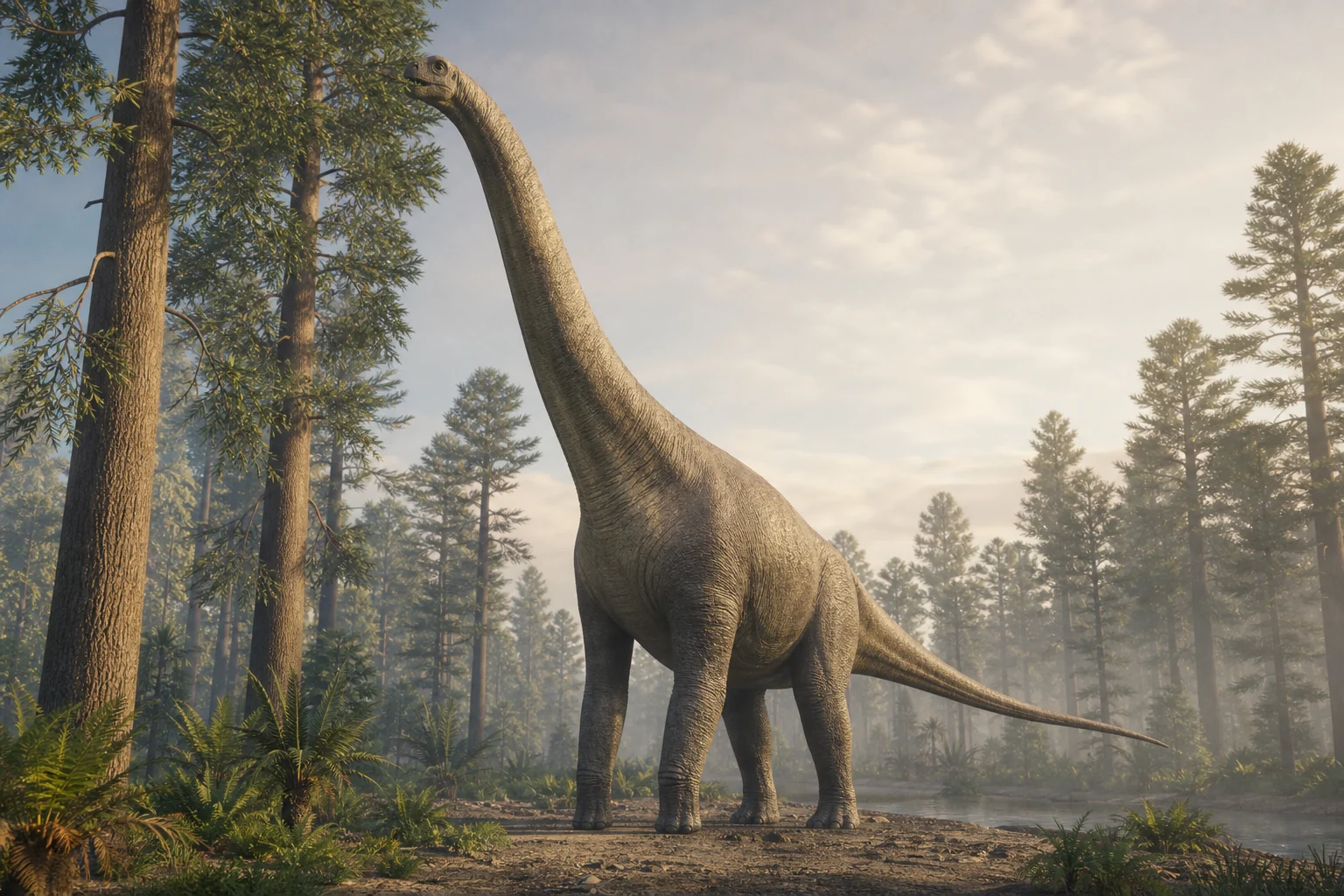 View full-resolution reconstruction ↗
This is an original generative reconstruction, not a photograph or scientific plate. Measurements and interpretations below are tied to named sources.
01 / NECK POSTURE
Did Brachiosaurus hold its neck vertically?
No single pose describes a living animal. Joint geometry, stress models and comparisons support different neutral and active angles, while long forelimbs already elevated the neck base. Feeding, locomotion and rest could use different postures.
02 / HIGH BROWSING
Was Brachiosaurus a high browser?
Its high shoulders, long neck and relatively long forelimbs provided access above lower sauropods and ornithischians. It could also sweep across a large volume without moving the massive body, so high browsing did not exclude feeding at intermediate levels.
03 / TEETH
How did Brachiosaurus process plants?
Spoon-like teeth concentrated near the front of the jaws cropped foliage with limited chewing. CT scans of referred jaw material suggest slower replacement than in Camarasaurus and diplodocoids, pointing to different wear or food-selection patterns.
04 / AIR SACS
How was the long neck kept light?
Bird-like air-sac diverticula entered vertebrae and ribs, replacing dense bone with internal spaces while retaining supportive struts. This reduced skeletal mass and supported efficient ventilation, but the neck still contained substantial muscle, vessels and skin.
05 / CIRCULATION
How did blood reach the head?
Raising the head increased hydrostatic pressure demands. A large powerful heart and vascular regulation are plausible, but no fossil preserves blood pressure or exact soft-tissue mechanisms. This constraint informs posture debate rather than proving the neck stayed horizontal.
06 / EVIDENCE VERDICT
What feeding picture best fits the evidence?
Brachiosaurus was a flexible bulk browser with a naturally elevated front body, not a rigid crane or underwater snorkeller. Anatomy supports high reach and efficient cropping; exact habitual angle, daily intake and preferred plant species remain uncertain.
FREQUENTLY ASKED QUESTIONS
Questions readers ask
How big was Brachiosaurus?
Common reconstructions are roughly 18–22 metres long and several tens of tonnes, but the holotype is incomplete.
How tall was it?
Large reconstructions place the shoulder near 6 metres; head height varied with neck posture.
Is the Berlin skeleton Brachiosaurus?
It is generally classified as Giraffatitan brancai, a related African genus once placed in Brachiosaurus.
Did Brachiosaurus live in water?
No. Columnar limbs, tracks and sauropod anatomy support a fully terrestrial animal; high nostrils do not make a snorkel.
Did it hold its neck straight up?
Probably not in one fixed pose. Neutral posture, feeding and movement could use different neck angles.
What did it eat?
Likely tall conifer and cycad foliage plus other available plants, cropped with spoon-like teeth.
SOURCES & FURTHER READING
Evidence used in this guide
Measurements and interpretations are tied to museum resources or peer-reviewed studies; disputed conclusions include evidence on both sides.
- 01Brachiosaurus ↗Natural History Museum, London
Museum overview of anatomy, discovery, tall feeding profile and distinction from Brontosaurus.
- 02Redescription of Brachiosaurid Sauropod Dinosaur Material ↗The Anatomical Record
CT-based reassessment of the referred skull, teeth, taxonomy and feeding strategy.
- 03Novel pneumatic features in the ribs of Brachiosaurus altithorax ↗Acta Palaeontologica Polonica
Direct description of air-sac invasion in holotype ribs.
- 04Why sauropods had long necks ↗PeerJ
Comparative evidence for lightweight necks, small heads and air-sac systems.