
BRACHIOSAURUS TOPIC HUB · SIZE & IDENTITY
Brachiosaurus Size, Height, Weight and Giraffatitan
How large was Brachiosaurus altithorax? Examine its incomplete holotype, length and mass estimates, shoulder height and the difference between Brachiosaurus and Giraffatitan.
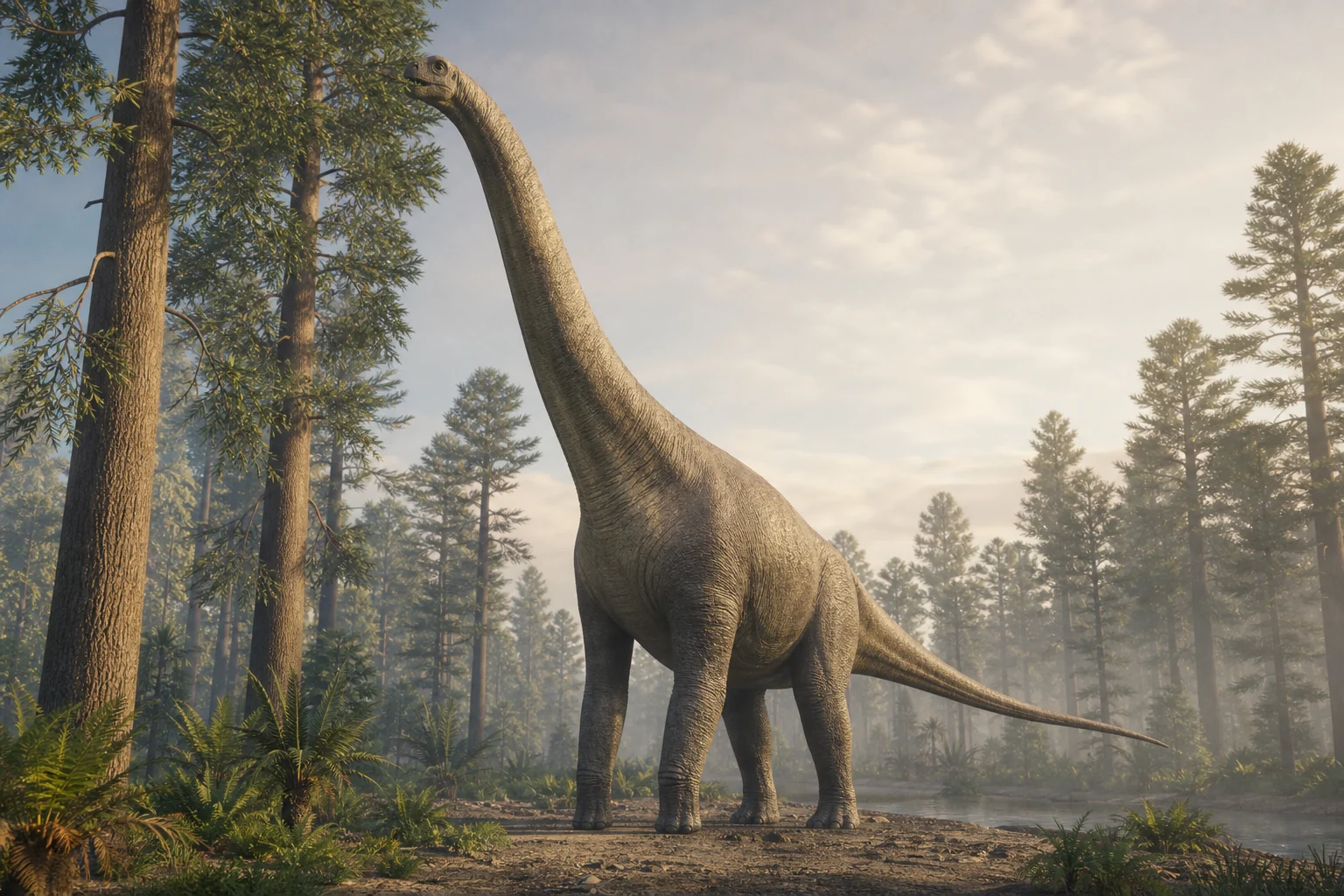 View full-resolution reconstruction ↗
This is an original generative reconstruction, not a photograph or scientific plate. Measurements and interpretations below are tied to named sources.
01 / HOLOTYPE
What does the original skeleton preserve?
FMNH PR 25107 includes much of the trunk, pelvis and limbs but not a complete neck, skull or tail. It directly establishes giant scale, deep ribs and forelimbs longer than the hindlimbs; missing regions require reconstruction.
02 / LENGTH
How long was Brachiosaurus?
Common estimates around 18–22 metres combine known trunk and limb proportions with brachiosaurid neck and tail information. Longer numbers can reflect different referral choices or scaling, so specimen and method matter more than one headline maximum.
03 / HEIGHT
How tall was Brachiosaurus?
Its long forelimbs raised the shoulders to roughly 6 metres in large reconstructions. Head height was not fixed: a mobile neck changed reach during feeding, walking and rest, and the missing complete neck adds uncertainty.
04 / BODY MASS
How much did it weigh?
Volumetric models place Brachiosaurus in the several-tens-of-tonnes range. Mass changes sharply with chest width, soft tissue and air-space assumptions, so apparently precise values should identify the digital model and skeleton used.
05 / IDENTITY
Is Giraffatitan the same animal?
No. The Tanzanian species once called Brachiosaurus brancai differs in trunk, limb and vertebral anatomy and is usually placed in Giraffatitan. Its more complete skeleton helps comparison but should not silently replace missing B. altithorax bones.
06 / EVIDENCE VERDICT
What is the honest size answer?
Brachiosaurus was a giant, unusually tall-shouldered sauropod, but not a completely measured skeleton or the largest dinosaur known. Use ranges, distinguish shoulder from head height and label every Giraffatitan-based inference.
FREQUENTLY ASKED QUESTIONS
Questions readers ask
How big was Brachiosaurus?
Common reconstructions are roughly 18–22 metres long and several tens of tonnes, but the holotype is incomplete.
How tall was it?
Large reconstructions place the shoulder near 6 metres; head height varied with neck posture.
Is the Berlin skeleton Brachiosaurus?
It is generally classified as Giraffatitan brancai, a related African genus once placed in Brachiosaurus.
Did Brachiosaurus live in water?
No. Columnar limbs, tracks and sauropod anatomy support a fully terrestrial animal; high nostrils do not make a snorkel.
Did it hold its neck straight up?
Probably not in one fixed pose. Neutral posture, feeding and movement could use different neck angles.
What did it eat?
Likely tall conifer and cycad foliage plus other available plants, cropped with spoon-like teeth.
SOURCES & FURTHER READING
Evidence used in this guide
Measurements and interpretations are tied to museum resources or peer-reviewed studies; disputed conclusions include evidence on both sides.
- 01Brachiosaurus ↗Natural History Museum, London
Museum overview of anatomy, discovery, tall feeding profile and distinction from Brontosaurus.
- 02Redescription of Brachiosaurid Sauropod Dinosaur Material ↗The Anatomical Record
CT-based reassessment of the referred skull, teeth, taxonomy and feeding strategy.
- 03Novel pneumatic features in the ribs of Brachiosaurus altithorax ↗Acta Palaeontologica Polonica
Direct description of air-sac invasion in holotype ribs.
- 04Why sauropods had long necks ↗PeerJ
Comparative evidence for lightweight necks, small heads and air-sac systems.