
Explore this animal in Size of Extinct Animals ↗
266 / Mesozoic
Thrinaxodon
Thrinaxodon liorhinus
A small Early Triassic cynodont with differentiated teeth, known from skeletons curled inside fossil burrows in South Africa.
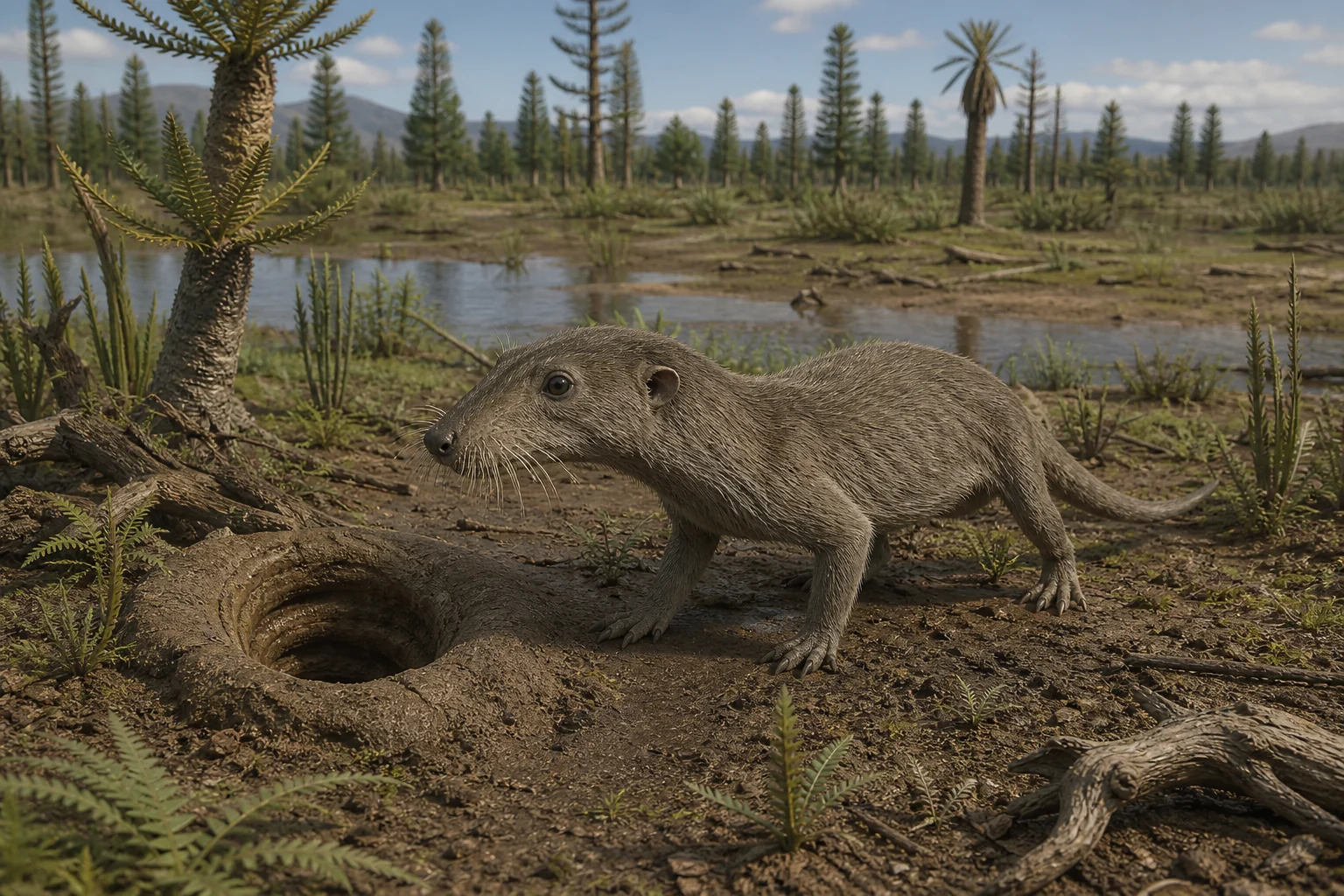 View original image · 1536 × 1024
- Time range
- About 252–247 million years ago
- Final stage
- Early Triassic
- Geographic range
- Seasonal river plains · South Africa and Antarctica
01 / ANSWER FIRST
What was Thrinaxodon?
Thrinaxodon liorhinus was a small Early Triassic cynodont, part of the synapsid lineage that later produced mammals. It is not itself a mammal.
It is best known from the Karoo Basin of South Africa, where skeletons have been found curled inside fossil burrows formed soon after the end-Permian mass extinction.
02 / QUICK FACTS
Thrinaxodon at a glance
- Animal group
- Early cynodont (non-mammalian synapsid)
- Key fossils
- Articulated skeletons inside burrow casts, Karoo Basin
- Age
- Early Triassic, soon after the end-Permian extinction
- Whiskers?
- Not established by snout pits
Why is Thrinaxodon found in burrows?
In 2003 Damiani and colleagues described a partial burrow cast containing an articulated Thrinaxodon skeleton from floodplain sediments near the Permian–Triassic boundary. It was the oldest evidence of burrowing by a cynodont. Its limbs could adopt a more upright, mammal-like stance inside the shaft.
A 2013 synchrotron scan revealed an even stranger burrow: a curled Thrinaxodon lying beside an injured amphibian, Broomistega, whose ribs show partly healed fractures. The authors interpreted Thrinaxodon as dormant—aestivating—when the amphibian crawled in, and suggested that burrowing and short dormancy helped mammal forerunners through harsh post-extinction conditions.
03 / ANATOMY
How mammal-like was Thrinaxodon?
Differentiated teeth
Like other cynodonts, it had teeth specialized along the jaw, a step toward the varied dentition of mammals.
Snout pits are not whiskers
Small pits on its snout were once read as whisker sockets. CT studies of therapsid skulls show a pattern closer to lizards in early cynodonts; whiskers probably arose later in the lineage. The pits alone do not prove whiskers.
04 / DIET & BEHAVIOUR
What did Thrinaxodon eat?
Its teeth suit a small carnivore or insectivore. The cited fossils do not preserve gut contents, so particular prey remains unknown.
05 / DIET & BEHAVIOUR
Life after a mass extinction
Burrows gave shelter in a seasonal, stressed Early Triassic landscape. Dormancy is an interpretation of posture and setting, not a directly observed behaviour.
06 / RANGE & HABITAT
Where did Thrinaxodon live?
Its best-documented fossils are from South Africa's Karoo Basin.
Karoo floodplains
Burrow casts come from terrestrial floodplain sediments deposited close to the Permian–Triassic boundary.
Antarctic records
Thrinaxodon has also been reported from Antarctica, which was joined to southern Africa within Gondwana.
07 / FOSSIL EVIDENCE
What do the burrows really show?
Behaviour from trace and body fossils
A skeleton inside a burrow links an animal to that shelter. It is stronger behavioural evidence than inferring burrowing from limb shape alone.
An unusual shared burrow
The Broomistega burrow is a single case. It shows tolerance in that instance, not a regular partnership between the two species.
08 / DISAPPEARANCE & DEBATE
Why did Thrinaxodon disappear?
The cited studies do not establish a species-specific extinction cause.
Later cynodonts diversified during the Triassic, but a younger fossil fauna does not by itself prove that they replaced Thrinaxodon.
09 / FREQUENTLY ASKED QUESTIONS
Thrinaxodon FAQ
Was Thrinaxodon a mammal?
No. It was a cynodont, a non-mammalian relative on the lineage that later gave rise to mammals.
Did Thrinaxodon have whiskers?
It is not established. Snout pits once cited as evidence resemble those of lizards, which lack whiskers.
Did Thrinaxodon survive the Permian extinction?
It lived in the Early Triassic, after the extinction. Its lineage survived; burrowing is one proposed reason.
04 / SOURCES & FURTHER READING
Check the source record
Use the scientific name to compare taxonomy, occurrence records and the fossil record. Database coverage and classifications may differ.
05 / REVISION HISTORY
How has this record changed?
- Expanded answers to reader questions, clarified the scope of fossil evidence and improved routes to related explanations.
- Added a sourced bilingual topic hub covering size, discovery history, anatomy, diet, habitat, uncertainty and FAQs; updated search metadata.
- Verified authoritative entity sources and added three responsive reconstruction sizes.
- Initial bilingual species record published.
06 / CORRECTIONS & ADDITIONS