
Explore this animal in Size of Extinct Animals ↗
52 / Mesozoic
Plateosaurus
Plateosaurus trossingensis
Plateosaurus was a Late Triassic sauropodomorph from central Europe. It combined a long neck with grasping hands and strongly developed hind limbs.
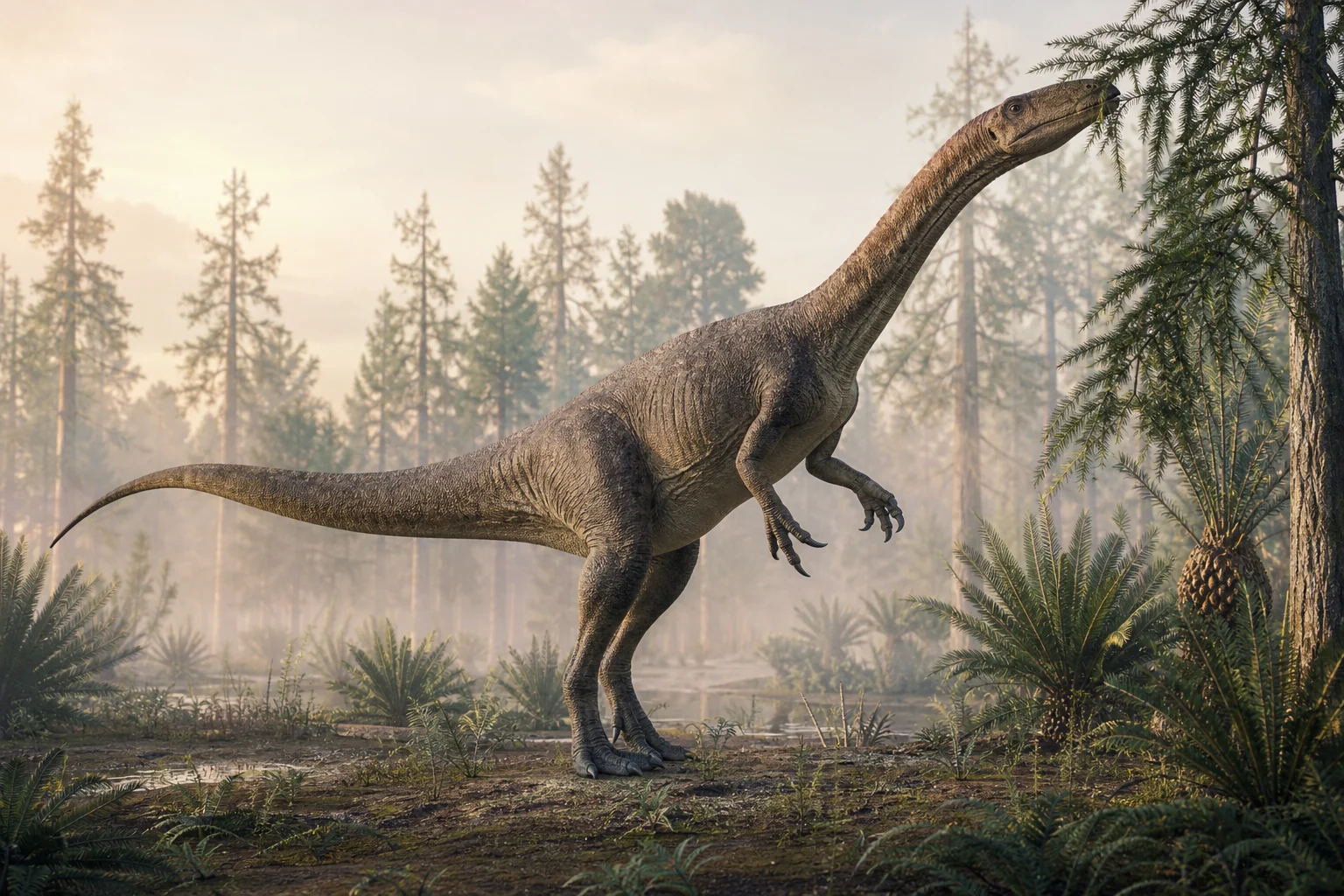 View original image · 1536 × 1024
Structured expansion · editorial review pending
- Time range
- About 214–204 million years ago
- Final stage
- Late Triassic
- Geographic range
- Central Europe
01 / ANSWER FIRST
What does the evidence show about Plateosaurus?
Plateosaurus was a Late Triassic sauropodomorph from central Europe. It combined a long neck with grasping hands and strongly developed hind limbs.
It helps test how the body plan preceding giant sauropods worked, without assuming it already walked like a four-legged sauropod.
02 / QUICK FACTS
Plateosaurus at a glance
- Scientific name
- Plateosaurus trossingensis
- Research focus
- Hands under test
03 / ANATOMY
How was Plateosaurus built?
Hands under test
Reiss and Mallison's 2014 joint-motion model found insufficient finger extension for weight-bearing quadrupedal walking.
Posture in three dimensions
Mallison's digital skeleton allowed alternative limb and neck poses to be checked against joint geometry.
04 / DIET & BEHAVIOUR
Reaching plants
A long neck expanded feeding reach. The exact plants eaten cannot be identified from reach alone.
05 / DIET & BEHAVIOUR
Walking on hind limbs
The hand study supports bipedal locomotion, with the hands better suited to grasping than routine weight support.
06 / RANGE & HABITAT
Where and when did Plateosaurus live?
Important skeleton collections come from Trossingen and Halberstadt in Germany and Frick in Switzerland. Species names applied to these materials have varied between studies.
07 / FOSSIL EVIDENCE
What evidence supports reconstructions of Plateosaurus?
Reconstructed movement
Joint models constrain possible poses; missing cartilage and soft tissue still introduce uncertainty.
Names and specimens
A result reported for P. engelhardti should be read with the authors' specimen assignments, rather than silently applied to every Plateosaurus fossil.
08 / DISAPPEARANCE & DEBATE
What remains uncertain?
A last fossil occurrence does not demonstrate that a named extinction event killed this particular species. The sources below primarily address anatomy and locomotion.
The linked sources support the specific observations above. An occurrence record alone does not identify an extinction mechanism.
09 / FREQUENTLY ASKED QUESTIONS
Plateosaurus FAQ
Did it normally walk on four legs?
The cited hand-motion study supports a biped, not routine quadrupedal walking.
Was it a giant sauropod?
It was an earlier sauropodomorph with a different locomotor anatomy.
04 / SOURCES & FURTHER READING
Check the source record
Use the scientific name to compare taxonomy, occurrence records and the fossil record. Database coverage and classifications may differ.
05 / REVISION HISTORY
How has this record changed?
- Replaced repeated expansion text with specimen-specific evidence, linked research and explicit limits; independent editorial review is pending.
- Completed an AI-assisted bilingual audit of the archive record, corrected identified issues and clarified evidence limits; independent editorial review is pending.
- Expanded into a structured bilingual profile with anatomy, ecology, range, evidence, debate and FAQs; independent editorial review is pending.
- Verified authoritative entity sources and added three responsive reconstruction sizes.
- Initial bilingual species record published.
06 / CORRECTIONS & ADDITIONS