
Explore this animal in Size of Extinct Animals ↗
38 / Paleozoic
Inostrancevia
Inostrancevia alexandri
Long saber canines armed one of the largest predators of the latest Permian.
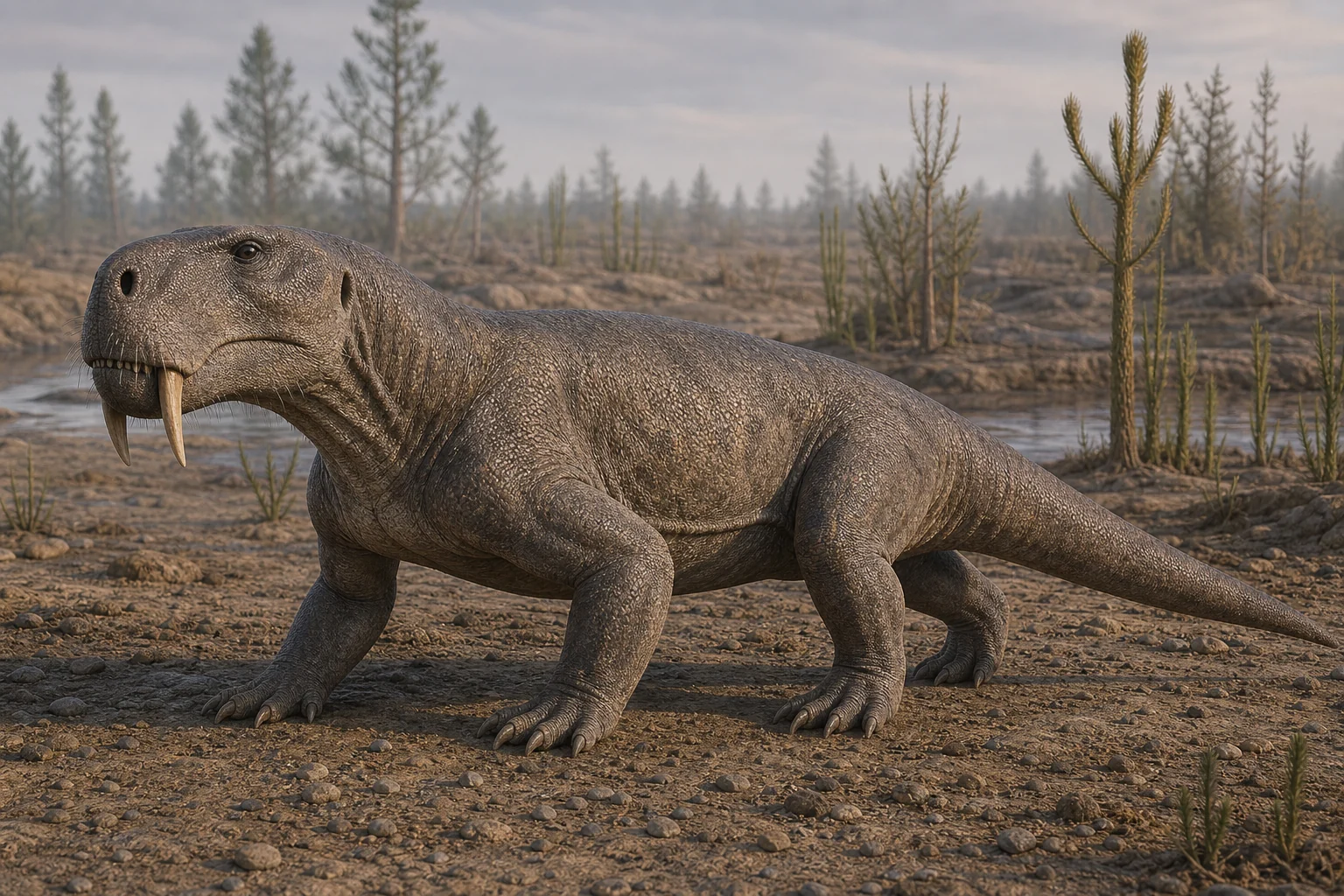 View original image · 1536 × 1024
- Time range
- About 259–252 million years ago
- Final stage
- End of the Permian
- Geographic range
- Northern Pangaea · Present-day Russia
01 / ANSWER FIRST
What was Inostrancevia?
Inostrancevia was a large saber-canine gorgonopsian and one of the apex terrestrial predators of the latest Permian in what is now Russia.
It was not a dinosaur. As a therapsid synapsid, it belongs on the mammal side of the amniote family tree, although it was far outside Mammalia and combined sprawling and more upright features.
02 / QUICK FACTS
Inostrancevia at a glance
- Scientific name
- Inostrancevia alexandri
- Age
- Latest Permian, about 259–252 Ma
- Group
- Gorgonopsian therapsid
- Length
- Roughly 3–3.5 m in large individuals
- Diet
- Large terrestrial vertebrates
- Range
- European Russia
- Key weapon
- Elongate upper canines
- Extinction
- End-Permian ecosystem collapse
03 / ANATOMY
A therapsid predator before true mammals
Saber-like canines
Long upper canines projected beyond the lower jaw and delivered deep puncturing bites; they were powerful but vulnerable to sideways bending.
Wide temporal openings
Large skull openings provided room for jaw muscles and are a defining synapsid feature.
Differentiated teeth
Incisors, canines and smaller postcanines performed different roles, foreshadowing the specialised dentition of later therapsids.
Semi-upright limbs
The limbs were not held exactly like those of a cat or dog, but posture and gait differed from many earlier sprawling synapsids.
04 / DIET & BEHAVIOUR
What did Inostrancevia hunt?
Large pareiasaurs and dicynodonts are plausible prey in the same communities. Direct predator-prey matches are uncommon, so exact preferences are inferred from size, teeth and association.
05 / DIET & BEHAVIOUR
How did saber canines work?
The animal likely opened its jaws wide and drove the canines into exposed soft tissue after gripping or destabilising prey. It was not a mammalian sabre-toothed cat, despite a functional resemblance.
06 / RANGE & HABITAT
Where did Inostrancevia live?
Classic specimens come from the North Dvina region of European Russia, deposited on seasonal river floodplains shortly before the end-Permian crisis.
Seasonal floodplains
Rivers shifted across dry landscapes and concentrated herbivores near water.
Open woodland and scrub
Patchy vegetation supported pareiasaurs and dicynodonts that formed the large-prey base.
Bone-bearing channels
Transport and burial can mix animals that did not die at exactly the same moment, so assemblages require stratigraphic control.
07 / FOSSIL EVIDENCE
How do fossils reveal a Permian apex predator?
Complete skulls
Skulls preserve canine roots, replacement teeth and jaw-muscle attachment surfaces.
Associated skeletons
Postcranial bones constrain body length, stance and running capacity better than skull scaling alone.
Tooth replacement
Developing canines inside the jaw show how a predator maintained its principal weapon after wear or breakage.
Stratigraphic communities
Precise rock-layer positions place Inostrancevia beside particular herbivores and track ecological collapse toward the Permian boundary.
08 / DISAPPEARANCE & DEBATE
Why did Inostrancevia go extinct?
It disappeared in the end-Permian mass extinction as extreme warming, aridity and food-web collapse eliminated both large prey and predator populations.
Siberian Traps volcanism drove global environmental stress. Top predators were especially vulnerable because they lived at low density and depended on every lower trophic level remaining productive.
09 / FREQUENTLY ASKED QUESTIONS
Inostrancevia FAQ
Was Inostrancevia a dinosaur?
No. It was a synapsid therapsid, more closely related to mammals than to dinosaurs, and lived before the first dinosaurs.
How large was Inostrancevia?
Large specimens are often reconstructed around three to three and a half metres long, though estimates vary with skeleton completeness.
Were its canines like Smilodon's?
Both evolved elongated killing canines, but they belonged to very distant lineages and differed in jaw, skull and prey-handling anatomy.
Did Inostrancevia live with Scutosaurus?
They occur in closely associated Late Permian Russian faunas, making Scutosaurus a plausible prey animal, though direct kills are not proven.
04 / SOURCES & FURTHER READING
Check the source record
Use the scientific name to compare taxonomy, occurrence records and the fossil record. Database coverage and classifications may differ.
05 / REVISION HISTORY
How has this record changed?
- Rewrote an extinction cause that presented environmental or faunal turnover as established; it is now given as context the record does not prove.
- Expanded into a curated bilingual A-tier profile with anatomy, ecology, range, evidence, debate and FAQs.
- Verified authoritative entity sources and added three responsive reconstruction sizes.
- Initial bilingual species record published.
06 / CORRECTIONS & ADDITIONS