
Explore this animal in Size of Extinct Animals ↗
51 / Mesozoic
Coelophysis
Coelophysis bauri
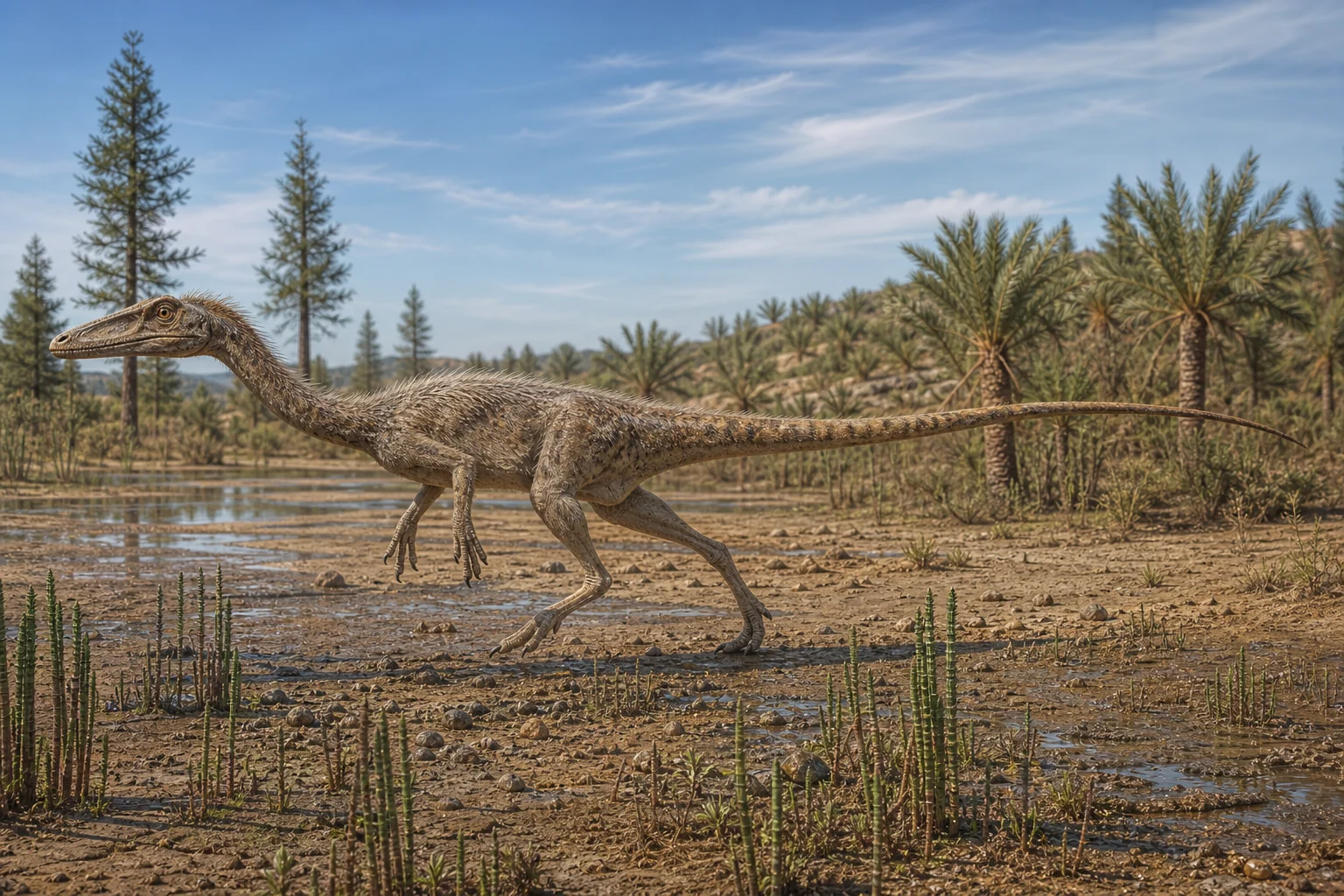
Coelophysis was a slender, two-legged theropod from the Late Triassic. Many skeletons occur together at Ghost Ranch in New Mexico.
 View original image · 1536 × 1024
Structured expansion · editorial review pending
- Time range
- About 216–203 million years ago
- Final stage
- Late Triassic
- Geographic range
- Southwestern North America
01 / ANSWER FIRST
What does the evidence show about Coelophysis?
Coelophysis was a slender, two-legged theropod from the Late Triassic. Many skeletons occur together at Ghost Ranch in New Mexico.
Its famous supposed cannibals show why identifying small bones matters more than repeating a dramatic story.
02 / QUICK FACTS
Coelophysis at a glance
- Scientific name
- Coelophysis bauri
- Research focus
- Light frame
03 / ANATOMY
How was Coelophysis built?
Light frame
A narrow body and hollow limb bones formed a lightly built animal; hollow does not mean empty of all internal structure.
Long hind limbs
Long legs and a balancing tail fit a mobile biped. They do not supply a measured maximum running speed.
04 / DIET & BEHAVIOUR
Prey inside a skeleton
A 2006 anatomical and histological study identified early crocodylomorph remains in the famous gut contents, rather than juvenile Coelophysis.
05 / DIET & BEHAVIOUR
Crowded burial
The Ghost Ranch accumulation records many deaths. A bonebed alone is not proof of coordinated pack hunting.
06 / RANGE & HABITAT
Where and when did Coelophysis live?
Ghost Ranch, in the Upper Triassic Chinle deposits of New Mexico, is the key locality for this account.
07 / FOSSIL EVIDENCE
What evidence supports reconstructions of Coelophysis?
Museum skeletons
AMNH's mount makes the long neck, hind limbs and tail visible together.
Testing cannibalism
Nesbitt and colleagues compared diagnostic bones and their microstructure. Their result removes support from these specimens, rather than proving the behavior never occurred.
08 / DISAPPEARANCE & DEBATE
What remains uncertain?
The cited specimens do not establish a species-level extinction mechanism. A mass-death deposit should not be confused with the last population of the species.
The linked sources support the specific observations above. An occurrence record alone does not identify an extinction mechanism.
09 / FREQUENTLY ASKED QUESTIONS
Coelophysis FAQ
Was it a proven cannibal?
The famous AMNH specimens do not substantiate that claim after re-examination.
Does the bonebed prove pack hunting?
No. Burial processes and social behavior need separate evidence.
04 / SOURCES & FURTHER READING
Check the source record
Use the scientific name to compare taxonomy, occurrence records and the fossil record. Database coverage and classifications may differ.
05 / REVISION HISTORY
How has this record changed?
- Replaced repeated expansion text with specimen-specific evidence, linked research and explicit limits; independent editorial review is pending.
- Completed an AI-assisted bilingual audit of the archive record, corrected identified issues and clarified evidence limits; independent editorial review is pending.
- Expanded into a structured bilingual profile with anatomy, ecology, range, evidence, debate and FAQs; independent editorial review is pending.
- Verified authoritative entity sources and added three responsive reconstruction sizes.
- Initial bilingual species record published.
06 / CORRECTIONS & ADDITIONS