
Explore this animal in Size of Extinct Animals ↗
272 / Mesozoic
Torvosaurus
Torvosaurus tanneri
A huge skull and unusually powerful three-fingered arms marked one of the largest megalosaurids.
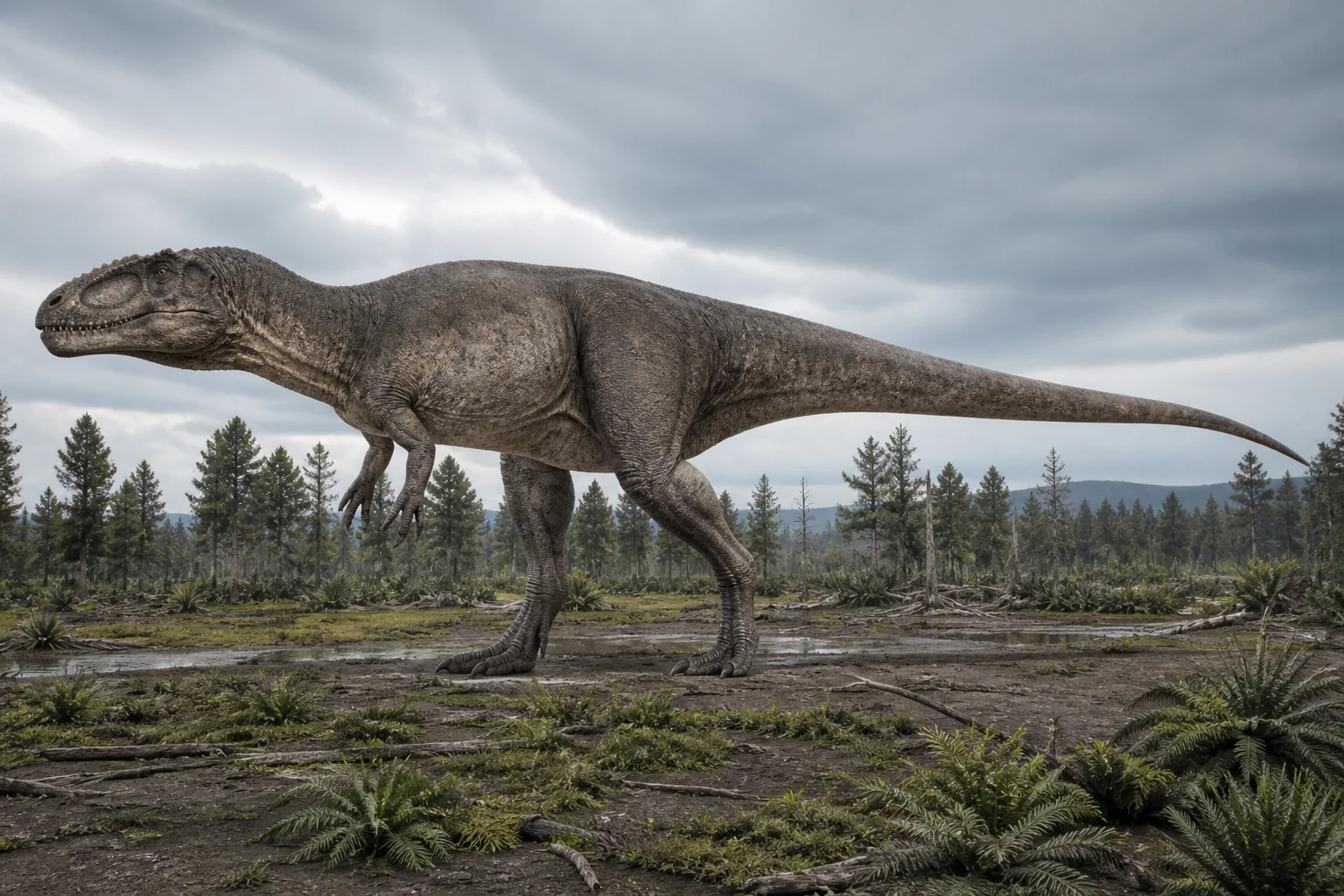 View original image · 1536 × 1024
- Time range
- About 153–148 million years ago
- Final stage
- Late Jurassic
- Geographic range
- River plains and open woodland · North America
01 / ANSWER FIRST
What was Torvosaurus?
Torvosaurus was a large megalosaurid theropod of the Late Jurassic. This archive record concerns the North American species Torvosaurus tanneri, rather than the Portuguese species T. gurneyi.
Its deep jaws and large serrated teeth identify a meat-eating dinosaur. Comparisons with Allosaurus are useful because both occur in the Morrison Formation, but they belonged to different theropod branches.
02 / QUICK FACTS
Torvosaurus at a glance
- Species here
- Torvosaurus tanneri
- Length
- About 10 m; genus-level reference
- Period
- Late Jurassic
- Diet
- Carnivorous
- Formation
- Morrison Formation, western USA
- Family
- Megalosauridae
Torvosaurus size: was it bigger than Allosaurus?
The Natural History Museum gives Torvosaurus a genus-level reference length of about 10 metres. It was among the largest Jurassic predators, but the material does not justify assigning one exact length or mass to every adult.
The 2014 description estimated the Portuguese T. gurneyi at about 10 metres and 4–5 tonnes. Those figures concern another species and specimen reconstruction; they should not silently become measurements of the American T. tanneri.
A meaningful comparison with Allosaurus must specify individuals and the metric. Longer jaws, longer bodies and greater body mass are different claims, especially when skeletons are incomplete.
Life and discovery timeline
Morrison ecosystems
T. tanneri lived in western North America among diverse sauropods and other theropods.
T. tanneri named
Galton and Jensen established Torvosaurus from North American material.
A Portuguese species
Hendrickx and Mateus named T. gurneyi, distinguishing its maxilla from T. tanneri.
03 / ANATOMY
A large-jawed megalosaurid
Serrated teeth
Laterally compressed teeth with cutting edges support flesh processing. Tooth form does not identify a single preferred prey species.
Deep maxilla
The upper jaw preserves useful diagnostic characters. Its openings, margins and tooth positions help compare North American and Portuguese specimens.
Bipedal body
Hindlimbs supported locomotion while the tail helped balance the body. Claims about maximum sprint speed need explicit biomechanical models.
04 / DIET & BEHAVIOUR
What did Torvosaurus eat?
Its feeding anatomy supports carnivory. The Morrison fauna offered many possible vertebrate foods, but habitat overlap is not direct evidence that Torvosaurus hunted a particular sauropod. Hunting and scavenging need not be mutually exclusive.
05 / DIET & BEHAVIOUR
Did it fight Allosaurus?
Both occur in the broad Morrison record, making ecological interaction possible. That does not document a particular confrontation, permanent rivalry or a scientifically predictable winner.
06 / RANGE & HABITAT
Where are Torvosaurus fossils found?
T. tanneri is associated with the Morrison Formation of western North America. Portuguese Torvosaurus material belongs to a separate regional and taxonomic discussion.
Morrison Formation
River deposits and floodplains preserve a patchwork of Late Jurassic environments. The formation spans substantial space and time; every listed dinosaur need not have lived at the same site.
Lourinhã Formation
The Portuguese T. gurneyi provides a comparison across the developing North Atlantic. A shared genus does not make the two species interchangeable.
07 / FOSSIL EVIDENCE
How do fossils distinguish species and behaviour?
Diagnostic bones
Descriptions document characters that can be checked on specimens. Identifying an isolated large tooth only as a large theropod can be more defensible than assigning a precise species.
Inference versus observation
Sharp teeth are observable; a detailed hunting sequence is reconstructed. Separating those levels keeps a predator profile useful without turning speculation into fossil evidence.
08 / DISAPPEARANCE & DEBATE
Why did Torvosaurus go extinct?
No specific extinction mechanism is established for T. tanneri. Its Jurassic record ends long before the asteroid impact 66 million years ago.
Environmental change and faunal turnover provide questions to investigate, not a demonstrated cause for this particular species.
09 / FREQUENTLY ASKED QUESTIONS
Torvosaurus FAQ
Was Torvosaurus bigger than T. rex?
Typical reconstructions of T. tanneri are shorter than large T. rex specimens. They also lived in different periods and never met.
Was Torvosaurus an Allosaurus?
No. Torvosaurus is a megalosaurid; Allosaurus belongs to a different theropod lineage.
Are T. tanneri and T. gurneyi the same species?
They were distinguished as separate species in the 2014 Portuguese description. This page's archive identity remains T. tanneri.
04 / SOURCES & FURTHER READING
Check the source record
Use the scientific name to compare taxonomy, occurrence records and the fossil record. Database coverage and classifications may differ.
05 / REVISION HISTORY
How has this record changed?
- Rewrote an extinction cause that presented environmental or faunal turnover as established; it is now given as context the record does not prove.
- Added a sourced bilingual topic hub covering size, discovery history, anatomy, diet, habitat, uncertainty and FAQs; updated search metadata.
- Verified authoritative entity sources and added three responsive reconstruction sizes.
- Initial bilingual species record published.
06 / CORRECTIONS & ADDITIONS