
SMILODON TOPIC HUB · HUNTING & EXTINCTION
How Did Smilodon Hunt and Why Did It Go Extinct?
Evidence for Smilodon hunting, saber protection, prey choice, possible social care and the interacting causes of its end-Pleistocene extinction.
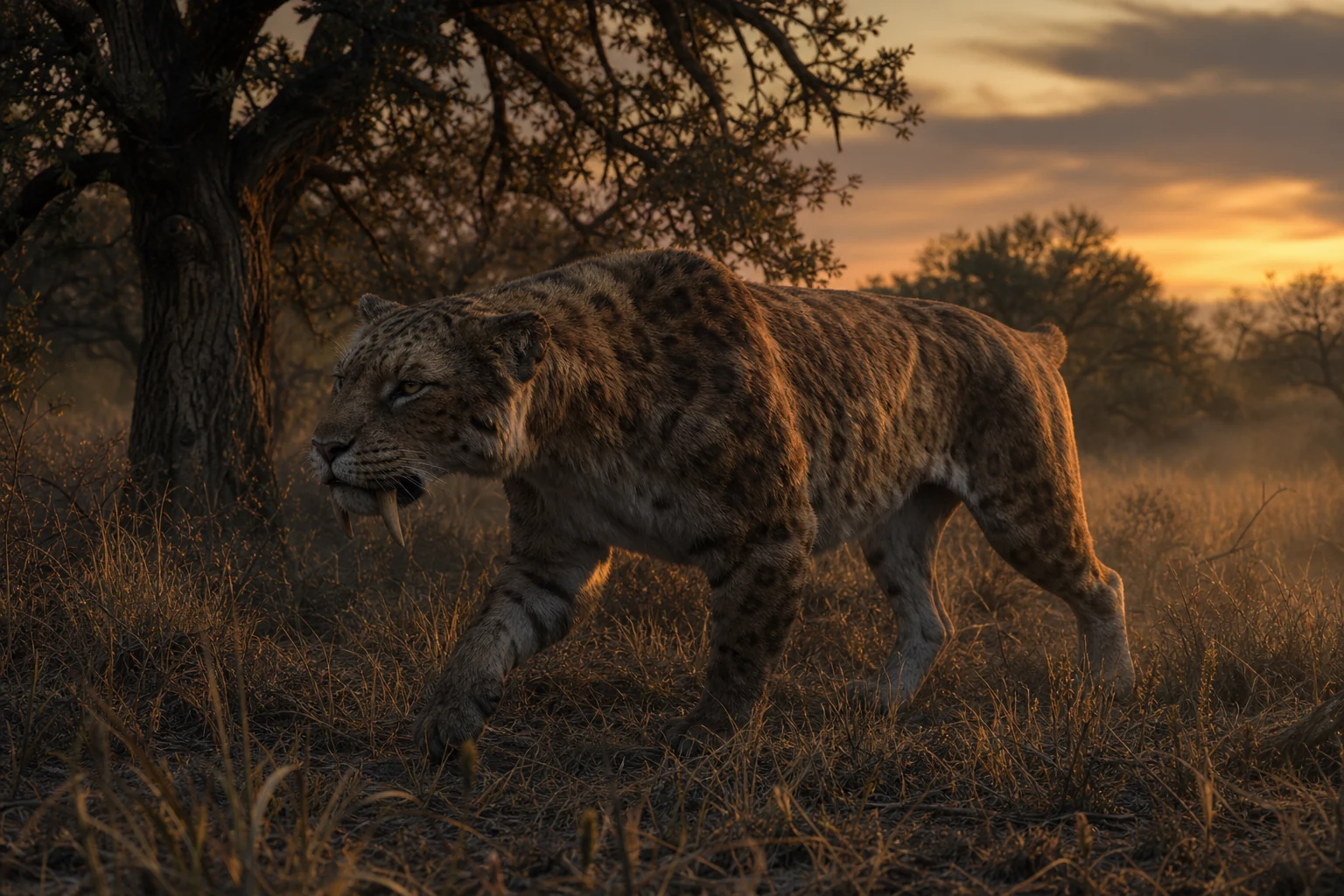 View full-resolution reconstruction ↗
Which dates and animal does this record describe?
This record focuses on Smilodon fatalis. The genus Smilodon includes other species with different ages and body sizes.
Species-level fossil record
Florida Museum summarizes its age range as roughly 700,000–11,000 years ago. This is an approximate fossil range, not a precise origin or extinction date.
Florida Museum · Smilodon fatalis ↗This is an original generative reconstruction, not a photograph or scientific plate. Measurements and interpretations below are tied to named sources.
01 / SABER CONTROL
How did Smilodon protect its saber teeth?
It likely pinned prey before delivering a targeted bite, reducing twisting loads that could snap the flattened canines. Reinforced forelimbs and neck muscles were therefore part of the weapon system, not separate features.
02 / PREY
What did Smilodon hunt?
Isotopes and associated faunas point to bison, horses, camels, juvenile ground sloths and other medium-to-large mammals. Diet varied by region and period rather than following one fixed menu.
03 / SOCIALITY
Did Smilodon live in groups?
Healed severe injuries and the abundance of individuals at La Brea are compatible with social care, but both have alternative explanations. Fossils do not reveal pride structure or coordinated hunts directly.
04 / LA BREA BIAS
Why are so many Smilodon fossils found together?
Trapped herbivores may have attracted repeated predators into asphalt seeps. The deposit gives an exceptional sample but overrepresents carnivores and cannot be treated as an ordinary living community.
05 / EXTINCTION
Why did Smilodon disappear?
Rapid warming and vegetation change coincided with collapses of large prey and expanding human impacts. A specialised reliance on restrainable large mammals may have made recovery harder, but no single cause is demonstrated everywhere.
06 / EVIDENCE VERDICT
What remains uncertain?
The anatomy strongly supports ambush and restraint; exact killing bites and social organisation remain debated. Extinction is best treated as a regional, multi-pressure process rather than a sudden universal event.
FREQUENTLY ASKED QUESTIONS
Questions readers ask
Was Smilodon a tiger?
No. It was a machairodontine cat on a separate extinct branch of Felidae.
How long were its saber teeth?
Large upper canines could reach about 28 cm including the root; the exposed crown was shorter.
How big was S. fatalis?
Often estimated around 160–280 kg, broadly lion-sized but more heavily built.
Did it hunt in groups?
Possible, but not proven. Injury survival and fossil abundance have multiple explanations.
What did it eat?
Large herbivores such as bison, camels and horses, varying by region and time.
Why did it disappear?
Prey loss, habitat change and human effects probably interacted; no single cause is established.
SOURCES & FURTHER READING
Evidence used in this guide
Measurements and interpretations are tied to museum resources or peer-reviewed studies; disputed conclusions include evidence on both sides.
- 01One of the earliest sabre-toothed mammals discovered in the USA ↗Natural History Museum, London
Overview of saber-tooth convergence and Smilodon canine function.
- 02Mammal Collections ↗La Brea Tar Pits
Official collection context for Smilodon and associated mammals.
- 03These Hips Don’t Lie ↗La Brea Tar Pits
Pathology and the debated inference of social care.