
OVIRAPTOR TOPIC HUB · ANATOMY & DIET
Oviraptor Size, Beak, Feathers and Diet
Reconstruct the crushed type without borrowing every Citipati feature.
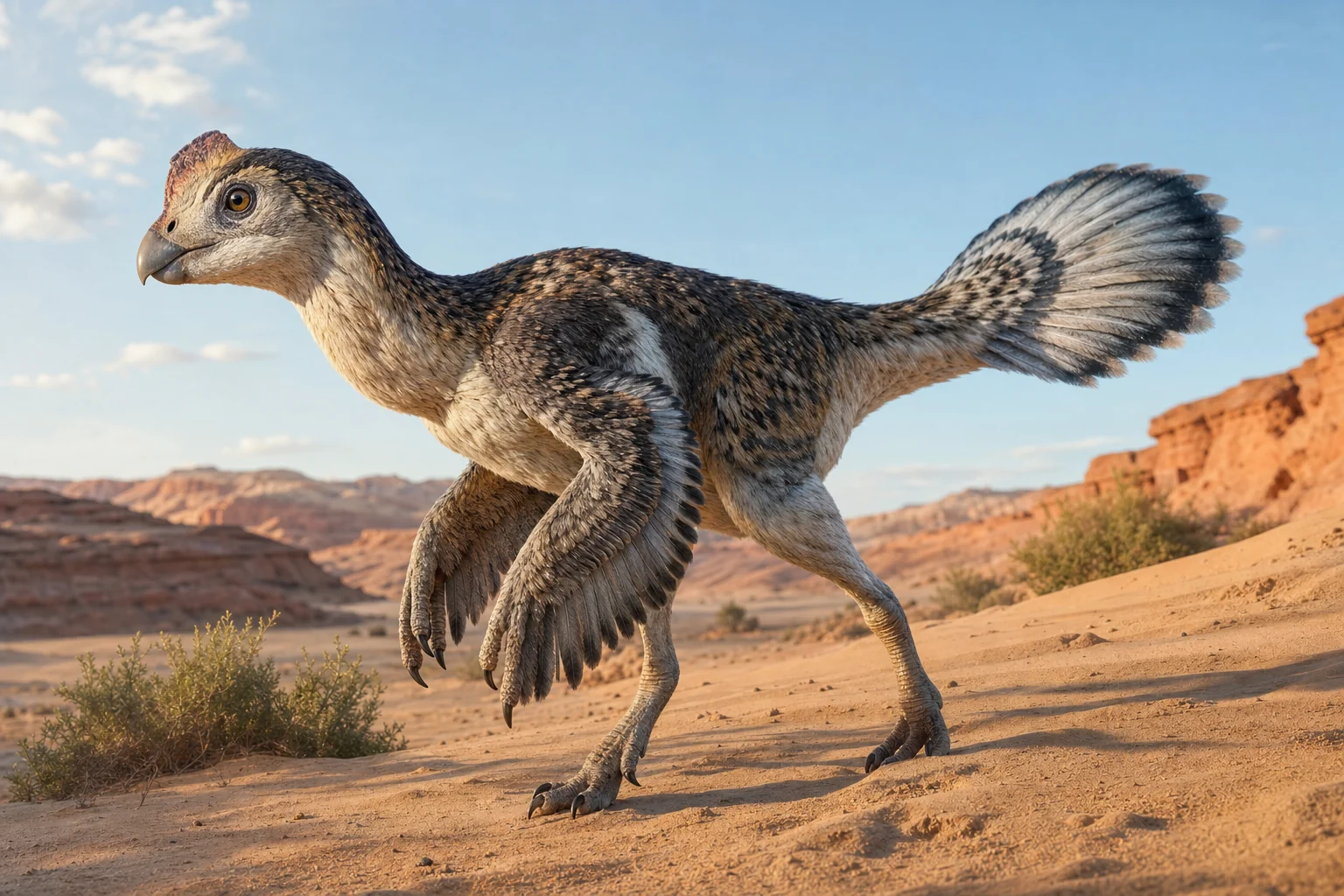 View full-resolution reconstruction ↗
This is an original generative reconstruction, not a photograph or scientific plate. Measurements and interpretations below are tied to named sources.
01 / QUICK ANSWER
What was Oviraptor?
Oviraptor was a roughly two-metre, feathered, toothless theropod from Late Cretaceous Mongolia whose misleading 'egg thief' name came from a nest misidentified in the 1920s.
The type specimen lay beside eggs then attributed to Protoceratops. Later embryos and brooding oviraptorids showed that this egg type belonged to oviraptorosaurs, making parental care more likely than theft, although the exact type-site behaviour remains unobservable.
02 / MEASUREMENTS
How large was Oviraptor?
Scientific name: Oviraptor philoceratops · Age: ~75–71 million years ago · Length: About 1.6–2 m · Mass: Roughly 20–35 kg · Mouth: Toothless beak and robust palate · Covering: Feathers strongly supported by relatives · Diet: Uncertain omnivory or specialised feeding · Range: Gobi Desert, Mongolia
03 / ANATOMY
A bird-like theropod with a powerful toothless mouth
Toothless beak: A keratin sheath covered deep upper and lower jaws.
Palatal projections: Bony structures may have crushed or gripped food.
Feathered arms: Oviraptorosaur wings covered eggs and aided display.
Crest uncertainty: The type skull is crushed; large crests in art often follow relatives.
04 / FUNCTION
Was Oviraptor really stealing eggs?
The original eggs were assigned to abundant Protoceratops, so the nearby theropod was interpreted as a nest raider. Oviraptorid embryos later appeared inside the same elongate egg type, overturning the identification.
Adults of close relatives such as Citipati are preserved centred over circular clutches with arms spread around the eggs, a brooding posture comparable to birds. The name remains valid historically even though its literal story is no longer supported.
05 / FOSSIL EVIDENCE
How do scientists know about Oviraptor?
Type skeleton: A crushed partial individual establishes the species.
Egg embryos: Related embryos identify elongate eggs as oviraptorosaur.
Brooding adults: Citipati specimens preserve bird-like nest posture.
Comparative skulls: Better oviraptorid skulls reconstruct missing beak and crest regions.
06 / EVIDENCE VERDICT
Why does the egg-thief myth persist?
The memorable name predates the embryo evidence, while popular images often combine Oviraptor with better-known Citipati anatomy.
Responsible pages retain the historical name but explain that the nest probably belonged to an oviraptorosaur and that diet remains open.
FREQUENTLY ASKED QUESTIONS
Questions readers ask
How big was Oviraptor?
About 1.6–2 metres long and roughly 20–35 kilograms.
Did it steal eggs?
The famous nest likely contained oviraptorosaur eggs, not stolen Protoceratops eggs.
Did it have feathers?
Feathered close relatives and brooding wings make feathers strongly supported.
Did it have teeth?
No; it had a deep toothless beak and specialised palate.
What did it eat?
Its precise diet remains uncertain and may have been omnivorous.
Was its crest like Citipati's?
Possibly, but the crushed type does not preserve the same complete crest evidence.
SOURCES & FURTHER READING
Evidence used in this guide
Measurements and interpretations are tied to museum resources or peer-reviewed studies; disputed conclusions include evidence on both sides.
- 01Dinosaur eggs ↗American Museum of Natural History
Museum history of the Oviraptor egg misidentification and embryo evidence.
- 02Follow the Fossil Specimen ↗American Museum of Natural History
Brooding oviraptorid specimen and preparation evidence.
- 03Oviraptor philoceratops ↗Paleobiology Database
Taxonomic and occurrence record.