
Extinction & survival
Is the megalodon really extinct?
Published · Editorial policy
The short answer
Yes. Evidence supports extinction around 3.6 million years ago, and no living megalodon has been scientifically confirmed. Unexplored ocean does not itself provide evidence that this particular shark survives.
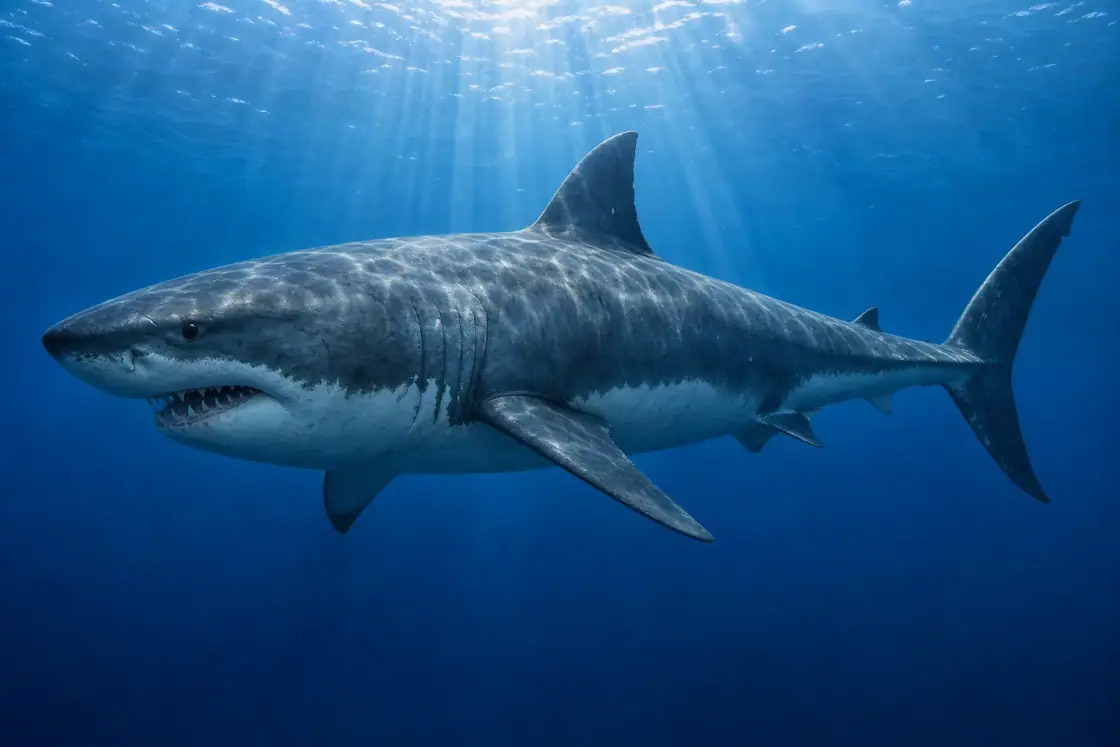
How researchers date its disappearance
In 2019, Robert Boessenecker and colleagues reassessed megalodon records, particularly from the eastern North Pacific. They examined whether supposedly young teeth were correctly dated and whether older fossils had been moved into younger deposits. Their analysis placed extinction near 3.6 million years ago, earlier than the often repeated 2.6-million-year estimate. This is a conclusion from the geological record, not an observed date for the death of the final shark.
Why the deep ocean is not a convincing refuge
A surviving population would need food and would leave physical traces, including shed teeth. No modern megalodon remains have been verified. The deepest trenches also offer little food for a predator adapted to taking large prey. Missing exploration is a gap in our observations; it does not cancel the fossil evidence or supply evidence of survival.
Extinction is clear; the cause is still being tested
Tooth chemistry provides two useful clues. Zinc isotopes indicate that early great whites and megalodon sometimes fed at similar positions in the food web, making competition plausible. Separate temperature research suggests megalodon maintained an elevated body temperature, which would have required substantial energy. Together these findings help explain vulnerability when food webs changed. They do not prove that great whites alone caused extinction, or identify a single event that killed every population.
What remains uncertain
The fossil record cannot identify the final individual. Better dating may refine the timing without providing evidence of present-day survival.
Related questions
Did megalodon evolve into the great white shark?
No. Megalodon and great whites belong to different evolutionary lineages. Their similar cutting teeth do not make one the direct ancestor of the other; their lineages overlapped in time.
Why do we find teeth more often than skeletons?
Shark teeth are hard and resist decay, while their largely cartilaginous skeletons preserve less readily. Sharks also replace teeth repeatedly, creating many more opportunities for teeth to enter the fossil record.
Sources & further reading
- Boessenecker et al. (2019), The Early Pliocene extinction of Otodus megalodon ↗
- Natural History Museum: Is megalodon still alive? ↗
- McCormack et al. (2022), Trophic position of Otodus megalodon and great white sharks through time revealed by zinc isotopes ↗
- Griffiths et al. (2023), Endothermic physiology of extinct megatooth sharks ↗
- Natural History Museum: Megalodon, the truth about the largest shark that ever lived ↗
Meet the species
Keep exploring

When and why did the dodo go extinct?
The last reliable sighting, uncertainty about the final date, hunting and introduced animals.
Read the answer ↗
Why did woolly mammoths go extinct?
Climate, human pressure and the last island populations.
Read the answer ↗
What are some of the most recently extinct animals?
Explore recent losses, with last-record dates kept distinct from extinction dates.
Read the answer ↗