
Explore this animal in Size of Extinct Animals ↗
65 / Cenozoic
Basilosaurus
Basilosaurus isis
This long-bodied early whale still carried tiny external hind limbs.
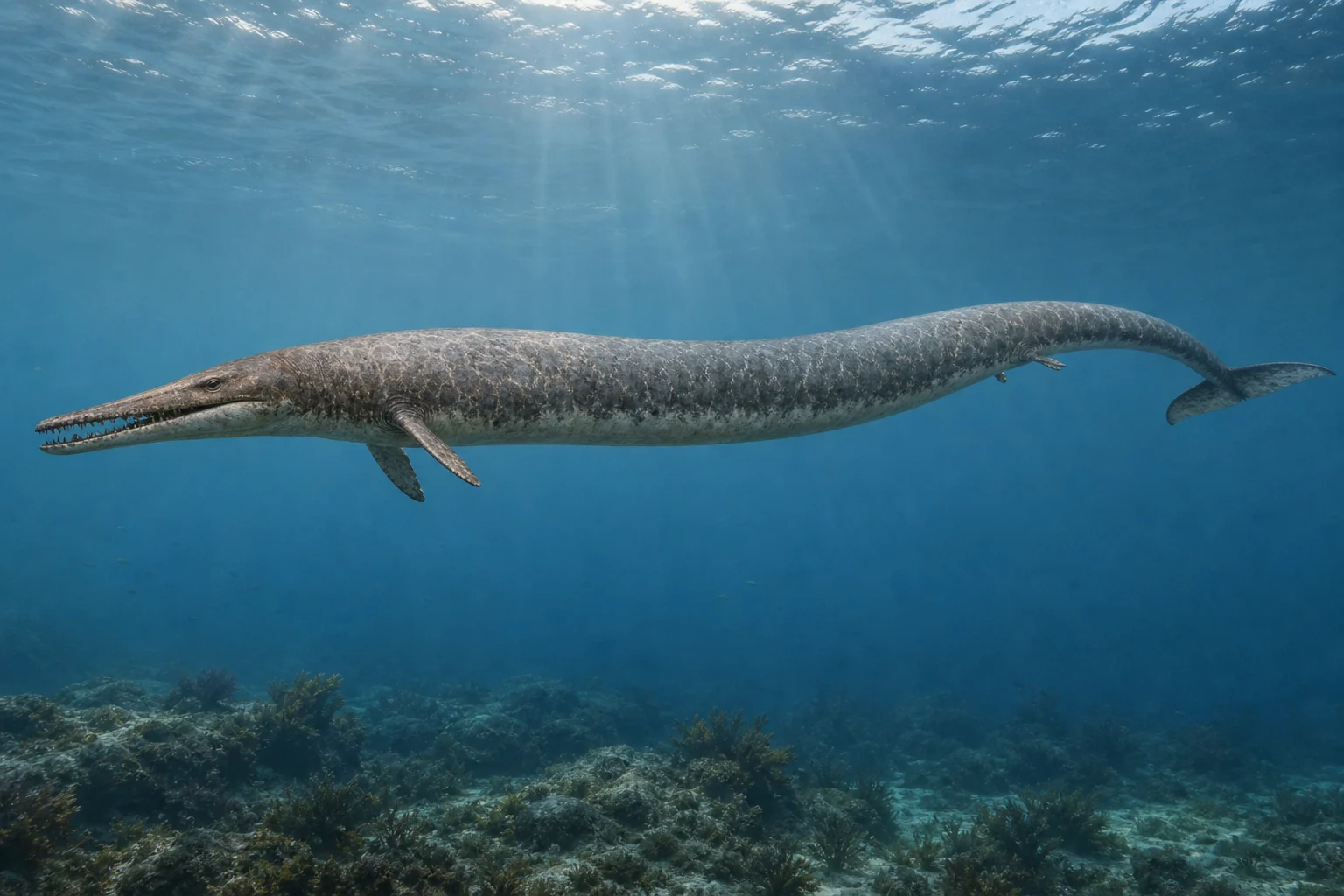 View original image · 1536 × 1024
- Time range
- About 41–34 million years ago
- Final stage
- Late Eocene
- Geographic range
- Tethys Sea · North American coasts
01 / ANSWER FIRST
What was Basilosaurus?
Basilosaurus isis was a fully aquatic early whale and large predator of late-Eocene seas, not a marine reptile despite its name meaning king lizard.
Its unusually long trunk contained elongated vertebrae, and tiny external hind limbs could not support walking. Fossil stomach contents include juvenile Dorudon whales and fish, directly identifying prey.
02 / QUICK FACTS
Basilosaurus at a glance
- Scientific name
- Basilosaurus isis
- Age
- ~38–36.5 million years ago
- Length
- About 15–18 m
- Identity
- Fully aquatic archaeocete whale
- Hind limbs
- Tiny, external, non-walking
- Propulsion
- Tail and small fluke
- Diet
- Fish and smaller whales
- Key locality
- Wadi Al-Hitan, Egypt
03 / CORE QUESTION
Why did Basilosaurus still have hind legs?
Its pelvis no longer joined the vertebral column, and the limbs were far too small to bear body weight. They are evolutionary remnants retained after whales became fully aquatic rather than evidence that Basilosaurus walked on land.
Joints and muscle attachments suggest the limbs remained mobile and may have served as copulatory guides during mating. That function is plausible from anatomy but cannot be watched directly in fossils.
Read the complete whale-evolution anatomy guideHow to read the numbers
This page separates direct evidence, comparative inference and unresolved debate.
04 / LIFE & DISCOVERY TIMELINE
A fully marine whale retaining its terrestrial history
Whales become fully marine
Basilosaurids lose weight-bearing contact between pelvis and spine.
Basilosaurus apex predator
Large adults hunt fish and smaller whales in Tethyan seas.
Mistaken for a reptile
Fragmentary vertebrae inspire the misleading lizard name.
Feet and diet resolved
Complete limbs and stomach contents reveal anatomy and prey.
05 / ANATOMY
An elongated whale powered from the rear
Elongated vertebrae
Long trunk vertebrae created a serpentine outline without reptilian sidewinding.
Tiny hind feet
Complete femur, lower leg and toes remained external but non-weight-bearing.
Flipper forelimbs
Elbows retained some movement while hands formed steering paddles.
Tail propulsion
Tail vertebrae support dorsoventral swimming and a modest fluke.
06 / DIET & BEHAVIOUR
What did Basilosaurus eat?
Associated stomach contents include fish and juvenile Dorudon, while bite marks support attacks on smaller whales.
Read the complete guide07 / DIET & BEHAVIOUR
Was it a deep diver?
Body form and Wadi Al-Hitan setting favour shelf and coastal seas; deep-diving performance is not demonstrated.
08 / RANGE & HABITAT
Where did Basilosaurus live?
Basilosaurus species were widespread in late-Eocene warm seas; B. isis is especially well documented from Egypt's former Tethyan coast.
Wadi Al-Hitan
Hundreds of whale skeletons preserve an ecosystem and life stages.
Fayum coast
Shallow marine sediments hold adults and prey.
Tethys Sea
Warm intercontinental waters connected populations.
Global relatives
Related Basilosaurus fossils occur in North America and other coasts.
09 / FOSSIL EVIDENCE
How do scientists know about Basilosaurus?
Articulated skeletons
Complete columns constrain true body length and swimming form.
Hind-limb bones
Feet directly record a non-walking evolutionary remnant.
Stomach contents
Prey bones within one body provide direct diet evidence.
Bite marks
Tooth spacing on Dorudon skulls tests predation scenarios.
10 / DISAPPEARANCE & DEBATE
Why did Basilosaurus disappear?
Basilosaurus vanished near the Eocene–Oligocene transition as oceans cooled and whale communities reorganised; no single species-level cause is proven.
Later whales evolved different body proportions, feeding systems and habitats. Evolutionary replacement describes turnover, but does not prove direct competitive extermination.
12 / FREQUENTLY ASKED QUESTIONS
Basilosaurus FAQ
Was Basilosaurus a dinosaur?
No. It was a fully aquatic early whale.
How long was Basilosaurus?
B. isis reached roughly 15–18 metres.
Could it walk on land?
No. Its tiny hind limbs could not bear weight and its pelvis was detached from the spine.
Why did it have feet?
They were evolutionary remnants, possibly retained for mating.
What did it eat?
Fish and smaller whales, including juvenile Dorudon.
Did it have a whale tail?
Tail anatomy supports a small horizontal fluke and up-down propulsion.
04 / SOURCES & FURTHER READING
Check the source record
Use the scientific name to compare taxonomy, occurrence records and the fossil record. Database coverage and classifications may differ.
05 / REVISION HISTORY
How has this record changed?
- Rewrote an extinction cause that presented environmental or faunal turnover as established; it is now given as context the record does not prove.
- Expanded into a bilingual S-tier hub with two evidence-led guides.
- Verified authoritative entity sources and added three responsive reconstruction sizes.
- Initial bilingual species record published.
06 / CORRECTIONS & ADDITIONS