
MEGALODON TOPIC HUB · SIZE & RECONSTRUCTION
Megalodon Size, Teeth and Body Shape: What Fossils Support
How big was Megalodon? Compare tooth-based equations, rare vertebrae, the 24.3-metre maximum, body mass and the uncertainty of its complete outline.
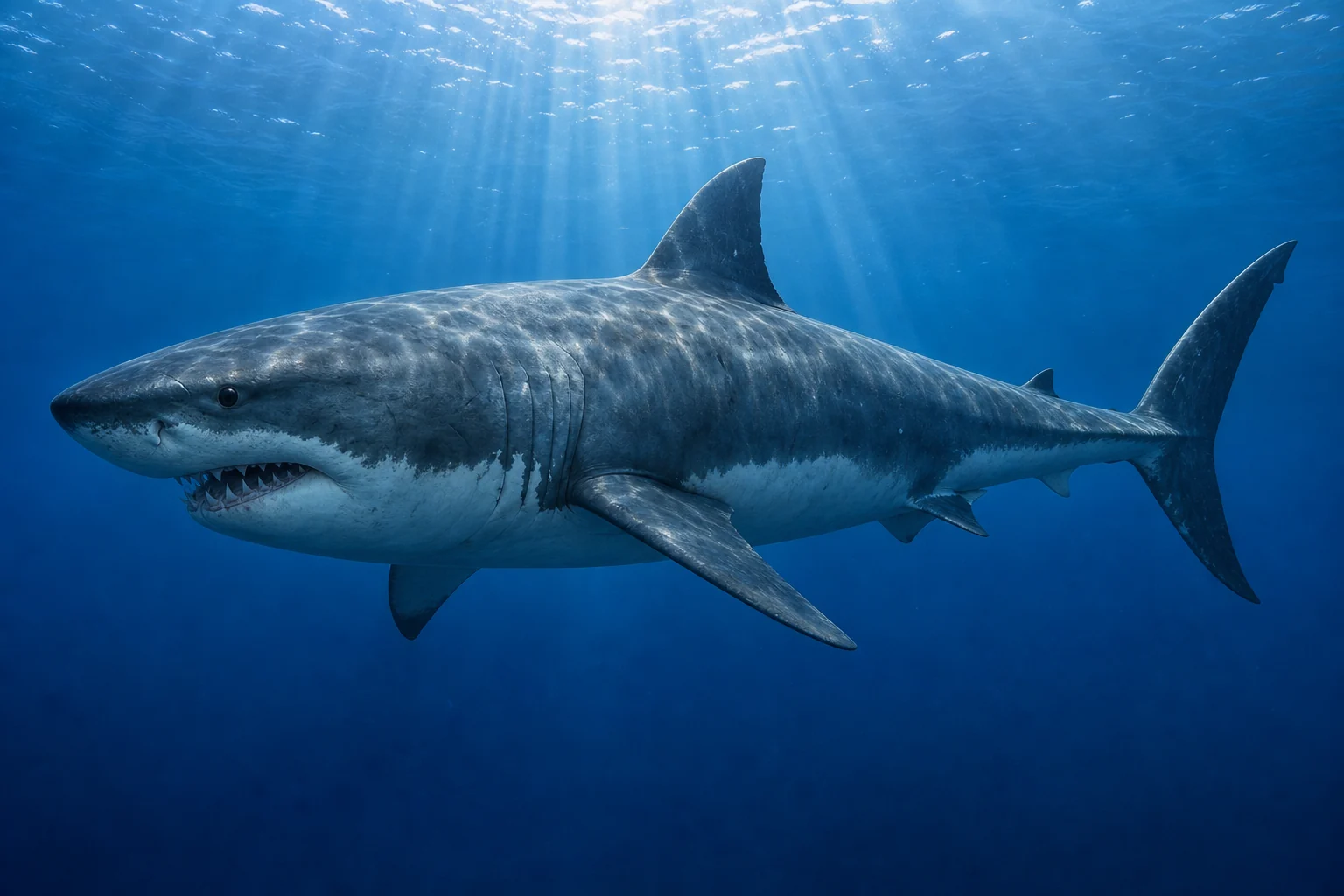 View full-resolution reconstruction ↗
This is an original generative reconstruction, not a photograph or scientific plate. Measurements and interpretations below are tied to named sources.
01 / EVIDENCE LIMITS
Why is Megalodon size so difficult to measure?
Shark skeletons are mostly cartilage. Megalodon left thousands of mineralised teeth but only scattered calcified vertebral centra and no complete skull, trunk or fins. A tooth can be measured precisely; the body attached to it cannot.
Researchers therefore use relationships between tooth dimensions, vertebral diameter and body length in living lamniform sharks. The result is a model with assumptions, not a ruler laid beside a complete animal.
Direct
Tooth crown, root and vertebral dimensions.
Inferred
Total length, mass, head and fin proportions.
02 / TOOTH EQUATIONS
How do teeth become a body-length estimate?
Different teeth occupy different positions in a shark jaw. An anterior tooth is not interchangeable with a lateral or posterior tooth, and crown height, width and slant each scale differently. Applying the wrong position can produce large errors.
The most useful associated dentitions preserve multiple teeth from one individual. They help reconstruct jaw width and test equations, but they still require a living or fossil comparison group. Megalodon was not a great white, so great-white-only scaling can force an incorrect outline.
03 / VERTEBRAL EVIDENCE
What do the rare vertebrae add?
A Belgian specimen preserves an approximately 11-metre vertebral column without the head and tail. Danish material includes exceptionally large centra. By comparing trunk, head and tail proportions across many lamniform sharks, researchers reconstructed a possible total length up to 24.3 metres.
That value is the largest currently defensible possibility, not a demonstrated common adult. Most teeth came from smaller animals and the preserved vertebral samples remain few.
04 / BODY FORM
Did Megalodon look like a giant great white?
Not necessarily. Great whites are one specialised branch of lamniform sharks, not Megalodon's direct modern model. Newer work reconstructs a proportionally longer, more streamlined trunk rather than an extremely deep-bodied white shark.
The exact snout, dorsal fin, tail lobes and colour remain unknown. Responsible palaeoart should show a plausible range and identify the reconstruction as an inference.
05 / COMPARISON
How did Megalodon compare with living sharks and whales?
Even a 15-metre Megalodon would be more than twice the length of a large great white. The 24.3-metre maximum approaches a medium blue whale in length, but whales and sharks distribute mass differently, so length alone does not equal body volume.
Mass estimates change rapidly with body shape because volume grows in three dimensions. The frequently cited 94 tonnes belongs to the exceptional maximum reconstruction, not to a typical tooth-bearing individual.
06 / EVIDENCE VERDICT
What is the most honest size answer?
Megalodon was unquestionably enormous, but the evidence supports a distribution of sizes rather than one number. Use 15–18 metres as a familiar large-adult orientation, treat 24.3 metres as an exceptional modelled maximum, and always state the fossil and equation behind a precise claim.
FREQUENTLY ASKED QUESTIONS
Questions readers ask
How big was Megalodon?
Large individuals are often reconstructed around 15–18 metres, while a 2025 analysis permits an exceptional maximum of 24.3 metres. The fossil record cannot supply one exact adult size.
Is Megalodon still alive?
No. Its youngest reliable teeth are about 3.6 million years old, and no modern teeth, carcasses, DNA or observations exist despite intensive ocean study.
Was Megalodon a giant great white shark?
No. They belong to different lineages, and recent reconstructions do not require the deep-bodied outline of a great white.
What was its bite force?
Very high values come from biomechanical models, not direct measurement. They depend strongly on reconstructed body size and jaw musculature.
What did Megalodon eat?
Marine mammals, large fishes and sharks. Bite marks and tooth chemistry show a high trophic position, but diet changed through life and geography.
Why are its teeth so common?
Sharks continuously replace hard mineralised teeth, while their cartilaginous skeletons usually decay.
SOURCES & FURTHER READING
Evidence used in this guide
Measurements and interpretations are tied to museum resources or peer-reviewed studies; disputed conclusions include evidence on both sides.
- 01Megalodon: the truth about the largest shark ↗Natural History Museum, London
Museum overview of fossils, size, body shape, diet and modern myths.
- 02Is Megalodon still alive? ↗Natural History Museum, London
Evidence for the 3.6-million-year extinction and multi-factor explanations.
- 03Reassessment of the biology of Otodus megalodon ↗Palaeontologia Electronica · DOI 10.26879/1502
2025 multi-author reconstruction of possible maximum size, form and life history.
- 04Estimating lamniform body size ↗Palaeontologia Electronica · DOI 10.26879/1140
Tests why isolated tooth position can create large differences in length estimates.
- 05Trophic position through time revealed by zinc isotopes ↗Nature Communications
Tooth chemistry comparing Megalodon and great-white trophic ecology.