
Explore this animal in Size of Extinct Animals ↗
62 / Cenozoic
Argentavis
Argentavis magnificens
Argentavis magnificens was a giant bird from Late Miocene Argentina. Its flight is reconstructed from incomplete fossils and aerodynamic models, not observations of a living bird.
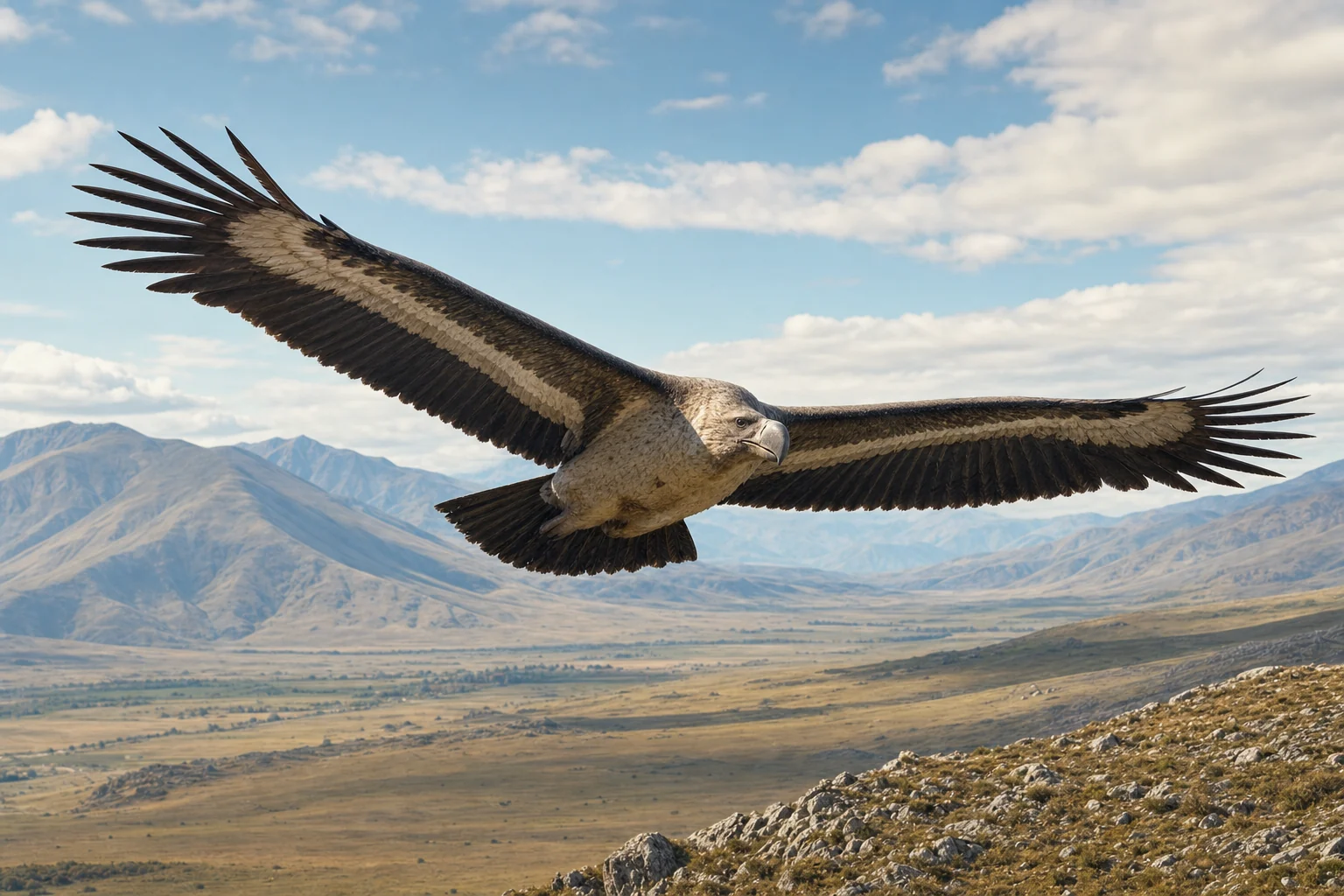 View original image · 1536 × 1024
Structured expansion · editorial review pending
- Time range
- About 8–6 million years ago
- Final stage
- Late Miocene
- Geographic range
- South America · Present-day Argentina
01 / ANSWER FIRST
What does the evidence show about Argentavis?
Argentavis magnificens was a giant bird from Late Miocene Argentina. Its flight is reconstructed from incomplete fossils and aerodynamic models, not observations of a living bird.
The useful question is how a very large bird could stay airborne. Comparing estimated wingspan, mass and wind conditions is more informative than simply calling it the largest.
02 / QUICK FACTS
Argentavis at a glance
- Scientific name
- Argentavis magnificens
- Research focus
- Estimated size
03 / ANATOMY
How was Argentavis built?
Estimated size
The 2007 model used about 7 m of wingspan and 70 kg of mass. These are reconstruction inputs, not direct measurements of a complete animal.
Scaling missing parts
Related teratorns supplied comparisons for missing skeletal elements. That introduces uncertainty into the reconstructed wing.
04 / DIET & BEHAVIOUR
Soaring
The simulations favor gaining energy from rising air rather than continuous powered flapping.
05 / DIET & BEHAVIOUR
Getting airborne
Downhill runs or launches from elevated ground were modeled as plausible aids. Takeoff depends on the assumed wind and terrain.
06 / RANGE & HABITAT
Where and when did Argentavis live?
The modeled bird is known from Late Miocene continental deposits in Argentina, around six million years old.
07 / FOSSIL EVIDENCE
What evidence supports reconstructions of Argentavis?
A flight calculation
Chatterjee and colleagues explicitly calculate performance from a reconstructed animal; simulation outputs are conditional estimates.
Comparing other giants
Ksepka's 2014 study of Pelagornis supplies a different giant-bird comparison. Its wing and mass estimates should not be transferred to Argentavis.
08 / DISAPPEARANCE & DEBATE
What remains uncertain?
The exact wing outline and flight envelope remain model-dependent. Flight studies alone do not identify why Argentavis became extinct.
The linked sources support the specific observations above. An occurrence record alone does not identify an extinction mechanism.
09 / FREQUENTLY ASKED QUESTIONS
Argentavis FAQ
Are 7 m and 70 kg exact measurements?
No. They are estimates used in the cited reconstruction.
Could it flap continuously?
The 2007 model favored soaring and did not support sustained flapping under its assumptions.
04 / SOURCES & FURTHER READING
Check the source record
Use the scientific name to compare taxonomy, occurrence records and the fossil record. Database coverage and classifications may differ.
05 / REVISION HISTORY
How has this record changed?
- Replaced repeated expansion text with specimen-specific evidence, linked research and explicit limits; independent editorial review is pending.
- Completed an AI-assisted bilingual audit of the archive record, corrected identified issues and clarified evidence limits; independent editorial review is pending.
- Expanded into a structured bilingual profile with anatomy, ecology, range, evidence, debate and FAQs; independent editorial review is pending.
- Verified authoritative entity sources and added three responsive reconstruction sizes.
- Initial bilingual species record published.
06 / CORRECTIONS & ADDITIONS