
Explore this animal in Size of Extinct Animals ↗
61 / Cenozoic
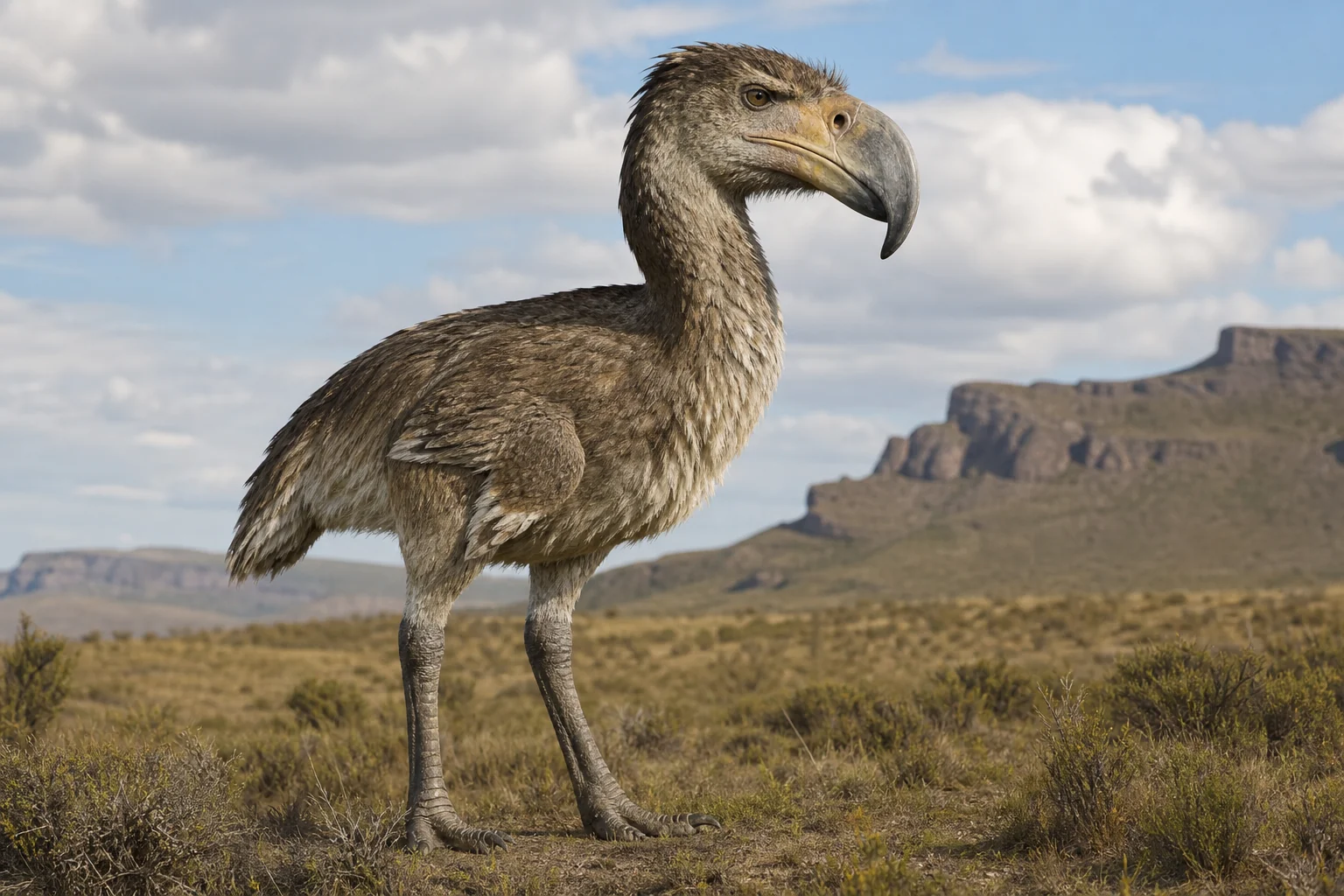
Phorusrhacos (Terror Bird)
Phorusrhacos longissimus
A tall flightless predator used a deep hooked beak to strike prey on the ground.
 View original image · 1536 × 1024
- Time range
- About 20–10 million years ago
- Final stage
- Miocene
- Geographic range
- Southern South America
Phorusrhacos and terror birds: the name matters
Phorusrhacos longissimus was a large flightless predatory bird from Miocene South America. ‘Terror bird’ names a wider family, so evidence from a different terror bird should not be presented as a direct measurement of Phorusrhacos.
Skull evidence
Published skull remains document its deep beak and cranial anatomy. They help distinguish the animal from reconstructions that combine features of different genera.
Speed and attack claims
Long legs support a terrestrial, mobile lifestyle, but there is no measured top running speed. A force model built for another terror bird is comparative evidence, not a filmed Phorusrhacos hunt.
01 / ANSWER FIRST
What was Phorusrhacos?
Phorusrhacos was a large flightless predatory bird from Miocene Patagonia, with a deep hooked beak, reduced wings and powerful running legs.
It belongs to Phorusrhacidae, the South American radiation nicknamed terror birds. Its skull was long known from incomplete material; better remains and comparisons help separate direct anatomy from dramatic but untested reconstructions.
02 / QUICK FACTS
Phorusrhacos at a glance
- Scientific name
- Phorusrhacos longissimus
- Age
- Early–Middle Miocene, roughly 20–10 Ma
- Height
- About 2.4 m in common reconstructions
- Diet
- Carnivorous
- Range
- Patagonia, Argentina
- Flight
- Flightless
- Locomotion
- Terrestrial runner
- Family
- Phorusrhacidae
03 / ANATOMY
A giant predatory bird, not a feathered dinosaur remake
Deep hooked beak
The tall, laterally compressed skull ended in a hooked tip suited to gripping and tearing. Beak force and exact strike behaviour are modelled, not directly observed.
Powerful neck
Large attachment areas indicate strong neck muscles that stabilised the head and could drive rapid movements.
Reduced wings
Short wings could not power flight. Their role in balance, display or manoeuvring remains uncertain.
Long running legs
Hindlimb proportions indicate terrestrial locomotion, but maximum speed cannot be read directly from bone length.
04 / DIET & BEHAVIOUR
What did Phorusrhacos eat?
It was a predator or large-bodied carnivore within Miocene food webs, probably taking vertebrate prey and carrion. Specific prey lists are hypotheses unless supported by direct associations.
05 / DIET & BEHAVIOUR
How did it hunt?
A strong beak and neck could deliver forceful bites or downward strikes. Computer models test possible loading, but living seriemas are analogues rather than exact behavioural copies.
06 / RANGE & HABITAT
Where did Phorusrhacos live?
Secure records come from Miocene deposits of Patagonia, especially the Santa Cruz Formation in southern Argentina.
Open woodland
Patchy woodland and shrub communities supplied cover and varied prey.
Floodplains
River systems buried bones among a rich assemblage of mammals, reptiles and birds.
Changing Patagonia
Cooling, drying and Andean uplift altered habitats through the Miocene.
07 / FOSSIL EVIDENCE
How do scientists reconstruct Phorusrhacos?
Skull remains
New and re-examined skull material constrains beak depth, palate, jaw articulation and sensory anatomy.
Hindlimb bones
Femora, tibiotarsi and feet reveal body support and running adaptations while leaving speed estimates model-dependent.
Santa Cruz fauna
Associated mammals and sediments reconstruct prey communities, vegetation and climate without proving every interaction.
Family comparison
Better-known terror birds help fill gaps, but features should not be transferred to Phorusrhacos without matching bones.
08 / DISAPPEARANCE & DEBATE
Why did Phorusrhacos disappear?
Phorusrhacos disappeared during Miocene faunal and environmental turnover; there is no evidence for one sudden species-specific catastrophe.
Its disappearance predates the final extinction of terror birds and the Great American Biotic Interchange. Climate, habitat and food-web change are broad context, not a demonstrated single cause.
09 / FREQUENTLY ASKED QUESTIONS
Phorusrhacos FAQ
Was Phorusrhacos a dinosaur?
It was a bird, and birds are living dinosaurs in evolutionary terms, but Phorusrhacos was not a non-avian dinosaur like Tyrannosaurus.
How tall was Phorusrhacos?
Common reconstructions place it around 2.4 metres tall, but complete skeletons are lacking and estimates vary.
Could Phorusrhacos fly?
No. Its wings were reduced and its heavy body was specialised for terrestrial life.
Did Phorusrhacos meet humans?
No. Phorusrhacos lived millions of years before humans reached South America.
04 / SOURCES & FURTHER READING
Check the source record
Use the scientific name to compare taxonomy, occurrence records and the fossil record. Database coverage and classifications may differ.
05 / REVISION HISTORY
How has this record changed?
- Rewrote an extinction cause that presented environmental or faunal turnover as established; it is now given as context the record does not prove.
- Expanded into a curated bilingual A-tier profile with anatomy, ecology, range, evidence, debate and FAQs.
- Verified authoritative entity sources and added three responsive reconstruction sizes.
- Initial bilingual species record published.
06 / CORRECTIONS & ADDITIONS