
MEGALODON TOPIC HUB · EXTINCTION EVIDENCE
Why Did Megalodon Go Extinct? Climate, Prey and Competition
Evidence for Megalodon's extinction 3.6 million years ago: ocean cooling, habitat change, prey turnover, great-white overlap and why no single cause is proven.
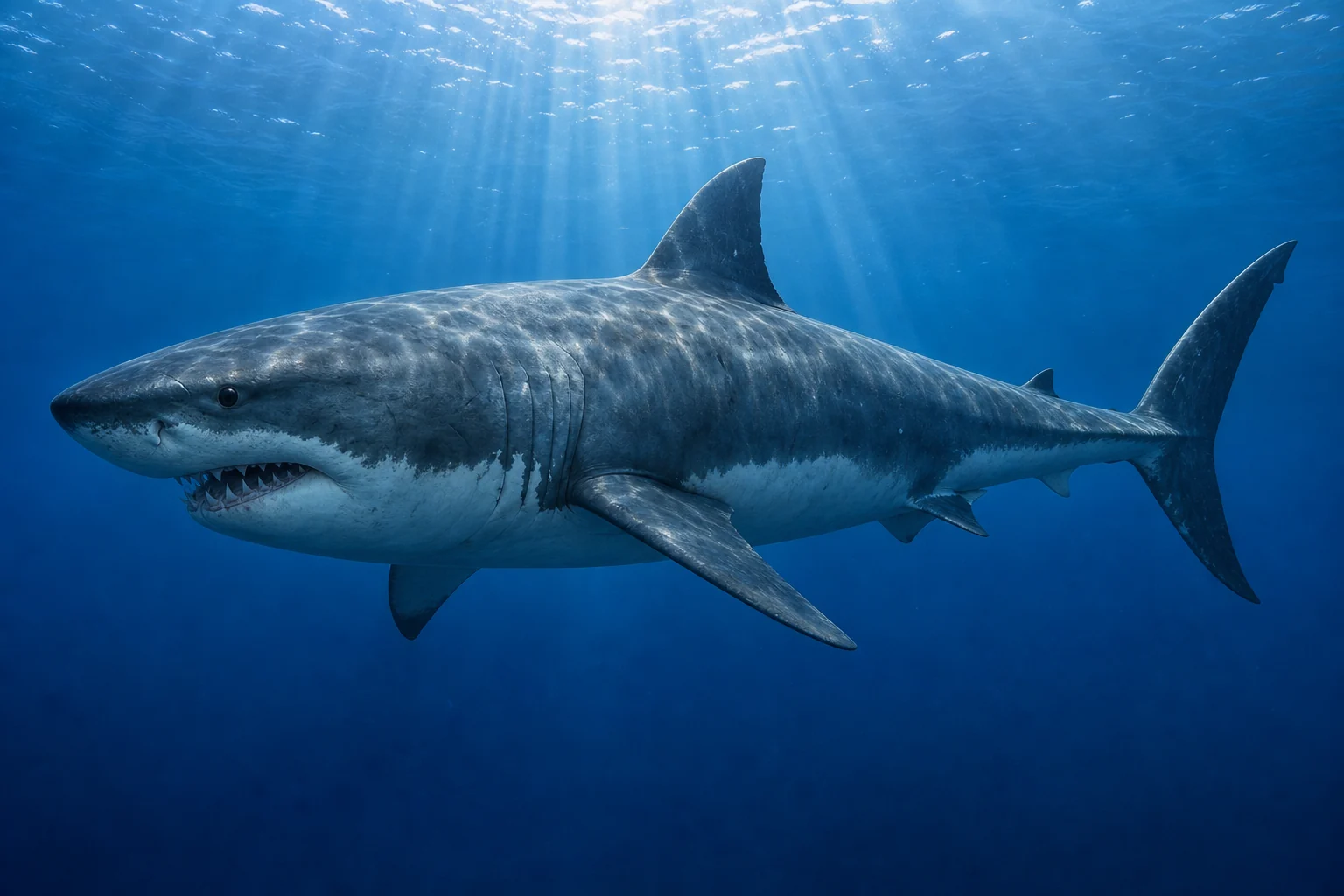 View full-resolution reconstruction ↗
This is an original generative reconstruction, not a photograph or scientific plate. Measurements and interpretations below are tied to named sources.
01 / EXTINCTION DATE
When did Megalodon go extinct?
The youngest well-dated teeth are about 3.6 million years old. Revised fossil databases moved the extinction earlier than older 2.6-million-year claims by excluding reworked or poorly dated specimens.
A global shark tooth record continues into younger rocks without Megalodon. That absence, combined with no fresh teeth, carcasses, DNA or observations, rules out modern survival.
02 / COOLING OCEANS
How did Pliocene cooling matter?
Megalodon fossils cluster in warm and temperate waters. Cooling changed currents, sea level and the position of productive shelves, shrinking or fragmenting suitable habitat in some regions.
Cooling alone is not enough: the lineage survived earlier climate swings. The important question is how late-Pliocene climate interacted with prey, reproduction and competitors.
03 / PREY TURNOVER
Did Megalodon run out of food?
Marine mammal communities changed as some small and medium whales declined or shifted toward colder, more seasonal waters. A very large shark required substantial predictable prey, especially during growth and reproduction.
Bite traces and tooth chemistry show a broad predatory diet, so Megalodon did not depend on one whale species. Food-web reorganisation, rather than disappearance of one prey, is the stronger model.
04 / COMPETITION
Did great white sharks replace Megalodon?
Zinc isotopes show Early Pliocene great whites and Megalodon occupied similar mean trophic levels at one well-sampled North Carolina locality. This makes resource competition plausible.
One locality cannot prove a global takeover. Great whites were smaller, ecologically flexible and better suited to some cooling seas, but competition should be treated as a contributing pressure rather than a single victorious duel.
05 / REPRODUCTION
Were nursery grounds a vulnerability?
Shallow sheltered coasts are important nurseries for many living sharks, and concentrations of small Megalodon teeth have been interpreted similarly. Sea-level and current changes could reduce such habitat.
Not every small-tooth deposit is a nursery: tooth position and size estimates can misclassify age. The hypothesis is credible but site-specific.
06 / EVIDENCE VERDICT
What is the best current explanation?
A multi-factor extinction best fits the evidence. Climate and sea level changed habitat; prey communities reorganised; competitors overlapped; and high energy demand magnified each stress. Their relative importance differed by ocean basin and remains under study.
FREQUENTLY ASKED QUESTIONS
Questions readers ask
How big was Megalodon?
Large individuals are often reconstructed around 15–18 metres, while a 2025 analysis permits an exceptional maximum of 24.3 metres. The fossil record cannot supply one exact adult size.
Is Megalodon still alive?
No. Its youngest reliable teeth are about 3.6 million years old, and no modern teeth, carcasses, DNA or observations exist despite intensive ocean study.
Was Megalodon a giant great white shark?
No. They belong to different lineages, and recent reconstructions do not require the deep-bodied outline of a great white.
What was its bite force?
Very high values come from biomechanical models, not direct measurement. They depend strongly on reconstructed body size and jaw musculature.
What did Megalodon eat?
Marine mammals, large fishes and sharks. Bite marks and tooth chemistry show a high trophic position, but diet changed through life and geography.
Why are its teeth so common?
Sharks continuously replace hard mineralised teeth, while their cartilaginous skeletons usually decay.
SOURCES & FURTHER READING
Evidence used in this guide
Measurements and interpretations are tied to museum resources or peer-reviewed studies; disputed conclusions include evidence on both sides.
- 01Megalodon: the truth about the largest shark ↗Natural History Museum, London
Museum overview of fossils, size, body shape, diet and modern myths.
- 02Is Megalodon still alive? ↗Natural History Museum, London
Evidence for the 3.6-million-year extinction and multi-factor explanations.
- 03Reassessment of the biology of Otodus megalodon ↗Palaeontologia Electronica · DOI 10.26879/1502
2025 multi-author reconstruction of possible maximum size, form and life history.
- 04Estimating lamniform body size ↗Palaeontologia Electronica · DOI 10.26879/1140
Tests why isolated tooth position can create large differences in length estimates.
- 05Trophic position through time revealed by zinc isotopes ↗Nature Communications
Tooth chemistry comparing Megalodon and great-white trophic ecology.